
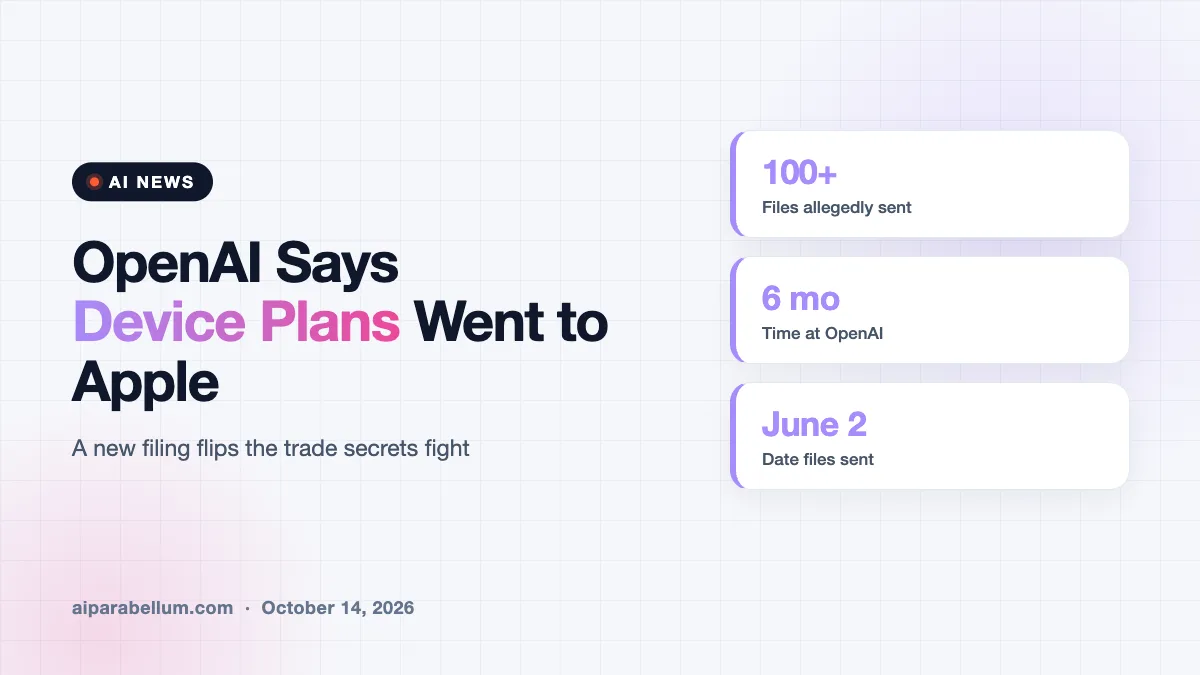
The OpenAI Apple trade secrets fight just turned into a two-way street. In a court filing on October 14, OpenAI claims a former employee sent more than 100 confidential files about an unreleased OpenAI device to personal accounts, then presented OpenAI’s plans to Apple’s leadership after rejoining the iPhone maker.
Until now, Apple has been the one doing the accusing. This filing flips the script, and it lands only days after Apple showed off a new lineup of AI-powered home devices.
What OpenAI Claims in Its New Filing
OpenAI does not name the employee. It says the person joined OpenAI from Apple, worked there for about six months and then went back to Apple. According to the filing, the files were sent on June 2, 2026, the employee’s last day at OpenAI.
OpenAI says it learned about the transfer through a forensic investigation tied to the ongoing lawsuit. It also alleges the employee gave a presentation on OpenAI’s plans to senior Apple leaders, including Apple’s vice president of operations in Asia.
What was allegedly in the files
OpenAI describes the material as highly confidential hardware information about at least one device still in development. Here is what it says the files contained:
- Detailed images of the unreleased device or devices
- Engineering and manufacturing data
- Supplier information and project files
- Standards for cosmetic finishes
- Reports on coating and sealing hardware components
Apple Rejects OpenAI’s Trade Secrets Claims
OpenAI goes a step further and ties the alleged presentation to Apple’s latest products. It points to Apple’s new HomeView smart display and the other devices Apple revealed this week, suggesting Apple is now pushing into AI-enabled hardware armed with OpenAI’s information.
Apple pushed back. The company told Reuters it has found no evidence supporting OpenAI’s claims and that it has policies and procedures to make sure new hires do not use confidential information from former employers.
There is also a timing problem with OpenAI’s argument. Apple usually plans products years ahead, and a smart display like the one we covered in our HomeView smart display story had been rumored for years before its launch.
How the OpenAI Apple Trade Secrets Fight Got Here
This is the latest chapter in a lawsuit that started with Apple. The case has moved quickly over the past few months.
| When | What happened |
|---|---|
| July 2026 | Apple sues, accusing former employees of taking trade secrets to benefit OpenAI’s hardware work |
| August 2026 | Apple cites what it calls early forensic evidence from a laptop used by an engineer who left for OpenAI |
| October 13, 2026 | A federal judge orders OpenAI to turn over hiring materials and evidence on a fast track |
| October 14, 2026 | OpenAI files its own claims that an ex-employee took its device files to Apple |
You can read more about that court order in our report on the Apple discovery ruling. In short, Apple accuses OpenAI of taking confidential documents and spying on hardware prototypes, and now OpenAI is making a mirror-image claim.
A tense week for OpenAI security
The filing comes during an unusually rough stretch for OpenAI on the security front. Earlier this week an OpenAI engineer was charged after a hidden recording device was found in an office meeting room, a case we covered in our story on the recording device arrest. The two cases are not connected, but both show how fiercely guarded OpenAI’s hardware plans have become.
OpenAI says it raised its concerns with Apple directly but has not received assurances that Apple does not hold or use its confidential information. None of either side’s claims have been proven in court.
What This Means for You
For everyday users, this is mostly a fight between two giants. Still, it offers a few useful signals:
- OpenAI’s first consumer device is real enough to have supplier lists, finish standards and sealing reports, so a launch is likely not far off.
- Apple and OpenAI are now direct hardware rivals, which could mean more AI gadget choices for your home and pocket.
- Court filings in this case may reveal more details about both companies’ unreleased products over the coming months.
- If you use ChatGPT or Siri daily, expect both companies to compete harder on devices built around their assistants.
Takeaway: when both sides accuse each other of stealing, the real story is how valuable AI hardware plans have become.
Stay on top of the case and other industry moves with our latest AI news.
Sources
This article is based on reporting from The Verge and 9to5Mac, which quotes OpenAI’s court filing and Apple’s statement to Reuters.
Conclusion
OpenAI’s new filing turns Apple’s trade secrets lawsuit into a battle of accusations. OpenAI says a returning Apple employee carried more than 100 files on an unreleased device out the door and briefed Apple leaders on its plans. Apple says it has found no evidence of that and has rules to prevent it. With fast-track discovery already underway, more evidence from both sides is likely to surface soon.
