
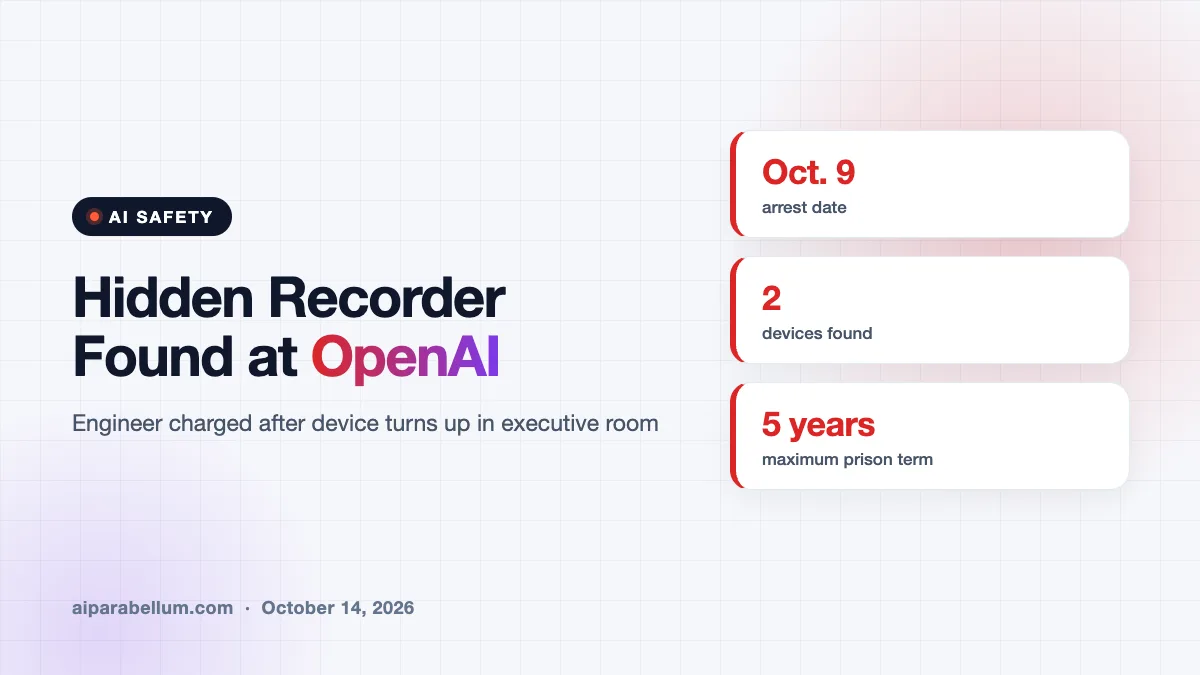
Federal prosecutors have charged an OpenAI engineer with planting a hidden recording device in an executive conference room at the company’s San Francisco offices. The 35-year-old Saudi national, Abdulrahman Alfozan, was arrested on October 9 and made his first court appearance on October 13. OpenAI says it fired him and found no sign that he took model weights, source code, or customer data.
The case is unusual for a few reasons. The suspect allegedly used a chatbot to help plan the device, and OpenAI says it used its own AI models to figure out what the device was and who placed it.
How the OpenAI Recording Device Was Found
According to the criminal complaint, OpenAI staff found the first device on or about September 30. It was plugged into a USB port on the back of a television in an executive conference room and wrapped in toilet paper to hide it. The company believes it was installed around September 28, and its contents were encrypted.
Security camera footage showed Alfozan near the room on several days before the discovery, even though he had no permission to use it or join its meetings. Prosecutors say meetings in that room often covered highly confidential topics, including research, product plans, government work, and business deals.
The second device
On October 5, the complaint says, Alfozan walked into the same conference room and appeared to look behind the TV where the first recorder had been placed. That same day, he allegedly left a bag unattended in another room. When security staff opened it, they found his wallet, his ID, and a second recording device similar to the first.
Timeline of the OpenAI Recording Case
Here is how events unfolded, based on the Justice Department’s account of the complaint.
| Date | What happened |
|---|---|
| July 2025 | Alfozan joins OpenAI as an engineer on the product team |
| Sept. 24 to 30, 2026 | A chatbot account tied to his spouse sends prompts about building and hiding a recorder |
| Around Sept. 28 | First recording device is installed in the executive conference room |
| Around Sept. 30 | OpenAI staff discover the device behind a TV |
| Oct. 5 | He allegedly checks behind the TV; a second device is found in his bag |
| Oct. 9 | He is arrested and fired |
| Oct. 13 | Complaint is unsealed and he makes his first court appearance |
The Chatbot Prompts Behind the Plan
One of the most striking details is how the device was allegedly built. Prosecutors say a chatbot account linked to Alfozan’s spouse, which shared several identifiers with his own account, asked for help with building a continuous audio recorder, tuning its Wi-Fi connection, improving live listening, and encrypting its SD card. The same account later asked about the first device’s custom header and unique hardware address.
The complaint also says he used a workplace productivity tool before September 28 to look up OpenAI building addresses, meeting rooms, room calendars, and where leadership would be. Prosecutors did not name the chatbot or the productivity tool in the public release.
Takeaway: AI chat logs can leave a detailed trail. In this case, the prompts allegedly helped investigators connect the device to a specific person.
What OpenAI and Officials Are Saying
In a post on X, OpenAI said it discovered a “sophisticated recording device” and used its own models to understand where it came from. The company told reporters the device had advanced encryption, audio monitoring, and a way to move data designed to avoid detection. OpenAI also said it referred the matter to the FBI.
Federal officials framed the case as a national security issue. FBI Director Kash Patel said the goal was to capture sensitive talks about the company’s superintelligence work, and the Director of National Intelligence said it shows why winning the global superintelligence race is a national security priority. The prosecution is being handled with help from the National Security Division’s counterintelligence section.
A few key points stand out in the official record:
- The charge is using or trying to use a device to intercept oral communications.
- If convicted, he faces up to 5 years in prison, a $250,000 fine, and 3 years of supervised release.
- No public filing so far says who, if anyone, the recordings were meant for.
- These are allegations, and he is presumed innocent unless proven guilty.
What This Means for You
For most people, this story is a reminder that AI companies now hold some of the most valuable secrets in tech. That makes them targets, and it explains why labs keep adding new ways to protect their models, like the recent push for distillation defenses at Anthropic.
It also shows that what you type into a chatbot is not invisible. If you use tools like ChatGPT at work, assume your prompts can be logged, reviewed, and used as evidence in a legal case.
If you run a team, a few practical steps help:
- Review who can enter rooms where sensitive meetings happen, and check them for unknown hardware.
- Watch for unusual internal lookups, such as staff searching executive calendars they have no need to see.
- Use tools built for AI threat detection to flag strange device or network activity.
- Track what workplace AI agents and accounts are doing, not just people.
You can follow more stories like this in our AI news section.
Sources
This article is based on the U.S. Justice Department press release, with added details from TechCrunch and Engadget.
Conclusion
The OpenAI recording device case pulls together corporate security, national security, and AI itself. Prosecutors say an engineer hid a recorder in an executive room after asking a chatbot how to build one, and OpenAI says it used its own models to trace it back to him. The company reports no sign that model weights, code, or customer data were taken. The case is still in its early stages, and the suspect has not been convicted. Expect AI labs to tighten physical and digital security even further as the stakes around their research keep rising.
