
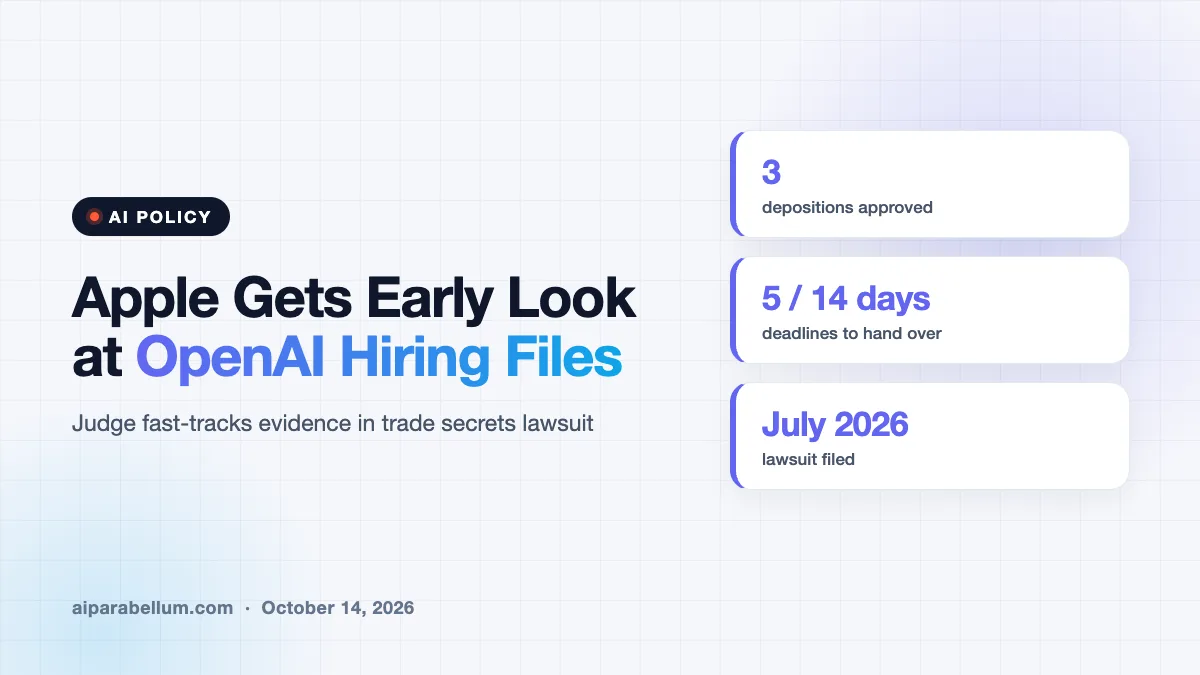
Apple just won an early peek inside OpenAI’s hiring process. In the Apple OpenAI lawsuit over alleged trade secret theft, a federal judge has ordered OpenAI to hand over interview materials, private chat messages and forensic evidence on a fast track, and to make three people available for questioning.
The ruling came from U.S. District Judge Edward Davila on October 13. It does not decide who is right. But it gives Apple a head start on evidence it says will show how its secrets ended up helping OpenAI build its first hardware device.
What the Apple OpenAI Lawsuit Is About
Apple filed the case in July against OpenAI, io Products and two former Apple employees, Chang Liu and Tang Tan. Tan is now OpenAI’s chief hardware officer. Apple claims the pair improperly accessed or used confidential information about its products to boost OpenAI’s consumer hardware work.
The complaint goes further than two people. Apple says former employees used Apple laptops to download files on unannounced products, including technical specs, engineering presentations and project data. It also alleges that ex-Apple staff at OpenAI coached people still at Apple on what information to bring to job interviews.
OpenAI has opposed Apple’s push for early evidence. It argued the requests were too broad and that the normal discovery process was about to start anyway. None of Apple’s claims have been proven in court.
Why hardware is the flashpoint
OpenAI is working on its first consumer device, a project tied to io Products. Many people expect it to compete, sooner or later, with phones like the iPhone. That makes any flow of Apple engineering know-how into the project a big deal for both companies.
What the Judge Ordered OpenAI to Hand Over
Judge Davila granted part of Apple’s request for expedited discovery. Here is what Apple gets early:
- Forensic images the defendants have already collected that relate to Apple’s claims.
- Documents used to guide or run interviews with Apple candidates for OpenAI’s consumer hardware group, such as checklists, guides, manuals and scripts.
- Records summarizing those interviews, including technical deep-dive presentations and any mention of Apple technology or parts.
- LINE messaging app conversations between Liu and OpenAI employee Yu-Ting “Alyssa” Peng since January 1, 2026.
Apple can also depose Liu, Tan and Peng, all three of whom are former Apple employees. It may question corporate representatives from OpenAI and io Products too. OpenAI has five days to turn over materials it already collected and 14 days for the rest.
| Apple request | Court decision |
|---|---|
| Interview guides and scripts for Apple candidates | Granted on a fast track |
| Private LINE messages between Liu and Peng | Granted |
| Depositions of Liu, Tan and Peng | Granted |
| Forensic images already collected | Granted |
| R&D files on metal finishes, power and batteries | Denied for now; left to regular discovery |
| “Apple Originated Information” requests | Postponed; Apple has five days to narrow them |
Where Apple Fell Short in the OpenAI Lawsuit
The judge did not give Apple everything. He turned down early access to OpenAI’s research and development files on metal finishes, power management and battery features for consumer hardware. Those will go through the regular discovery process instead.
He also put off a group of requests built around what Apple calls “Apple Originated Information.” The court found Apple’s definition of that term too vague as written. Apple can talk with the defendants and come back with a tighter definition within five days.
Why this round matters
Fast-tracked evidence feeds into Apple’s bid for a preliminary injunction. That injunction would bar the defendants from building the alleged secrets further into OpenAI’s hardware while the case plays out. If the interview files back up Apple’s story, its injunction argument gets much stronger.
What This Means for You
Most people won’t feel this case directly, but it could shape the AI gadgets you see in the next few years. Here is what to keep in mind:
- OpenAI’s hardware timeline could slip. An injunction or a long legal fight may slow the device it is building with io Products.
- Hiring is becoming a legal risk in AI. Big tech firms are watching how rivals recruit their engineers, and this case shows courts will dig into interview practices.
- If you work in tech, be careful with old files. Taking a former employer’s documents to a new job, even by accident, can turn into evidence in a lawsuit like this one.
- Competition is heating up. Apple’s own AI push, such as its new Siri smart display, shows how closely the two companies now overlap.
OpenAI is facing scrutiny on several fronts this week, including a separate security incident involving one of its workers. If you rely on ChatGPT every day, none of this changes the service for now. For more stories like this, browse our latest AI news.
Sources
This report is based on coverage from TechCrunch and 9to5Mac, which reviewed the court’s order.
Conclusion
Apple has won an important early round in its trade secrets case against OpenAI. The court is forcing OpenAI to share its interview playbooks, private messages and forensic evidence quickly, and to put three former Apple staffers in front of Apple’s lawyers. Apple did not get its broadest requests, and its claims remain unproven. Still, what comes out of these files could decide whether OpenAI’s first hardware device faces a court-ordered slowdown.
