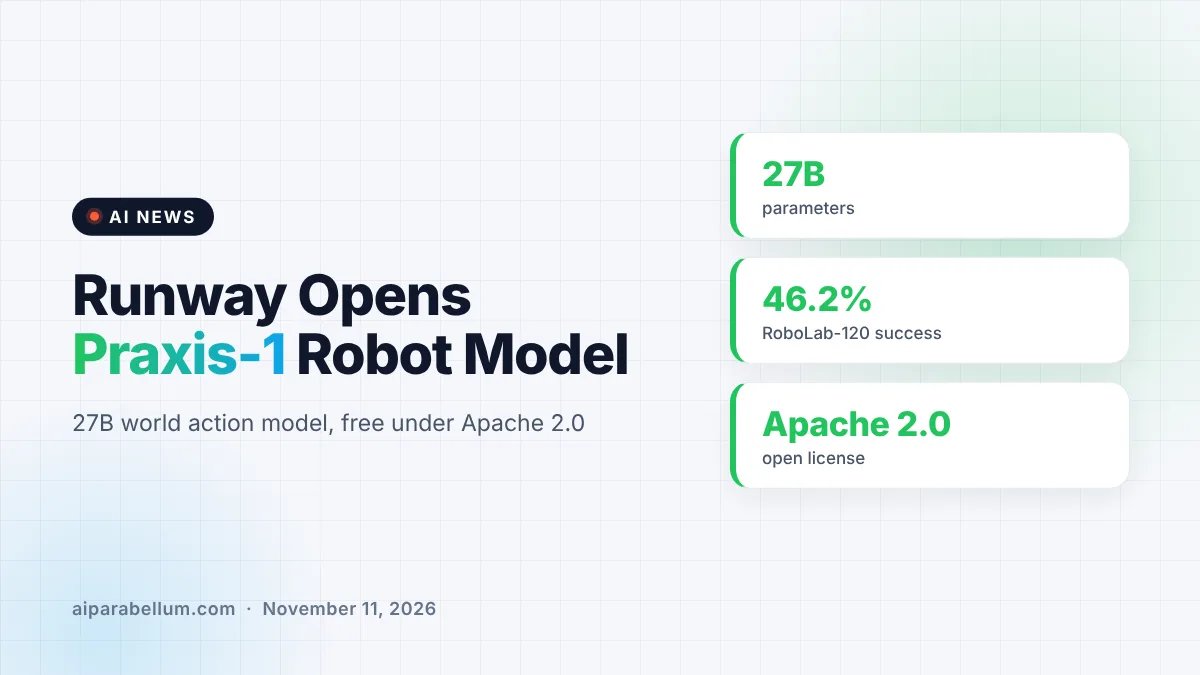
Runway has made Praxis-1, its world action model for controlling robots, free for anyone to download with open weights under the Apache 2.0 license. The 27-billion-parameter Runway Praxis-1 model was first shown in September and had only been in the hands of a few launch partners until now. Today, any robotics developer or researcher can run it, change it and use it in commercial products.
What Runway Praxis-1 Actually Does
Praxis-1 is what Runway calls a “world action model.” Instead of only producing video, it predicts video and robot actions together. In plain terms, it tries to picture what will happen next in a scene and decides how a robot should move to get a task done.
Under the hood, it is a mixture-of-experts diffusion transformer with 27 billion parameters. It grew out of the same large-scale video training that powers the company’s general world models, the tech behind tools like Runway AI for creators.
Why video training matters for robots
Runway says the model learns how objects behave and how tasks unfold by watching huge amounts of video. That gives it a head start when it meets a new robot body, before any extra training on that hardware. The company also says its research found that ordinary web video works about as well as teleoperated robot video for pretraining, which could make robot training data far easier to collect.
How Praxis-1 Scores Against Other Open Robot Models
Runway says Praxis-1 is the top-performing world action model on Nvidia’s RoboLab-120 leaderboard. It also says the model beats every open-weight vision-language-action (VLA) model on that test. Keep in mind these are the company’s own reported figures, measured as success rate across 1,200 episodes.
| Model | RoboLab-120 success rate |
|---|---|
| Praxis-1 (Runway) | 46.2% |
| FLUX 3 Action | 42.9% |
| Cosmos3 Nano | 36.8% |
| π0.5 | 28.0% |
Runway also tested how well the model adapts to hardware it never saw. After fine-tuning on Google’s RT-1 robot, which was not in its training data, Praxis-1 reached an 80.0% success rate on the SimplerEnv benchmark. The original RT-1 policy scored 52.4% on the same test.
What Comes in the Open Release
This is not just a weights drop. Runway says the full package is released under Apache 2.0, including commercial use, and covers:
- The model weights, hosted on Hugging Face with native LeRobot support
- Inference and fine-tuning code on GitHub
- Support for both full fine-tuning and lighter LoRA fine-tuning
- Serving through vLLM-Omni, plus hosted inference on Runway’s Reactor service
- Training tutorials through Nvidia’s NeMo Automodel
With LoRA, teams can adapt the model to their own robot body, cameras and tasks without retraining the whole thing. That matters because full retraining of a 27B model is out of reach for most small labs. If you already use Hugging Face tools, getting started should feel familiar.
Hardware it runs on
Runway says Praxis-1 works out of the box across Nvidia hardware. That ranges from data center chips like the H100 and B200, to workstation cards like the RTX 5090 and RTX PRO 6000, down to the Jetson Thor computer that sits on the robot itself.
Partners Already Running Praxis-1 on Real Robots
Before today, three launch partners had been testing the model on very different machines. Noble Machines ran it on a legged humanoid, Standard Bots on a six-axis industrial arm, and Ultra on a dual-arm warehouse robot. Runway says a single Praxis-1 checkpoint adapted to all of these with only light fine-tuning.
The release also ties into Runway’s role as a founding member of the Cosmos Coalition, an effort with Nvidia around open world models for physical AI. It joins a busy stretch for robot AI, including DeepMind’s Gemini Robotics 2.5 and Nvidia’s push on open Nemotron models.
Why Runway Is Going Open
Runway says it promised to ship Praxis-1 as an open model when it first announced it. The company argues that US leadership in physical AI needs openness and interoperability that robot makers don’t have yet. Open weights let hardware builders run, inspect and adapt the model on their own terms instead of relying on a closed API.
Our take: an Apache 2.0 robot model that a small team can fine-tune on one workstation lowers the cost of trying physical AI in a big way.
What This Means for You
Most people won’t run a robot model at home, but this release still matters for anyone following AI tools. Here is what to keep in mind:
- If you build robots or teach robotics, you can now test a strong world action model for free, including in commercial products.
- If you are a startup, LoRA fine-tuning means you can adapt Praxis-1 to your hardware without a huge compute budget.
- If you follow AI industry news, expect more video AI companies to move into robotics, since the same training data now serves both.
- Treat the benchmark numbers as company claims until independent testers publish their own results.
Sources
Primary source: Runway’s Praxis-1 availability announcement.
Conclusion
Runway’s decision to open up Praxis-1 gives robotics developers a free, commercially usable world action model that the company says leads its class on Nvidia’s RoboLab-120 test. The full release, from weights to fine-tuning code, makes it practical for small teams to experiment on their own hardware. The real test now is how the model performs in independent hands. Either way, it is a clear sign that video AI and robotics are quickly merging into one field.