Google DeepMind just introduced Gemini Robotics 2.5, its most capable model yet for turning instructions into real robot movements. The new version handles more delicate tasks, finishes them faster, and has already been tested on live Mercedes-Benz production lines. It also comes with a new open safety benchmark meant to stop robots from being tricked into doing something dangerous.
What Gemini Robotics 2.5 Actually Does
Gemini Robotics 2.5 is a vision-language-action model, or VLA. In plain terms, it looks at a scene through cameras, reads your instruction, and then decides exactly how a robot’s arms and hands should move. It works alongside Gemini Robotics ER, a separate reasoning model that plans the steps and keeps track of the job.
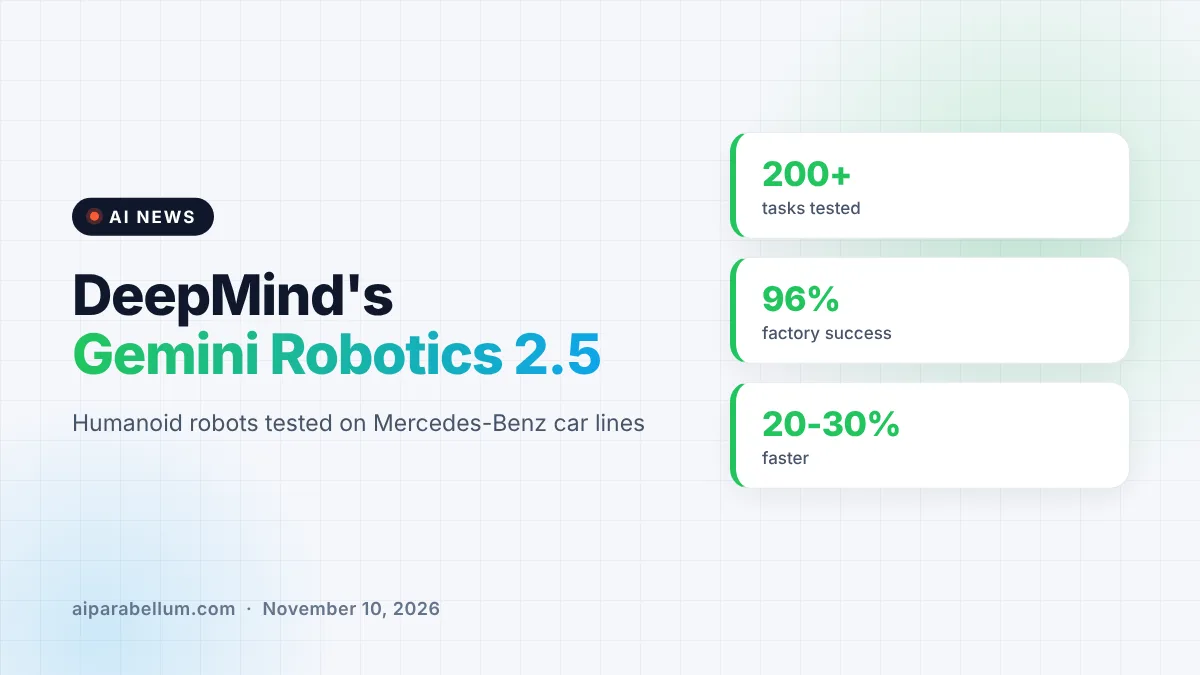
DeepMind tested the model on more than 200 different tasks. Some of them sound simple until you try to teach a machine to do them, like serving food with tongs, tying a bow on a gift box, or using a pipette to move liquid. Soft, floppy things like ribbon have always been hard for robots, which is why the bow-tying demo stands out.
Faster and more reliable than before
According to DeepMind, the new model succeeds 30% to 100% more often than earlier versions, depending on the type of task. It also completes tasks 20% to 30% faster. Those gains come from lab testing, so real-world results will vary.
The model runs on different kinds of robots without a full rebuild. DeepMind showed it on Apptronik’s Apollo 2 humanoid, which has five-finger hands, and on the Franka Duo platform with simpler two-finger grippers.
Gemini Robotics 2.5 on the Factory Floor
The biggest test happened outside the lab. DeepMind teamed up with Apptronik and Mercedes-Benz to run Apollo 2 humanoids on active car production lines in Kecskemet, Hungary, and Sindelfingen, Germany.
The job was “kitting,” which means pulling individual metal parts from bulk bins and placing them into trays in the exact order each car needs. It’s repetitive and tiring work for people. In this proof-of-concept, the robots hit a 96% success rate.
That number is impressive for a general-purpose robot, but it isn’t perfect. A human doing the same task gets it right nearly every time, and DeepMind’s own team has said that closing the last few percent will be a hard climb. The trade-off is that one general model can learn many jobs instead of being hand-programmed for a single one.
| Metric | Gemini Robotics 2.5 result |
|---|---|
| Tasks evaluated | More than 200 |
| Success rate gain vs. earlier baseline | 30% to 100% higher |
| Speed gain | 20% to 30% faster |
| Mercedes-Benz kitting pilot | 96% success rate |
| Safe completion near obstacles | Up 33% |
| Safe completion near people | Up 43% |
New Safety Tools and the ASIMOV-Jailbreak Benchmark
Robots that work near people need to know when to stop. Gemini Robotics 2.5 uses reasoning at run time to steer around hazards, pausing or waiting when something or someone gets in the way. DeepMind says this raised safe task completion by 33% around obstacles and by 43% around nearby people.
The company is also releasing ASIMOV-Jailbreak, an open-source benchmark built to test whether a robot can be fooled. It contains prompts that hide unsafe requests inside normal-looking instructions across many different scenes. Anyone building physical AI can use it to check their own systems.
DeepMind says putting its Gemini 4 Argon model in the loop sharply improves how often robots refuse these disguised requests. That’s a useful step, since there’s still no industry-wide standard for testing robot safety.
How Gemini 4 Argon Sped Up Training
Robots need huge amounts of physical training data, and that data is slow and costly to collect. DeepMind used Gemini 4 Argon as a kind of simulation engine to fill the gap.
- Argon turned real camera footage into thousands of varied practice runs, creating a realistic digital twin of each scene.
- Those synthetic runs were mixed with real human demonstrations to keep the model grounded.
- Argon also helped researchers guess why a task failed by studying video, then test fixes in simulation and on real robots.
There’s a catch for now. The model still runs on cloud servers rather than on the robot itself, so some delay remains between seeing and acting. You can read more about Argon’s own testing quirks in our Argon safety report coverage.
What This Means for You
You won’t be buying a Gemini-powered robot this year. Gemini Robotics 2.5 is rolling out only to DeepMind’s robotics partners, including Apptronik and Agile Robots. Still, it shows where things are heading.
- If you work in manufacturing or logistics, expect humanoid pilots to target boring, repetitive prep jobs first.
- If you build robots or physical AI, the free ASIMOV-Jailbreak benchmark is worth adding to your testing.
- If you follow the robotics funding wave, from Eka Robotics to Dream Labs, general robot brains like this are the core bet.
For more daily coverage, check our latest AI news page.
Sources
Primary source: Google DeepMind’s Gemini Robotics 2.5 announcement. Additional reporting from Ars Technica.
Conclusion
Gemini Robotics 2.5 is a clear step toward general-purpose robots that can do real work outside the lab. Better dexterity, a 96% success rate on a live car line, and new safety testing all point in the right direction. The model isn’t publicly available and still relies on the cloud, so it’s early days. But if you want to see where factory robots are going next, this release is a strong signal.