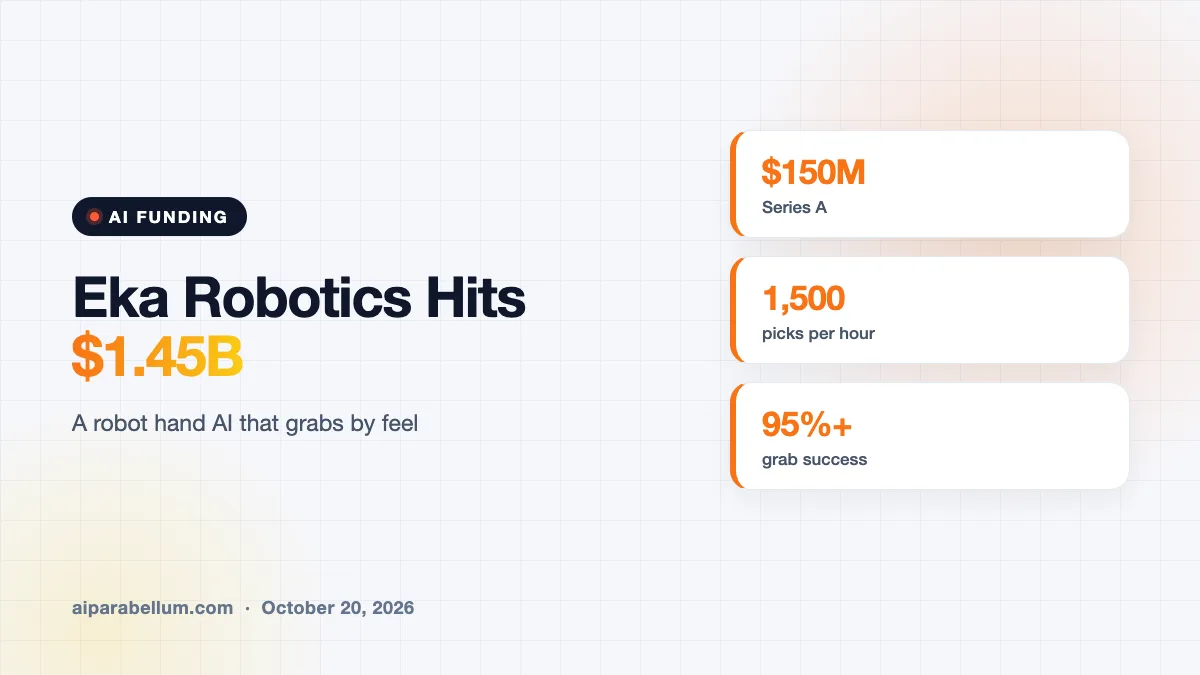
Eka Robotics, a young startup building AI that lets robot hands grab things by feel, has raised a $150 million Series A at a $1.45 billion valuation. The Eka Robotics funding round, announced on October 20, 2026, was led by Andreessen Horowitz and F-Prime. The big bet here is simple: robots need a sense of touch, not just better eyes, to handle the messy objects people pick up every day.
Eka Robotics Funding at a Glance
The round turns Eka into one of the newest unicorns in physical AI. Here are the key numbers from the announcement and early coverage.
| Detail | What We Know |
|---|---|
| Round | Series A |
| Amount raised | $150 million |
| Valuation | $1.45 billion post-money |
| Lead investors | Andreessen Horowitz and F-Prime |
| Founders | Pulkit Agrawal (MIT) and Tuomas Haarnoja (ex-Google DeepMind) |
| Reported speed | Up to 1,500 picks per hour in lab tests |
| Gripper cost | Under $1,000, rated for 5 million cycles |
Pulkit Agrawal runs a robot learning lab at MIT, and Tuomas Haarnoja co-created Soft Actor-Critic, a widely used AI training method, before working on humanoid behaviors at Google DeepMind. The two first met as grad students at UC Berkeley.
How Eka’s Robot Hand Model Works
Most robot brains today are vision-language-action models. They look at a scene, read an instruction, and decide what to do. Eka built what it calls a vision-force-action model, which leans on force sensors in the hand to guide the final grab.
Touch Over Sight
The idea is that cameras get a robot close, but touch finishes the job. If a part starts to slip, or a connector catches on an edge, the robot can feel it and adjust instead of failing. That is how the system can pick up a raspberry without crushing it.
Seeing where an object is and actually holding it are two very different problems, and Eka is betting the second one is where robots still fall short.
Practice in Simulation
Eka does not rely mainly on people demonstrating tasks over and over. Instead, it trains its robots with reinforcement learning inside a physics simulator, where virtual robots practice millions of small variations and failures. The founders say they can generate thousands of hours of robot experience in minutes, which means progress can scale with computing power rather than human labor.
Why Eka Robotics Won Over Funders
Early reactions from roboticists have been unusually strong. A University of Illinois professor who saw the robot praised how it adapted to many different objects without retraining. Lead investors also claim the system already beats human performance on some dexterous tasks.
- Speed: the company reports about 1,500 picks per hour in lab bin-picking, about 2.5 times a human’s pace.
- Reliability: Eka says it grabs objects successfully more than 95% of the time.
- Flexibility: it handles fragile items, slippery parts and tight insertions with the same model.
This fits a wider wave of money flowing into robot brains. Just a day earlier, a startup building one robot brain for many machines raised $90 million, and OpenAI has confirmed its humanoid robot plans too.
The Hard Part Still Ahead
Lab demos are not factory floors. Eka is running quiet pilots with industrial customers in two areas: pick-and-place work and handling wires. The real test is whether the robot can run on an assembly line for a full year without breaking down.
There is also the question of range. So far, most of what outsiders have seen is picking and placing, while many valuable factory jobs involve more complex steps. Eka also wants its gripper to reach the 20 million cycle durability of standard industrial arms, up from 5 million today.
What This Means for You
You probably will not buy an Eka robot anytime soon, but this kind of work shapes the products and jobs around you. Here is what to watch:
- Warehouse and factory automation could spread to tasks that were too fiddly for robots before, such as sorting mixed items or plugging in cables.
- If touch-based models work, home robots that load dishwashers or fold laundry become more realistic.
- Investors are now paying unicorn prices for AI startups in robotics, so expect more funding news like construction robot deals in the months ahead.
For more stories like this, keep an eye on our AI news hub.
Sources
Primary source: Andreessen Horowitz’s Eka Robotics Series A announcement. Additional reporting from TechCrunch.
Conclusion
Eka Robotics has turned a strong demo and a bold idea into a $1.45 billion valuation in its first major round. Its vision-force-action model and simulation-first training take a different path from most robot AI, focusing on touch to solve the last stretch of grabbing an object. Experts are impressed, but the company still has to prove its hands can work reliably on real production lines for months at a time. If it does, the range of jobs robots can take on could grow quickly. For now, Eka is one of the clearest signs that physical AI is the next big funding frontier.