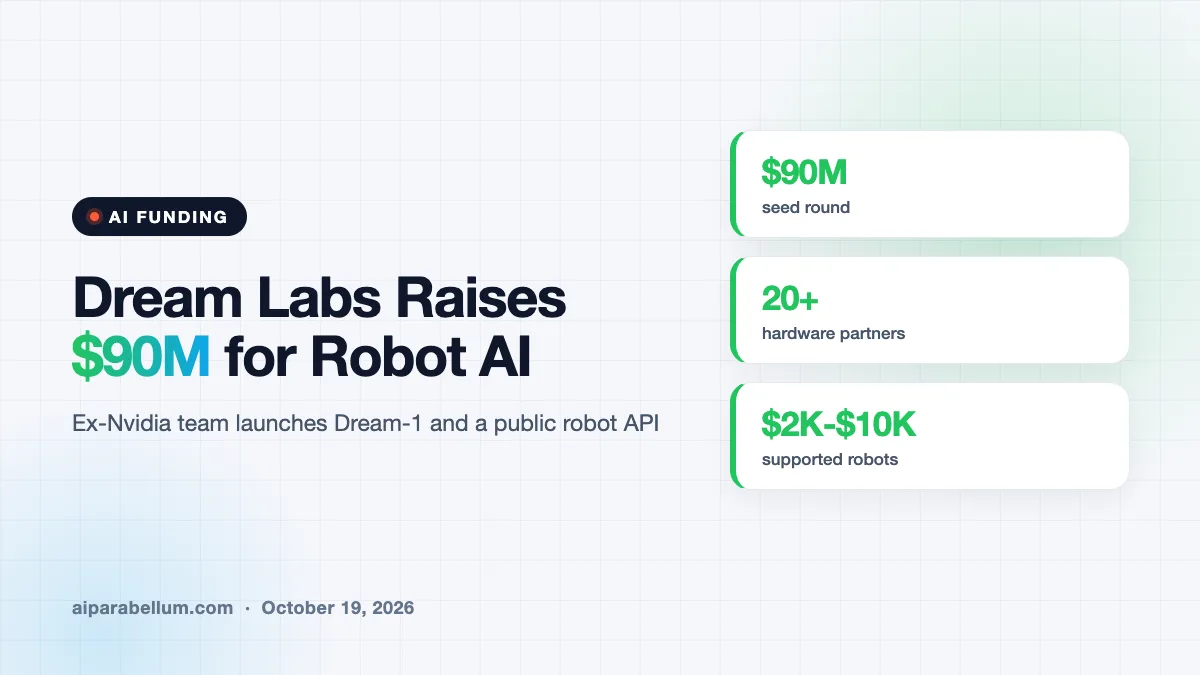
Dream Labs, a San Francisco startup started by former Nvidia robotics researchers, has raised $90 million in seed funding to build a single AI model that can control robots from many different makers. The Dream Labs funding news landed on October 19, 2026, along with the launch of a public API that lets developers tell a robot what to do in plain English. That is a big seed round, and it shows how hot the race to build general-purpose robot brains has become.
Dream Labs Funding at a Glance
B Capital led the round together with Kindred Ventures. Other backers include A.Capital, Unusual Ventures, SV Angel, Wing VC and Scribble VC, plus individual investor Adrian Aoun.
The company says most of the new money will go toward computing power. That compute will help it teach its model more tasks, support more kinds of robots and handle a growing number of users.
| Detail | What We Know |
|---|---|
| Round size | $90 million seed |
| Lead investors | B Capital, with Kindred Ventures |
| Headquarters | San Francisco |
| Founded | 2026, by former leads of Nvidia’s GR00T robotics research |
| Flagship model | Dream-1 |
| Hardware partners | More than 20 |
| Supported robot prices | About $2,000 to $10,000 |
How the Dream Labs Robot Brain Works
Most robots today are programmed for one job on one machine. If you change the task or swap the hardware, engineers often have to start over, which can take months. Dream Labs wants to fix that with a shared “brain” that works across many robots.
Its model, Dream-1, was trained on video of people doing everyday tasks. It looks at a robot’s camera feed, predicts what should happen next and turns that into movement. Because it learns from human video instead of one specific machine, the company claims its skills carry over to robots it has never seen before.
What Dream-1 can do today
Right now the model focuses on tabletop work, like picking up objects, placing them and folding laundry. Dream Labs says it can run any robot with grippers “zero-shot,” meaning without extra training data. For its hardware partners, the company goes a step further and tunes the model for each specific robot.
Support for wheeled mobile robots and more advanced robot hands is planned next. As with any startup launch, these are company claims, and real-world results will matter more than demos.
Three New Products for Developers
Alongside the funding, Dream Labs opened up its technology to the public. It launched three ways to try the model:
- Dream API: you send camera images, the robot’s current state and a task in plain English, and the API sends back the motor commands. The company calls it the first public API for a robot foundation model.
- Fine-tuning as a Service: if your robot isn’t supported yet, you can upload a small batch of demonstrations and get a custom model back within hours.
- Robot Playground: anyone with a web browser can type commands to a real robot in the company’s San Francisco office and watch it respond live, without buying any hardware.
CEO and co-founder Joel Jang compared the idea to renting a car, saying people don’t relearn how to drive each time. He also said the company wants to show a working model “mistakes included” rather than polished demo videos.
Why Cheap Robots Need Smarter AI
Robot arms have become far cheaper over the last few years. A capable arm that once cost as much as a luxury car can now sell for about the price of a high-end laptop. The problem is that these low-cost machines usually ship with no built-in intelligence.
That gap is where Dream Labs is placing its bet. One early partner, MakerMods, sells $2,000 two-armed robot kits and says its robot was running tasks within minutes using Dream-1. If that holds up widely, small shops and hobbyists could put robots to work without hiring specialists.
The startup also joins a crowded field. Big players are chasing the same goal, from Nvidia’s own robotics work to the OpenAI humanoid plans we covered recently. Smaller firms keep raising money too, like the drywall robot startup that landed $20 million last week.
What This Means for You
You probably won’t have a Dream-1 robot folding your laundry next month. Still, this round says a lot about where AI is heading after chatbots and coding tools.
- If you build or tinker with robots, the API and Robot Playground give you a low-cost way to test a general robot model today.
- If you run a small business, falling hardware prices plus plug-in AI could make simple automation cheaper within a few years.
- If you follow AI investing, a $90 million seed shows backers are paying up for teams with deep robotics research roots, much like the big bets on AI chip startups.
- If you’re judging claims, watch for independent tests of the “zero-shot” promise before treating it as proven.
For more on open models built for agents and machines, see our look at Nvidia’s Nemotron model. You can also catch every update in our daily AI news feed.
Sources
This article is based on the company’s funding announcement published via The National Law Review and product details from the Dream Labs website.
Conclusion
Dream Labs is starting life with $90 million, a team from Nvidia’s robotics research group and a public API that anyone can try. Its pitch is simple: one AI brain that can run cheap robots from many makers, learned from video of people doing everyday tasks. The model only handles tabletop jobs for now, and its bold claims still need outside testing. But if it works as promised, getting a robot to do useful work could shrink from months to minutes. That makes this one of the more interesting robotics bets to watch heading into 2027.