Salesforce research agents are now training and improving the AI models the company uses in production. The system, called SFR-AutoR&D, runs the research loop on its own: it forms a hypothesis, writes the code, runs experiments and keeps only the changes that beat a baseline. Salesforce shared the update on November 11, 2026, saying the agents have already improved the embedding model behind retrieval in its Data Cloud.
What Salesforce Research Agents Do
Normally, improving a machine learning model is slow, human work. Scientists propose an idea, build an experiment, read the results and decide what to try next, often over several weeks. Salesforce says SFR-AutoR&D handles that whole cycle by itself.
Researchers give the system three things: a goal, a system to work on and a compute budget. The agents then come up with ideas, implement them and test them in controlled experiments. A change stays in the codebase only when the evidence shows it is better, accurate and safe.
The Two Agents Behind the System
Salesforce built two agents that split the work:
- AutoR&D-Engineer looks for algorithm and systems improvements inside existing code.
- TrainForge explores new training methods and tests them on held-out benchmarks the system never trains on.
- Both run on AutoInfra, a training backbone that spreads experiments across shared GPU capacity.
Results From the Salesforce Research Agents
The headline result involves embedding models, which turn text into numbers so a system can find the right record among millions. When an Agentforce agent answers a question using a customer’s data, an embedding model decides what information comes back. Better retrieval means better answers from enterprise AI agents.
Salesforce says the agents improved SFR-Embedding V3, the model it uses for retrieval in Data Cloud. The team then pointed the system at the open-source EmbeddingGemma 2 model, and it produced SFR-Embedding v4, which the company says is better in both quality and speed.
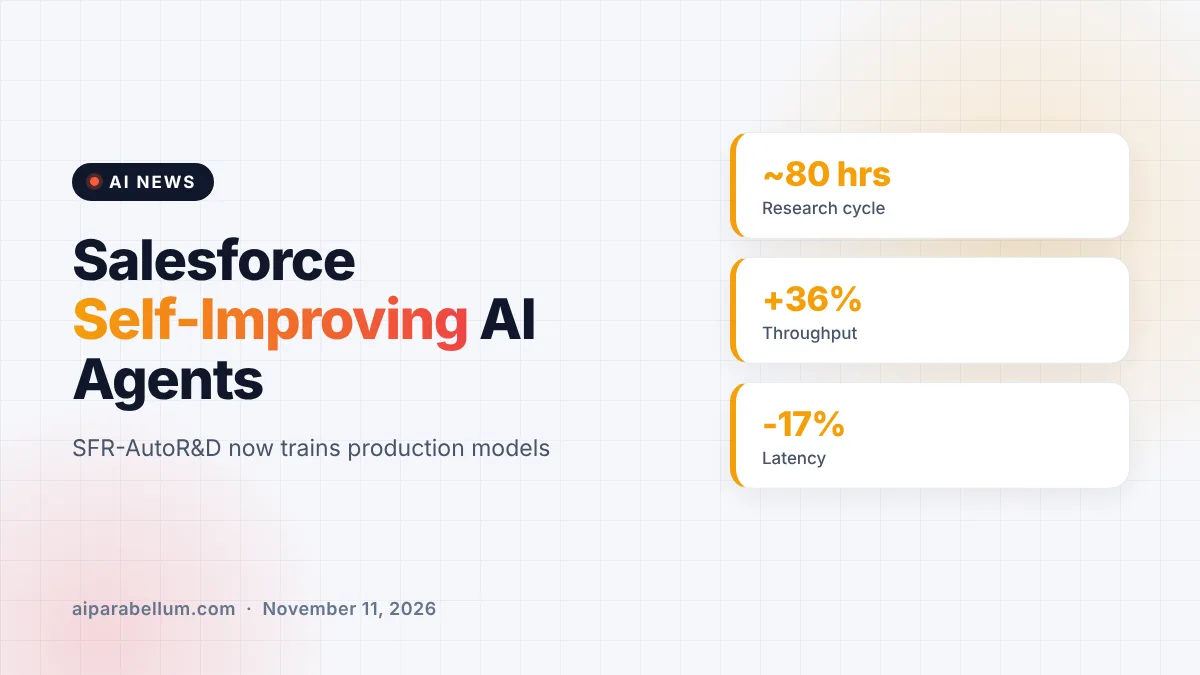
| Measure | Result reported by Salesforce |
|---|---|
| Time for one full research cycle | About 80 hours, versus several weeks for humans |
| Retrieval quality (nDCG@10, 10 MTEB tasks) | Up 6.13 points |
| Speed-focused second session | About 9 hours |
| Throughput | 36% higher |
| Latency | 17% lower, with almost no quality loss |
These numbers come from Salesforce itself and have not been independently checked. The nDCG@10 score measures how relevant the top 10 search results are, with more weight on the highest-ranked ones.
Earlier Wins on Open-Source Code
Before working on its own models, the system was tested on widely used open-source projects. Salesforce says it found extra performance gains in pandas, the popular Python data library, and in hnswlib and USearch, two libraries that power similarity search. Each change came with benchmark evidence.
How Salesforce Keeps Humans in Charge
Salesforce stresses that the autonomy has limits by design. Researchers set the goal, the budget, the evaluation method and the data rules, and the agents explore only inside those lines. If a change does not clearly beat the baseline, the existing model stays in place.
The company also says models built for its products use only datasets that passed ethical and legal review. A model that scores well in testing still has to meet production requirements before any customer sees it, and Salesforce says that work is underway now. Senior research director Shafiq Joty summed up the shift this way: “We used to count progress in weeks of human work. Now we count it in hours of compute.”
Salesforce also mentioned a related project, CodeEvolve, which uses evolutionary search with large language models to improve Java and Salesforce Apex code. The company says it will share more about that work later.
What This Means for You
If you use Salesforce products, the practical effect could be better and cheaper search behind its AI features over time. More broadly, this is a sign of where AI development is heading. Here is what to watch:
- Faster model updates: if research cycles shrink from weeks to days, the tools you use may improve more often.
- Lower running costs: speed gains like higher throughput can make AI features cheaper to run at scale.
- New skills for teams: engineers may spend more time setting goals and guardrails than running experiments by hand.
- Healthy skepticism: treat company-reported benchmarks as a starting point until outside tests confirm them.
Self-improving systems are also raising fresh questions about AI agent governance, since the more work agents do on their own, the more the rules around them matter.
Takeaway: Salesforce is betting that AI can do much of the trial-and-error work of AI research, as long as humans set the rules and the evidence decides.
For more stories like this, visit our AI news page.
Sources
Primary source: Salesforce’s SFR-AutoR&D announcement.
Conclusion
Salesforce’s SFR-AutoR&D shows a big company letting AI agents run real research on models it uses in production. The company reports faster research cycles, better retrieval quality and lower latency, though those figures are its own. Humans still set the goals, budgets and data rules, and nothing ships without evidence and production review. If this approach holds up, AI tools could start improving at the speed of compute rather than the speed of human experiments.