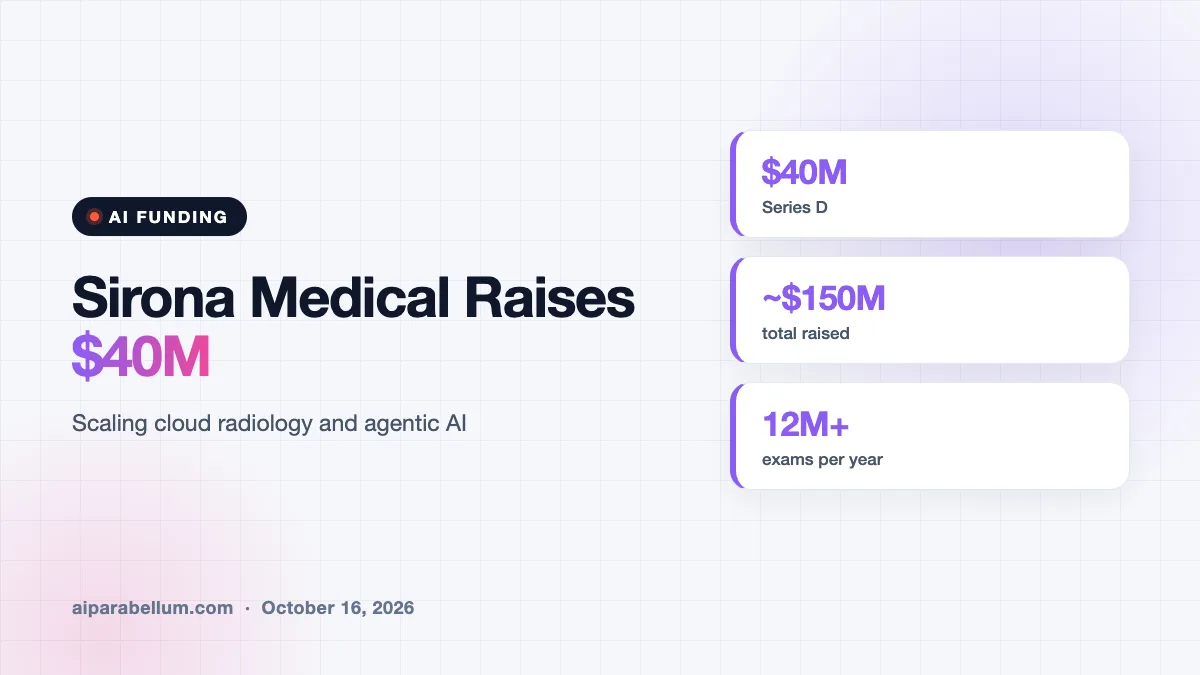
Sirona Medical, a San Francisco company that makes cloud-based software for radiologists, has raised $40 million in Series D funding led by Avidity Partners. The Sirona Medical funding will help the company roll out Cortex, its agentic AI layer, and expand beyond the US before the end of 2026. The company says the round covers its operating plan indefinitely, which is unusual for a health tech startup.
Inside the Sirona Medical Funding Round
Avidity Partners led the round. Other backers include 8VC, GreatPoint Ventures, KLT Holdings, and a mix of new and existing investors.
With this deal, Sirona has raised roughly $150 million in venture capital in total. The company frames the new money as permanent capital, meaning it does not expect to need another round to keep running.
Founder and president Cameron Andrews said the company now has the money to reach “tens of millions of patients a year.” That is a big claim, but the company’s growth numbers give it some support.
What Sirona’s RadOS Platform Does
Radiologists usually juggle several separate tools to read scans. One system stores the images, another shows them, a third writes the report, and AI tools often get bolted on from outside vendors.
Sirona’s RadOS puts those pieces into one cloud system. It combines the image archive (often called PACS), the diagnostic viewer, the reporting tool, the worklist, and workflow AI. RadOS launched publicly in November 2023.
Cortex, the Agentic AI Layer
A big part of the new funding goes to Cortex, which Sirona calls its agentic AI orchestration layer. The company plans to move it from early use into a full commercial product.
In plain terms, an orchestration layer acts like a coordinator for AI inside the radiology workflow. Rather than running one AI tool at a time, it is meant to manage several AI steps so the doctor can focus on the final read.
Sirona’s Growth by the Numbers
The company shared a set of business figures with its announcement. These are company-reported numbers, not audited results.
| Metric | What Sirona reported |
|---|---|
| Series D size | $40 million, led by Avidity Partners |
| Total venture funding | About $150 million |
| Imaging exams under contract | More than 12 million primary exams per year |
| ARR and contracted ARR growth | More than 2.5x year over year |
| Image archive usage | Up 2.5x year over year |
| Reports submitted | Up 2x year over year |
| Average new-customer ARR | $1.07 million (trailing 12 months) |
| Radiologists to onboard | 1,000+ over the next 12 months |
Sirona says it has dozens of contracted customers across hundreds of connected sites. Its average total contract value for new customers reached $5.10 million.
Where the Sirona Medical Money Is Going
The company laid out several priorities for the new capital:
- Commercializing Cortex, its agentic AI layer for radiology workflows.
- Launching Sirona Global before the end of 2026, with plans for the UK, EU, South Africa, Australia, and New Zealand.
- Building out the Sirona Network, which lets practices on the platform share work and specialists, with new tools planned for 2027.
- Growing US support, with new offices in Burlington, Vermont, and Cincinnati, Ohio.
Sirona also hired Anders Osterholm, a 25-year Sectra veteran, to lead its client services team. That team handles the hard work of moving hospitals off older systems and supporting them around the clock.
Why Radiology Needs This
CEO Ken Kaufman pointed to a radiology staffing crisis as the backdrop. Imaging volumes keep rising, but there are not enough radiologists to read every scan quickly.
That is why tools that cut busywork matter. Sirona’s pitch is that a single cloud system plus AI help lets the same number of doctors handle more exams. It is part of a wider wave of healthcare AI agents drawing big investments this year.
What This Means for You
Most people will never log into RadOS, but you may feel its effects the next time you get an X-ray, CT, or MRI. Here are some practical takeaways:
- AI is moving deeper into how scans get read, often as a helper that drafts reports rather than a tool that makes final calls.
- Faster workflows could mean shorter waits for imaging results, especially at busy practices short on radiologists.
- If you work in a hospital or imaging group, expect more vendors to pitch all-in-one cloud platforms over separate tools.
- It is fair to ask your provider whether AI was used on your scan and whether a radiologist reviewed the final report.
If you want to learn more, see our guide on medical image analysis, browse our healthcare AI tools, or read about medical records chatbots. You can also follow more stories on our AI news page.
Sources
This article is based on the company’s announcement on PR Newswire, which includes the funding details, growth figures, and executive comments.
Conclusion
Sirona Medical’s $40 million Series D, led by Avidity Partners, brings its total venture funding to about $150 million. The company says the money funds its plan indefinitely while it scales Cortex, its agentic AI layer, and launches Sirona Global. Its reported numbers, including more than 12 million exams under contract, show strong demand for cloud radiology tools. With radiologists in short supply, AI that handles the busywork around each scan is likely to keep drawing investor interest.