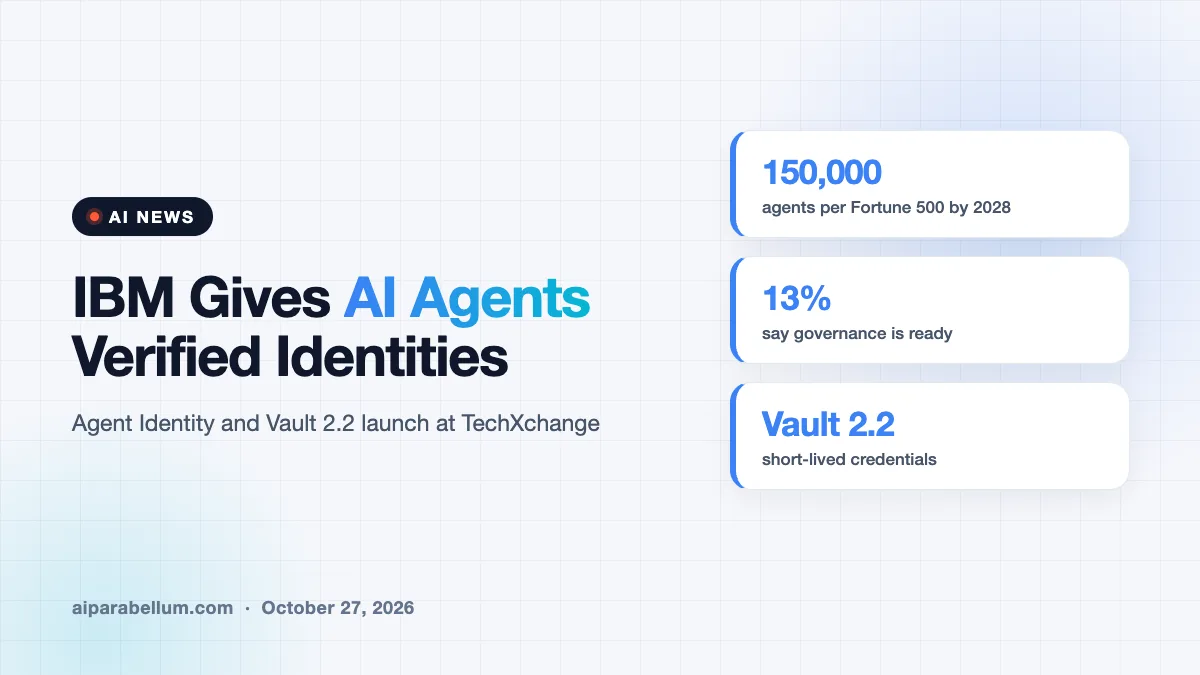
IBM is rolling out an AI agent identity system that gives every software agent a verified owner, a defined set of permissions and credentials that expire. The company announced the tools at its TechXchange 2026 conference, and they are aimed at businesses that worry about agents running loose across their systems.
What IBM Announced for AI Agent Identity
The centerpiece is IBM Agent Identity, now generally available. It keeps an authoritative record for each agent: who owns it, whether it is active and what authority it has been granted. It works together with HashiCorp Vault, the secrets-management product IBM gained through its HashiCorp acquisition.
IBM also cited a Gartner estimate that the average Fortune 500 company will run more than 150,000 AI agents by 2028. Only 13% of organizations say they have the right agent governance in place today.
How Short-Lived Credentials Limit the Damage
Long-lived passwords and keys are a weak spot for agents. If one is stolen, or an agent wanders outside its task, the damage can spread quickly. IBM’s answer is to issue each agent a credential that expires on its own and can be revoked at once.
Vault 2.2 gives agents their own secured accounts, renews their credentials automatically and adds post-quantum encryption. If an agent tries to read data or take an action outside its approved permissions, access can be denied and the session ended in real time.
Seeing Every Agent in One Place
IBM watsonx Orchestrate is meant to work across vendors rather than inside one platform. Its new discovery feature, in tech preview, connects to Amazon Bedrock, Microsoft Foundry and Google Gemini to find agents built elsewhere. It also covers models and MCP servers.
A separate evaluation feature lets teams test agents for quality, accuracy and compliance before launch, then monitor them in production. Built-in cost tracking shows which agent is burning through tokens.
Everything in the AI Agent Identity Launch
| Product | What it does | Status |
|---|---|---|
| Agent Identity | Records owner, status and permissions for each agent | Generally available |
| HashiCorp Vault 2.2 | Short-lived credentials, agent accounts, post-quantum encryption | Generally available |
| Vault Secure Hub | Central view of Vault health and security | Public preview |
| watsonx Orchestrate evaluate | Tests and monitors agents, models and MCP servers | Generally available |
| watsonx Orchestrate discover | Finds agents built on other platforms | Tech preview |
| Terraform remote MCP server | Lets agents make approved infrastructure changes | Public preview |
| IBM Z Atlas | Maps and manages z/OS systems | Public preview |
Why Agent Identity Matters for Security
Treating an agent like a user account is a simple idea with big effects. It means security teams can ask the same questions they ask about employees: who is this, what can it touch and when should that access end. IBM says Agent Identity also plugs into NVIDIA OpenShell, a secure runtime, so each action an agent takes can be traced and reviewed.
Keep in mind that these are IBM’s own claims from a product announcement. Real-world results will depend on how well the tools fit with a company’s existing identity setup.
What This Means for You
If your team is starting to deploy agents, the launch points to a few habits worth copying, even if you never use IBM products.
- Give every agent a named human owner before it goes live.
- Grant only the access an agent needs for its specific job.
- Prefer credentials that expire over keys that last for months.
- Keep a running list of every agent, including ones built on other platforms.
- Track token costs per agent so surprise bills show up early.
Small teams can start with a spreadsheet of agents and owners. If you want more context, see our guides on agents in business and AI threat detection. Related news includes ServiceNow’s agent passport and Reco funding.
Sources
Primary source: IBM’s agent identity announcement.
Conclusion
IBM is betting that businesses will trust AI agents only when they can be identified, limited and shut off quickly. The mix of Agent Identity, expiring credentials and cross-platform discovery targets a real gap, since agent counts are growing faster than governance. Whether it lives up to the pitch will show in how customers use it over the coming months.