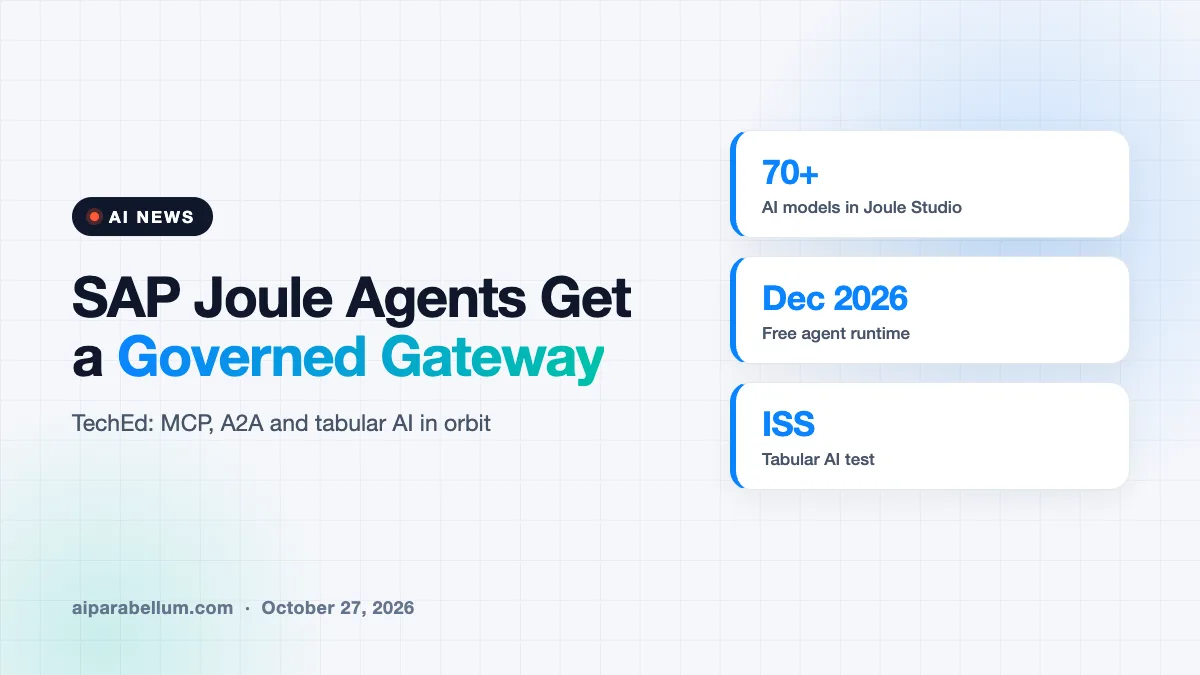
SAP Joule agents are getting a major upgrade at the company’s TechEd developer conference in Berlin. SAP says its Joule assistant and agent tools will now work with outside AI agents through a controlled front door, while a new set of governance tools tracks what every agent does. SAP also revealed that its tabular AI model will run on the International Space Station.
What SAP Announced for Joule Agents
SAP wants Joule to be the place where employees state a goal and let software finish the job. The company is adding “agentic thinking” features that plan and order the steps an agent needs for a long business process. These agents can also use open standards, namely Model Context Protocol (MCP) and Agent2Agent (A2A), so they can pull in outside data and tools.
Joule Studio, SAP’s builder for custom agents, lets teams pick from more than 70 AI models. Early-access customers can also design and run n8n workflows inside it. SAP adds that customer data stays with the customer and is not shared to train large language models.
| Area | What is new | Why it matters |
|---|---|---|
| Joule Work | Agentic planning, MCP and A2A support | Agents can finish multistep tasks across systems |
| Agent gateway | Third-party agents call Joule Agents through a governed entry point | Outside agents get access without losing control |
| Enterprise AI Gateway | One place for authentication, routing, usage tracking and auditing | IT sees all AI traffic in one view |
| Joule Studio | Tools to watch agent behavior, model use and spend | Costs and actions stay visible |
| SAP-RPT-2.0 and SAP-RPT-TS | Tabular models for anomalies and time-based forecasts | Better use of spreadsheet-style business data |
Why Joule Agents Need Governance
As companies add more AI agents, a basic question grows louder: who is allowed to do what? SAP’s answer is a governed gateway. When an outside agent wants to call a Joule agent, it passes through one checkpoint that enforces access rules.
SAP’s product chief for business AI, Ted Way, summed up the idea to SiliconANGLE as “open protocols need governed doors.” The company also announced a new SAP Enterprise AI Gateway, a Joule Assistant, an SAP AI Agent Hub and an AI Governance Assistant. The last one is meant to help customers meet European Union AI Act requirements.
Free Runtime Through December
For select customers, running custom agents on SAP’s managed Joule Studio runtime stays free through December 2026. Design tools for building and testing agents and n8n workflows remain free under fair-use limits.
New Data Tools Behind the Agents
Agents are only as good as the data they can see. SAP is expanding its Business Data Cloud with an Ontology Manager, which defines how facts from different apps relate to each other. SAP also says it is adding Apache Iceberg and Apache Polaris support through Dremio, so teams can query data without copying it.
Other data moves include a deeper tie-in with Databricks, branded SAP Databricks, and SAP Reltio, which will bring master data management for customer, supplier and product records.
- Ontology Manager helps agents understand how business data connects.
- Dremio support enables queries across systems without moving data.
- Databricks integration brings its data engineering tools into SAP’s data cloud.
- Reltio adds cleaner master records for agents to rely on.
A Tabular AI Model on the Space Station
Most AI news focuses on chatbots, yet much company data sits in tables. SAP-RPT-2.0 is a tabular model that will add anomaly and outlier detection, plus multi-table analysis. A second model, SAP-RPT-TS, aims at forecasting values over time inside SAP Integrated Business Planning, without custom machine learning.
Together with Hewlett Packard Enterprise, SAP plans to run SAP-RPT onboard the space station’s Spaceborne Computer-2. The goal is to flag problems before failures grow, fill in missing sensor values, and write mission-health reports without sending data back to Earth. SAP calls this one of the most notable edge-computing tests of an enterprise AI model so far.
What This Means for You
If your company runs SAP, these updates affect how you will manage AI agents in the near term. Even if it does not, they show where enterprise AI is going: less about clever chat and more about control, cost tracking and clean data.
- Ask your IT team which agents can touch your business systems today, and who approves them.
- Look for tools that show agent actions and spending, not only results.
- Clean up your tables and master records first, since agents reason from them.
- Check whether the free Joule Studio runtime window through December fits a pilot.
Some of these features are described as coming later, and early access applies to certain items, so check availability before planning around them. For more on this trend, see our look at agent governance, how agents replace integrations, and our guide to business AI tools. You can also browse the latest AI news, read about agent identity vaults, or explore data analytics tools.
Sources
Primary source: SAP’s TechEd announcement. Additional reporting from SiliconANGLE.
Conclusion
SAP is betting that businesses will trust AI agents once they can control and audit them. The governed gateway, the new AI gateway and the spending tools all point that way. The space station test is a flashy proof point for tabular AI, but the real story is how enterprises plan to run many agents safely.