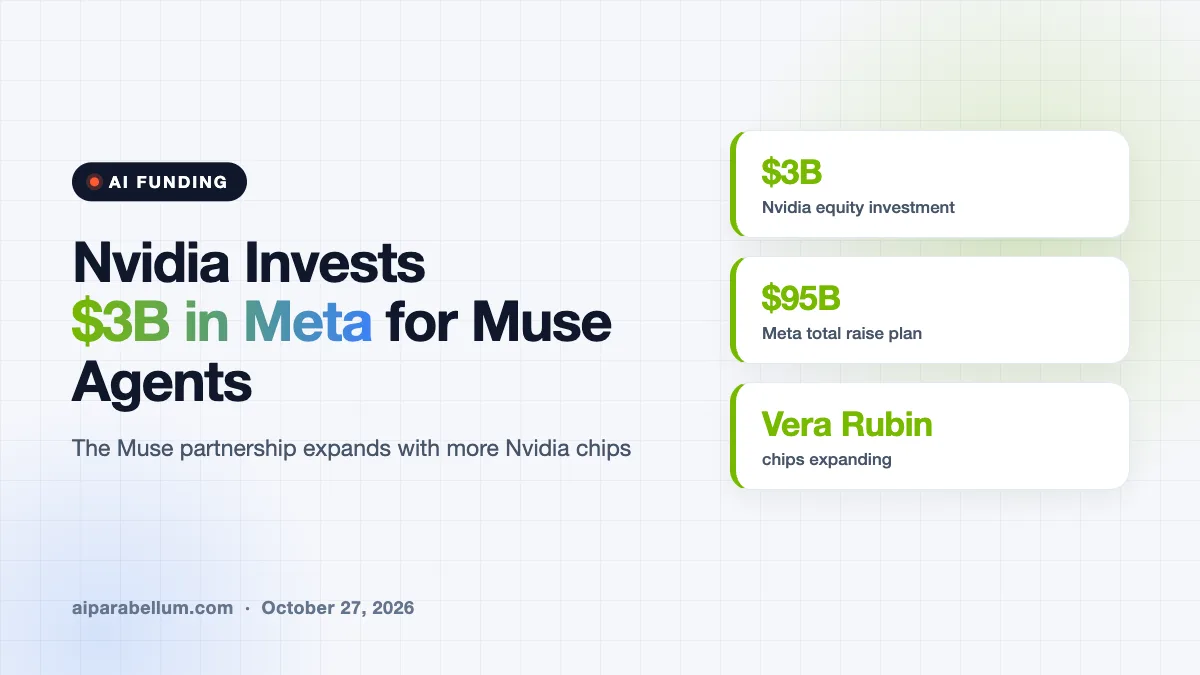
Nvidia and Meta announced on October 27, 2026 that they will deepen their Muse AI agents partnership, and Nvidia will put $3 billion into Meta’s equity offering. The two companies say they will tune Muse and the wider Muse family of models for faster training and cheaper inference. Meta also plans to roll out more Nvidia hardware to run them.
What Nvidia and Meta Announced
Muse is Meta’s family of AI models and the personal agent built on top of them. According to Nvidia, Muse has delivered frontier-level benchmark results and strong consumer download growth since it launched. The new deal is meant to keep that momentum going.
The companies plan to work together on software and workflow optimizations. The goal is to squeeze more speed out of each chip and bring down the total cost of running Muse at scale.
Nvidia also described a few other areas where the two firms may team up. These are not firm commitments yet, because both companies only said they would consider them.
- Nvidia OpenShell, a reference architecture for deploying AI agents more safely
- Nvidia Sentry, a tool for monitoring what agents are doing
- Data processing for structured, unstructured and graph data
The $3 Billion Nvidia Investment in Meta
The headline number is the $3 billion Nvidia will invest in Meta’s equity offering. It lands just as Meta lays out a much bigger fundraising plan.
According to CNBC, Meta said it plans to raise $95 billion in total to pay for AI infrastructure. That starts with $35 billion in public equity offerings, then another $60 billion through an at-the-market program.
CNBC also reported that Meta said Nvidia, AMD and Broadcom were interested in buying up to $5 billion in shares. Nvidia’s own statement gives the $3 billion figure, so final amounts could still shift.
Meta’s stock slipped about 1.6% in morning trading after the raise was announced, per CNBC. Last week, the company also lifted the low end of its 2026 capital spending forecast to a range of $135 billion to $145 billion.
More Nvidia Hardware Inside Meta’s Data Centers
Meta says it intends to expand its use of Nvidia infrastructure. The plan covers several pieces of the stack, from processors to networking.
| Nvidia product | What it does | Meta’s plan |
|---|---|---|
| Vera Rubin | Next-generation AI accelerator platform | Expand deployment |
| Vera CPU | Processor built for agent workloads | Expand deployment |
| Spectrum-X Ethernet | High-throughput networking | Deploy to boost efficiency |
| BlueField-4 | Data processing and networking chip | Deploy to support throughput |
Nvidia says the focus is performance per watt. Power is now one of the hardest limits on building AI data centers, so getting more work out of every watt matters as much as raw speed.
Why Muse AI Agents Drive the Deal
Both chief executives framed the deal around agents. Nvidia’s Jensen Huang called agents a new computing paradigm, where software understands your goals, reasons, uses tools and gets work done for you. Meta’s Mark Zuckerberg said Muse is how the company plans to bring personal superintelligence to everyone.
That focus matters because agents are far more demanding than a simple chatbot. They run longer tasks, call tools and make many model calls for one request. Cheaper inference makes that practical for billions of users.
The safety tools are part of the story too. If agents act on your behalf, companies need ways to limit what they can touch and to watch what they do. You can see the same pressure across the industry, from agent security startups to new agent governance tools.
Muse AI Agents in Meta’s Bigger AI Push
Meta has moved quickly on its Muse line this month. It released its first frontier model in Muse Wonder earlier in October, and followed with an open-weight release in Muse Spark Open.
Nvidia has also been pushing agents beyond the data center, as shown by its local agent hardware. Tying itself closer to one of the biggest AI buyers in the world helps keep Nvidia’s chips at the center of that growth.
What This Means for You
You will not see this deal in your apps tomorrow, but it points to where Meta AI is heading. Here is what to watch.
- Expect Muse features to roll out wider if Meta can run them more cheaply.
- Look for stronger agent safety controls as OpenShell and Sentry are discussed.
- Watch for more money flowing into AI infrastructure, which can affect the pace of new releases.
- Treat the extra collaboration areas as ideas, since both firms said only that they would consider them.
If you build with AI tools, it also signals that big players are betting on agents rather than plain chat. That is a good reason to try agent features now and learn what they can do for your work.
Sources
Primary source: Nvidia’s announcement. Additional reporting from CNBC.
Conclusion
Nvidia’s $3 billion investment and the expanded Muse partnership show how closely chips and AI models are now tied together. Meta gets more hardware and tuning help for Muse, while Nvidia secures a stake in one of its biggest customers. For everyday users, the real test is whether cheaper, safer agents actually show up in the apps you use.