NVIDIA has expanded its Cosmos platform for world models with new data tools, training recipes and simulation-ready model versions. World models are AI systems that learn how the physical world looks and behaves, so robots and self-driving cars can practice in simulation before they touch the real world. The update, announced on October 22 during NVIDIA’s GTC Berlin event, is aimed at the slowest parts of that work: gathering good training data and getting a model ready to deploy.
What’s New in NVIDIA Cosmos
The announcement covers three layers of the platform. There’s a data layer for preparing training material, a framework layer for adapting and shrinking models, and a deployment layer for running them quickly.
NVIDIA also says Cosmos ranks in the top five on six different open model leaderboards. That’s a company claim, but it signals how hard NVIDIA is pushing Cosmos as the open default for physical AI.
| Piece | What it does | What changed |
|---|---|---|
| Cosmos Data Factory | Labels, curates, augments and checks training data | Five cloud blueprints on GitHub, Azure, Nebius and CoreWeave |
| Cosmos Curator | GPU-accelerated video dataset curation | Now handles multimodal, multisensor inputs |
| Cosmos Framework | Fine-tuning, reinforcement learning, distillation and quantization | Recipes offered as agent skills for more open models |
| Cosmos 3 Nano variants | Smaller models for simulation | New versions for testing robot and car policies |
| Cosmos 3 NIM microservices | Packaged model serving | Up to 2x faster inference in validated setups |
The Five Cosmos Data Factory Blueprints
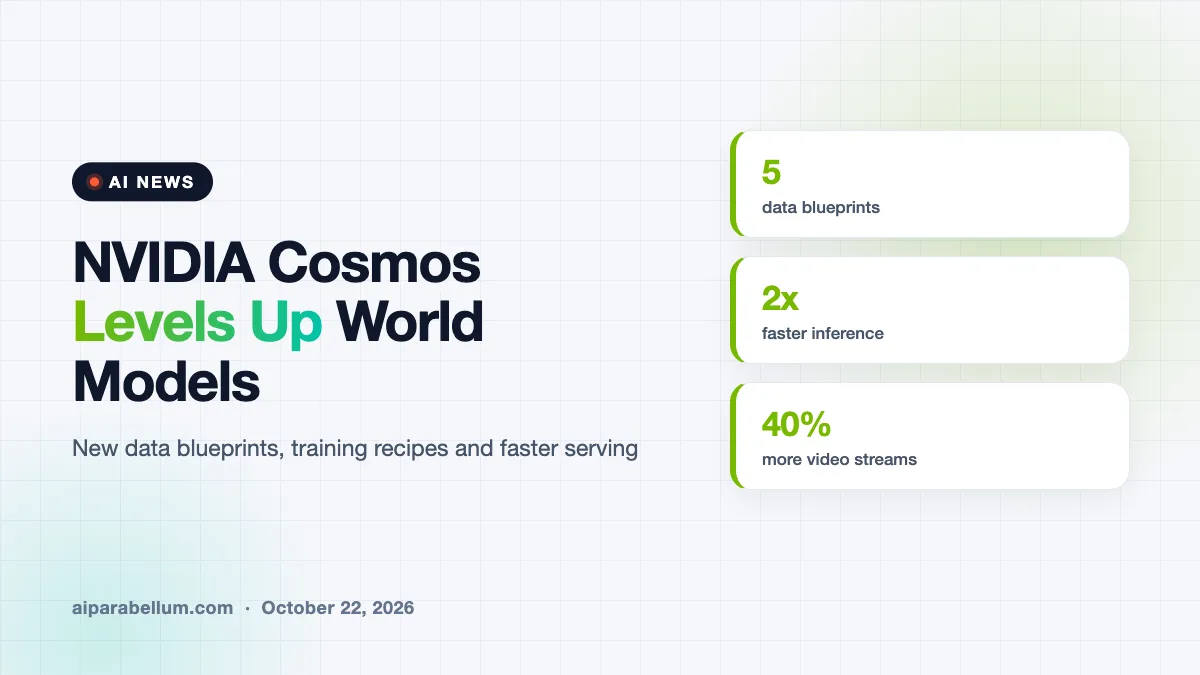
Data is usually the hardest part of building a world model. You need huge amounts of video and sensor footage, including rare events that are dangerous or expensive to stage. NVIDIA’s answer is a set of ready-made pipelines it calls blueprints:
- Autonomous vehicle dataset generation, which curates driving footage and adds synthetic hard-to-capture scenarios.
- Image attribute augmentation, which varies how objects look to improve image search.
- Event video generation, which turns still images into synthetic clips of rare or unsafe events.
- Defect image generation, which creates flaws in circuit boards, metal and glass for inspection models.
- Video data augmentation, which changes weather and lighting while keeping the scene intact.
The idea is simple. Instead of waiting months to film a forklift spill or a snowy intersection, a team can generate examples and spend real-world testing time where it matters most.
Early Users Share Results
NVIDIA pointed to several companies already using the blueprints. Porsche is leading a shared self-driving data effort across Volkswagen Group brands, and NVIDIA says it could cut repeated physical test drives by up to 90% and development cycles by up to 85%.
Robotics firm ANYbotics generated more than 1,500 synthetic video clips to teach its inspection robots to spot liquid spills. Ultralytics retrained its YOLO vision model with a mix of real images and synthetic defects and reports better defect detection.
Synthetic data won’t replace real-world testing, but it can make every real test drive count for more.
Training and Deploying Cosmos World Models
Once the data is ready, the Cosmos Framework helps developers adapt models through fine-tuning and reinforcement learning, then shrink them with distillation and quantization. NVIDIA has packaged those steps as agent skills, so AI coding agents can run parts of the workflow too. It works with open models such as GR00T, Alpamayo, Qwen, Pi0.5 and other compatible Hugging Face models.
One example stands out. Robotics lab MicroAGI post-trained Cosmos 3 on videos of people handling objects, then distilled its 32-billion-parameter reasoner into an 8-billion-parameter Nano model that NVIDIA says lost no accuracy. Developers can also label data and post-train Cosmos 3 on Roboflow for specific factory or warehouse jobs.
On the deployment side, updated Cosmos 3 NIM microservices promise up to twice the inference speed in validated configurations. A new Metropolis blueprint for video search and summarization, version 3.3, is built on those services, and NVIDIA says it lets teams watch 40% more video streams on the same GPU.
Why Physical AI Needs Better Simulation
Chatbots learn from text, but robots have to deal with gravity, glare and slippery floors. That’s why companies building physical AI lean on simulation, and why tools that generate realistic scenes are in such demand. Startups in this space keep drawing big checks, like the robot “brain” maker covered in our Dream Labs funding story.
The Cosmos update also fits NVIDIA’s bigger push in Europe. NVIDIA has also been promoting local AI agents, and Germany has already signed an industrial AI pact with NVIDIA to modernize factories. Open models like its Nemotron vision model are a big part of that strategy.
Energy giant ADNOC offers a real-world example. It uses a safety platform from Fogsphere, built on Cosmos and the Metropolis blueprint, to spot hazards in real time across 65 sites.
What This Means for You
If you don’t build robots, you won’t touch Cosmos directly. Still, the tools shape products you’ll meet, from warehouse robots to driver-assist systems.
- If you work in robotics or computer vision, the blueprints are worth testing before you spend money staging rare events for training data.
- If your team runs camera networks, the new video search blueprint may let you cover more feeds without buying more hardware.
- If you’re just following AI, watch how fast synthetic data closes the gap between lab demos and robots that work reliably in messy places.
Keep in mind that the speed and accuracy figures come from NVIDIA and its partners. Real results will depend on your data and setup. For more updates like this, check our AI news hub.
Sources
Primary source: NVIDIA’s Cosmos announcement.
Conclusion
NVIDIA’s latest Cosmos update is less about one flashy model and more about the plumbing behind physical AI. Ready-made data blueprints, agent-friendly training recipes and faster serving make it easier for teams to build and test world models before they reach real streets and factory floors. The headline numbers come from NVIDIA and early partners, so independent results will be the real test. Still, the move strengthens Cosmos as the open starting point for anyone building robots or self-driving systems.