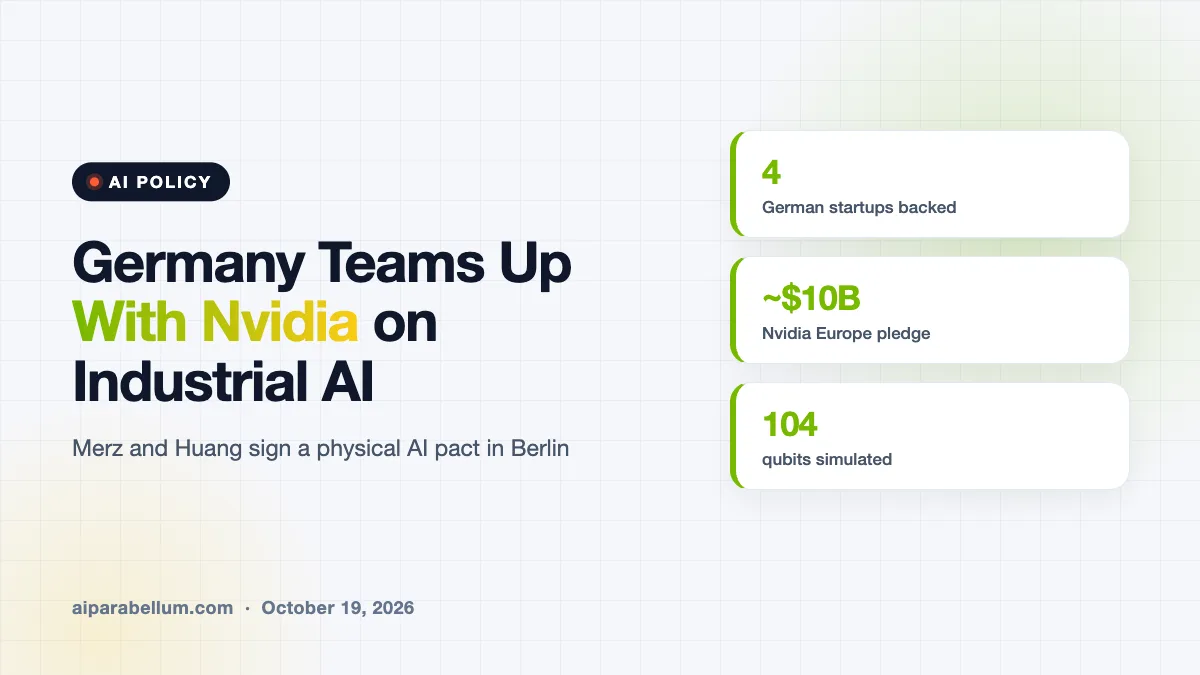
Germany wants to become the world leader in industrial AI, and it just made Nvidia a formal partner in that push. On October 19, Chancellor Friedrich Merz and two federal ministries signed a joint declaration of intent with Nvidia to build advanced AI models for factories, robots and other physical machines. Nvidia CEO Jensen Huang also used the Berlin event to announce new investments in four German startups.
What the Germany Industrial AI Deal Covers
The agreement was signed at the Invest in Germany Summit by Merz, the Federal Ministry for Economic Affairs and Energy and the Federal Ministry for Research, Technology and Space. It sets up a joint initiative with Nvidia focused on “physical AI,” meaning AI that controls or works with real-world machines.
The deal also expands Nvidia’s work with Germany’s Industry 4.0 Platform, a group that brings together government, industry, researchers and trade groups. The government’s stated goal is to bring industrial AI into widespread use and build a leading industrial AI ecosystem in Europe.
Later that day, Merz and Huang sat down for a public conversation inside Kraftwerk, a former power station in Berlin. Merz said he wants to meet Huang at least once a year to review Germany’s progress.
Why Germany Is Betting on Industrial AI
Germany’s economy has barely grown in recent years. It faces high energy costs, tough competition from China in areas like cars, and red tape that can hold projects up for years.
Leaders see AI as a way to get growth back on track without abandoning what Germany does best. Merz pointed to the Mittelstand, the country’s huge network of small and mid-sized manufacturers, and urged those firms to open up their data for AI.
Huang made a similar case. He told German makers that digital tech will not replace heavy industry, putting it simply: “electrons will never replace atoms.” His message was that Germany’s factory know-how is a national asset that AI can strengthen, not replace.
The Data Question
Europe also worries about relying too much on U.S. tech firms. It lags the U.S. in data center capacity, and companies are wary of storing sensitive data on servers owned by American providers. Huang seemed to nod to this, telling Germany to bring in AI technology but keep its own knowledge at home.
Nvidia’s New German Startup Bets
Huang announced planned investments in four German companies. They are part of a nearly $10 billion Nvidia commitment to support companies, universities and research groups across Europe.
| Startup | Base | What It Builds |
|---|---|---|
| Agile Robots | Munich | AI robot arms and the Agile ONE humanoid |
| Avelios Medical | Munich | An AI-native hospital information system |
| Mirelo | Germany | AI that creates sound effects, speech and music for video |
| Reflex Aerospace | Berlin | Satellites ready to launch in about 12 months |
Nvidia already backs other well-known German names, including workflow tool n8n, Neura Robotics and image model maker Black Forest Labs. The company has been spreading similar bets across Europe, such as its recent UK safety funding.
Siemens and a Record Quantum Simulation
The same day, Siemens said it is partnering with Nvidia on AI-driven, autonomous factories. Siemens claims a fully virtual production ramp-up cuts engineering effort by up to 85%, and agent-based planning can save up to 20% in costs.
Nvidia researchers also used JUPITER, Europe’s largest supercomputer, to run a 104-qubit simulation of a fault-tolerant quantum computer. Nvidia says it is the largest and most detailed simulation of its kind so far.
What This Means for You
Most people won’t touch a German factory robot, but this kind of deal shapes the products and prices you see later. Here is why it matters:
- Physical AI is the next big race. After chatbots, chipmakers and governments are now chasing AI that runs robots and machines, like the new robot AI brain from Dream Labs.
- Governments are picking AI partners. Expect more countries to sign deals like this one to avoid falling behind.
- Nvidia’s reach keeps growing. Beyond chips, it now invests in startups and helps shape national AI plans, as seen with its AI factory designs.
- Company claims need proof. Savings figures like Siemens’ 85% are best-case numbers from a showcase factory.
You can follow the rest of this week’s developments in our AI news section.
Sources
This article draws on the official Nvidia blog announcement and Associated Press coverage published by WTOP.
Conclusion
Germany’s new pact with Nvidia is a clear sign that the country sees industrial AI as its best shot at reviving growth. The deal pairs German engineering and factory data with Nvidia’s AI tools, and it comes with fresh startup investments and a Siemens factory partnership. Big questions remain about data control and how fast small manufacturers will actually adopt AI. Still, with the chancellor promising yearly check-ins, this is one partnership that will be measured in public.