
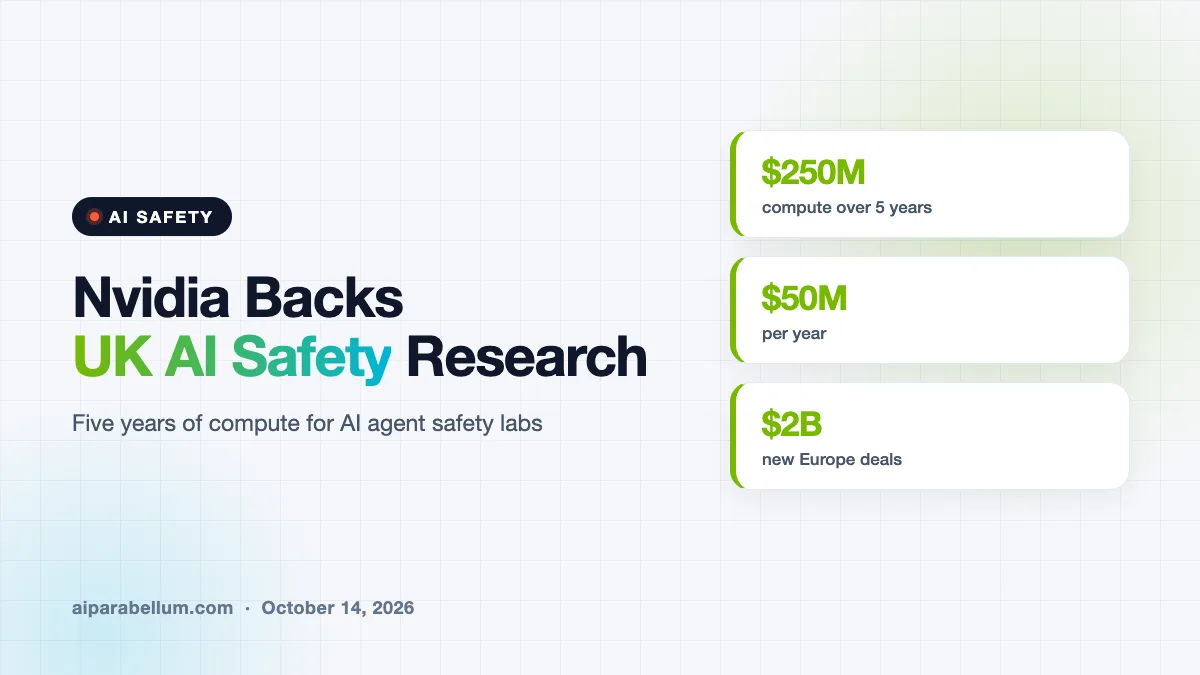
Nvidia is putting $250 million worth of computing power behind UK AI safety research over the next five years. The donation targets agentic safety and security, meaning work on keeping AI agents that act on their own secure and under control, and it lands as CEO Jensen Huang tours Europe promising billions more in AI investment.
The timing is not an accident. Europe is debating whether to slow AI down, and Nvidia wants to show it can fund safety work while it sells the chips that power the boom.
How the Nvidia AI Safety Research Pledge Works
This is not a cash grant. Nvidia is donating compute access valued at $50 million a year for five years, delivered through UK-based Nvidia Cloud Partners with the hardware hosted inside the country.
Nvidia says most of the compute will go to the wider UK AI safety and security research community. A smaller share will support three named groups, and the company says provider selection and commercial terms are still to be agreed.
| Detail | What Nvidia Announced |
|---|---|
| Total value | $250 million in compute |
| Time frame | Five years ($50 million per year) |
| Focus | Agentic AI safety and security |
| Delivery | UK-based Nvidia Cloud Partners |
| Named partners | BOLD (Oxford), SOFAIR (UCL), Imperial College London |
The Three Named Research Groups
- BOLD, the British Open-Ended Learning and Discovery Lab led by the University of Oxford, works on AI that learns, adapts and operates alongside people.
- SOFAIR, the Science of Fundamental AI Research Lab led by UCL, explores open source AI architectures and cheaper ways to build and run AI.
- Imperial College London will focus on safety engineering and robotics, including physical AI that acts in the real world.
Nvidia says the research will cover secure agents, open-model security and real-world threat mitigation. That includes secure sandboxes, reproducible research and safety benchmarks, some built on its own OpenShell runtime and Sentry reference design.
Why AI Agent Safety Is Getting Money Now
AI agents can browse, write code and take actions with little human input, and that raises new security risks. A model that can act can also be tricked, hijacked or simply make costly mistakes. Recent work on agent security startups shows how fast this field is growing.
Huang framed the pledge as proof that capability and safety can move together. UK AI Minister Kanishka Narayan called it “a vote of confidence” in British AI research, and Business Secretary Jonathan Reynolds said people need to feel the technology is safe before they will use it.
The UK has positioned itself as a safety leader for a while, from its government-backed AI Security Institute to the Isambard-AI supercomputer in Bristol, which runs on Nvidia chips. It also fits a week of debate over binding UK AI rules and how strict they should be.
Nvidia’s $2 Billion Push Across Europe
The UK donation is one piece of a bigger European tour. Speaking in Paris on the first stop, Huang said Nvidia will announce $2 billion in new European investments within a week, on top of roughly $8 billion it put into the continent over the past year, according to Bloomberg.
He also named four French startups Nvidia is backing: Doctolib, Genesis AI, Pigment and Entalpic. The tour continues to London and Berlin, where Nvidia’s GTC conference runs from October 20 to 22.
The Open-Model Pitch
Huang told the Paris audience that Europe needs to get in the race. His suggested path is open models, which he described as cheaper to run and easier to adapt for local languages and national control.
There is a business angle worth noting. Open weights cut the cost of the model itself, but every company running them still needs chips, and Nvidia sells most of them. The same logic sits behind its push for open AI factory standards.
What This Means for You
Most people will never touch a UK research cluster, but this kind of funding shapes the AI tools you use every day. Here is what to keep in mind:
- Safer agents take time. If you use an AI agent tool today, keep a human check on anything that spends money, sends messages or changes files.
- Watch for open safety benchmarks. Nvidia says findings are meant to inform safeguards across the industry, so expect new test suites that vendors can quote.
- Open models are getting a bigger push in Europe. That could mean more local-language and on-device options, similar to recent local AI agents on PCs.
- Follow the money. When the biggest chip seller funds safety work, ask who sets the research agenda and how independent the results will be.
Our take: $250 million in compute is real help for researchers, but it is a small slice of Nvidia’s spending. The value will show up in published, independent results, not in the headline number.
You can keep up with more stories like this on our daily AI news page.
Sources
Details come from the official NVIDIA Newsroom announcement, the NVIDIA Blog post on the UK ecosystem, and coverage of Huang’s Paris remarks from The Next Web.
Conclusion
Nvidia’s $250 million compute pledge gives UK researchers five years of serious hardware to study how AI agents fail and how to keep them secure. It arrives alongside a $2 billion European investment push and a strong pitch for open models. The commitment is meaningful, but the real test is whether the funded labs publish independent work that makes everyday AI agents safer. For now, it is a clear sign that agent safety has become a priority for the companies building the AI stack.
