Online education has grown massively over the past few years, but most of it still follows the same model as a traditional classroom. A teacher delivers content, students absorb it at the same pace, and everyone takes the same test regardless of how well they understood the material.
AI is changing that model at every level. Intelligent tutoring systems now adapt to each student’s learning speed, identify knowledge gaps in real time, and provide personalized explanations that match how a student actually thinks. For educators, AI handles the time-consuming work of grading, lesson planning, and progress tracking so they can focus on what matters most: teaching.
Here is how to use AI in online tutoring and education to create better learning experiences, save instructors hours of administrative work, and help students learn faster than traditional methods allow.
Why AI Matters for Online Tutoring
The fundamental challenge of online education is scale. One instructor cannot provide personalized attention to 200 students simultaneously. In a physical classroom, teachers read body language, notice confused faces, and adjust their explanations on the fly. Online, those signals disappear.
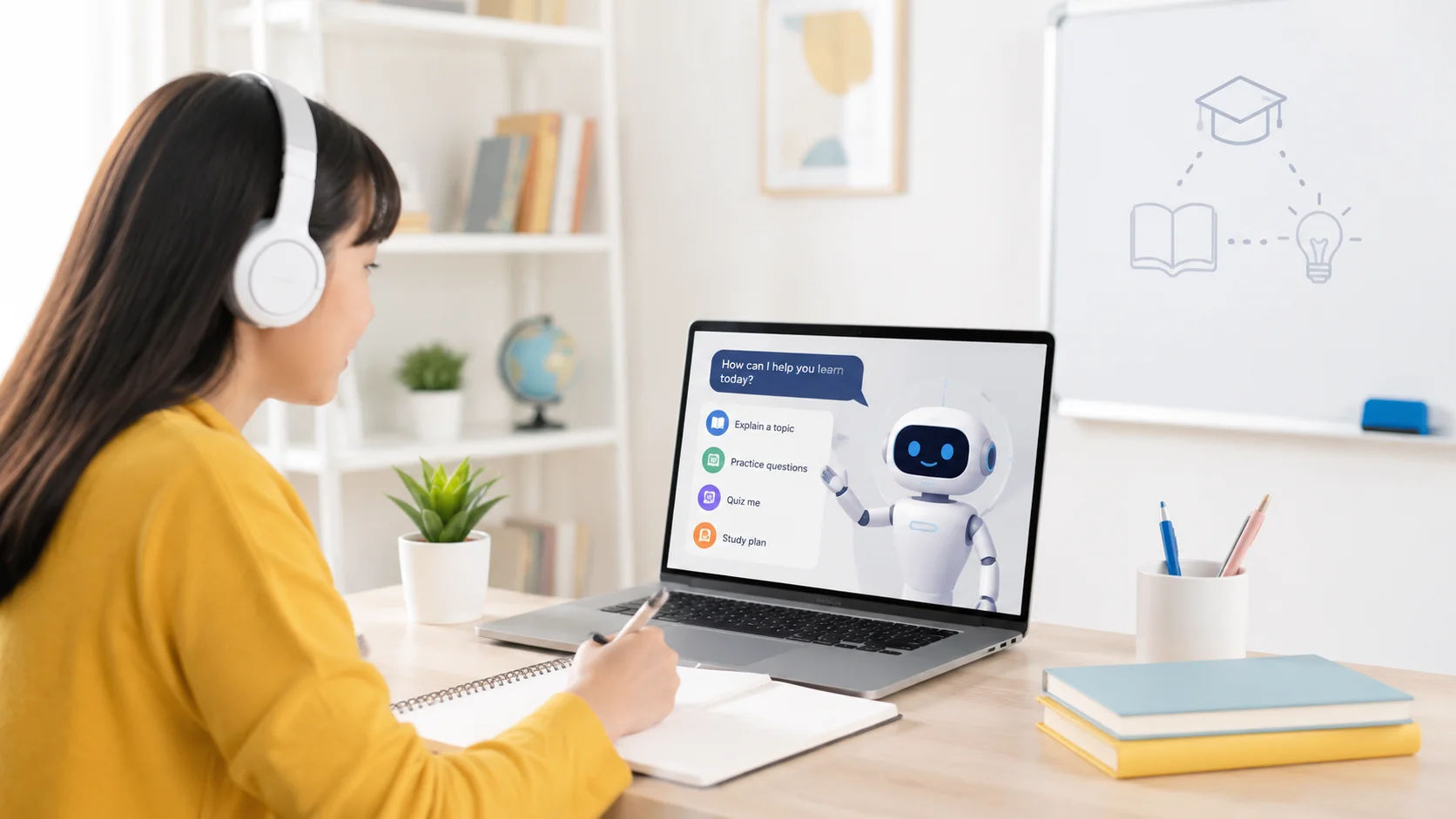
AI fills this gap by acting as a tireless, always-available tutor that adapts to each student individually. It detects when a student is struggling based on response patterns, time spent on questions, and error types. It then adjusts the difficulty, provides alternative explanations, and offers practice problems targeted at the specific concept the student has not yet mastered.
According to the U.S. Department of Education, AI-powered adaptive learning systems can improve student outcomes by 20 to 30 percent compared to traditional one-size-fits-all instruction. The improvement comes from meeting each student exactly where they are rather than where the syllabus assumes they should be.
A great tutor adjusts to the student, not the other way around. AI makes that level of personalization possible for every learner, not just those who can afford private instruction.
AI Tools for Online Tutoring and Education
A growing number of AI-powered platforms serve different roles in the online education ecosystem. Some focus on student-facing tutoring, others help teachers create and manage courses, and several handle specific tasks like grading or quiz generation.
| Tool | Free Option | Best For | Key Feature |
|---|---|---|---|
| Khan Academy (Khanmigo) | Free for students | K-12 and college prep tutoring | AI tutor that guides without giving answers |
| ChatGPT | Free tier available | General-purpose learning assistant | Explains any topic at any level of detail |
| Quizgecko | Free tier available | AI quiz and assessment generation | Creates quizzes from any text or document |
| Coursebox | Free trial | AI course creation | Builds entire courses from source material |
| StudyX | Free tier available | Homework help and step-by-step solutions | Breaks down problems into learning steps |
| Synthesia/HeyGen | Free trials | AI video lesson creation | Creates instructor-led videos without filming |
For individual tutors and small teaching operations, ChatGPT paired with a quiz generator like Quizgecko covers the most ground with minimal cost. Larger institutions benefit from purpose-built platforms that integrate adaptive learning, analytics, and course management into a single system.
AI-Powered Personalized Learning
Personalization is where AI delivers the biggest improvement over traditional online education. Instead of delivering the same content to every student, AI adapts the learning path based on individual performance, preferences, and pace.
Adaptive Learning Paths
AI creates a unique learning journey for each student. When a student demonstrates mastery of a concept, the system moves them forward immediately rather than forcing them to sit through material they already understand. When a student struggles, the system provides additional explanations, worked examples, and practice problems before advancing.
This adaptive approach eliminates the two biggest problems in online education: boredom for advanced students and confusion for those who need more time. Everyone progresses at their own pace without holding anyone back or leaving anyone behind.
Learning Style Detection
AI analyzes how each student interacts with different content formats to determine what works best for them. Some students learn faster from video explanations. Others prefer reading text with diagrams. Some need hands-on practice problems before a concept clicks.
The system tracks engagement metrics like time spent, completion rates, quiz scores, and re-watch behavior to identify each student’s preferred format. It then prioritizes that format for future lessons while still exposing students to other approaches. Understanding how to write effective AI prompts helps students get more targeted explanations when using AI tutoring tools directly.
Every student who “just does not get it” usually just has not had it explained the right way yet. AI keeps trying different approaches until it finds the one that works.
AI for Creating Educational Content
Creating high-quality educational content is one of the most time-consuming parts of teaching. AI reduces the production time dramatically while maintaining or improving quality.
Lesson Plan Generation
AI generates complete lesson plans from a topic description, learning objectives, and target audience. It structures the content into logical sections, suggests activities and discussion questions, creates assessment criteria, and aligns everything with educational standards. A lesson plan that takes an instructor two hours to build from scratch takes AI about 30 seconds.
The same AI content creation tools that marketers use for blog posts and copy work equally well for educational content. Teachers describe what they want to cover, and AI produces structured, engaging material ready for classroom use.
Quiz and Assessment Creation
AI generates quizzes, tests, and assessments from source material automatically. Upload a textbook chapter, lecture notes, or video transcript, and AI creates multiple-choice questions, short-answer prompts, and essay topics that test comprehension at various levels of Bloom’s taxonomy.
The AI can also create flashcards from notes instantly, turning passive study material into active recall exercises. This saves hours of manual question writing while producing assessments that accurately measure understanding.
Video Course Production
AI video tools let educators create professional-looking lecture videos without a camera, studio, or editing skills. Type the script, choose an AI presenter, and the platform generates a polished video with synchronized slides, graphics, and captions. The AI tools available for teachers now handle everything from video creation to automatic captioning and translation.
AI Tutoring Chatbots for Student Support
AI chatbots provide instant, 24/7 academic support that scales to any number of students without increasing instructor workload.
How AI Tutoring Chatbots Work
Unlike a simple FAQ bot, AI tutoring chatbots understand context and adapt their responses to the student’s level. When a student asks about quadratic equations, the chatbot does not just provide the formula. It asks what the student already knows, identifies the gap, and walks through the concept step by step using examples that build on the student’s existing knowledge.
The most effective AI tutors use the Socratic method. Instead of giving answers directly, they ask guiding questions that lead the student to discover the answer themselves. This approach produces deeper understanding than simply reading the correct answer.
- Available around the clock, including weekends and holidays when instructors are offline.
- Never impatient, never judgmental, and willing to explain the same concept 50 different ways.
- Remembers previous conversations and builds on what the student has already learned.
- Provides instant feedback on practice problems with detailed explanations of mistakes.
- Scales from one student to thousands without any loss in response quality.
Modern AI chatbot technology has reached the point where students often prefer the AI tutor for routine questions because it responds instantly and without the social anxiety some students feel when asking a human instructor for help.
Subject-Specific AI Tutors
AI tutoring works especially well for subjects with clear right and wrong answers: math, science, programming, language learning, and test preparation. The AI can check work instantly, identify exactly where the student made an error, and provide targeted practice to fix the misunderstanding.
For writing and humanities, AI serves a different role. It provides feedback on essay structure, argument clarity, grammar, and citation format. It cannot judge creative quality the way a human can, but it handles the mechanical aspects of writing instruction that consume most of an instructor’s feedback time. AI in creative writing continues to evolve, offering students increasingly nuanced feedback on narrative structure and style.
AI-Powered Grading and Assessment
Grading is one of the largest time sinks in education. AI automates much of it while providing students with faster, more detailed feedback than most instructors can deliver manually.
| Assessment Type | AI Capability | Time Saved |
|---|---|---|
| Multiple choice and true/false | Fully automated with instant results | 100 percent |
| Short answer responses | Semantic matching against correct concepts | 80-90 percent |
| Essay assignments | Structure, grammar, argument analysis with rubric scoring | 50-70 percent |
| Code assignments | Automated testing, style checking, logic analysis | 90 percent |
| Math problem sets | Step-by-step solution checking with error identification | 85-95 percent |
AI grading does not replace instructor judgment for complex assessments, but it handles the routine work that eats up most grading time. An instructor who spends 15 hours per week grading can redirect 10 of those hours to actual teaching, mentoring, and course improvement.
The AI productivity tools that streamline other professional workflows apply directly to educational administration. Automating grading, attendance tracking, and progress reporting frees educators to focus on the human elements of teaching.
Teachers did not get into education to spend half their time grading papers. AI handles the busywork so educators can do what they actually love: helping students grow.
AI for Language Learning
Language learning is one of the most successful applications of AI in education because it requires exactly what AI provides well: patient repetition, instant feedback, and adaptive difficulty.
Conversational Practice
AI language tutors engage students in real-time conversation practice at any proficiency level. The AI adjusts its vocabulary, grammar complexity, and speaking speed to match the student’s ability. It corrects errors gently, suggests better phrasing, and introduces new vocabulary in context rather than through memorization lists.
This eliminates one of the biggest barriers to language learning: the lack of a practice partner. Students can practice speaking, writing, and comprehension exercises at any time without scheduling a session with a human tutor. Natural language processing has advanced to the point where AI conversation partners feel natural enough to build genuine speaking confidence.
Pronunciation and Grammar Feedback
AI provides instant pronunciation feedback by comparing the student’s speech patterns against native speaker models. It identifies specific sounds the student struggles with and creates targeted drills to improve those particular phonemes. Grammar corrections come with explanations of the rule, not just a red underline.
AI Analytics for Student Progress Tracking
AI turns raw student data into actionable insights that help both instructors and students understand learning progress.
- Real-time dashboards showing individual and class-wide performance on every concept and skill.
- Early warning systems that flag students at risk of falling behind before they fail a major assessment.
- Learning pattern analysis that identifies which content formats, times of day, and session lengths produce the best outcomes for each student.
- Skill gap mapping that shows exactly which prerequisite concepts a student is missing, enabling targeted intervention.
- Engagement tracking that distinguishes between students who are actively learning and those who are passively clicking through material.
These analytics replace gut feeling with data. Instead of guessing which students need help, instructors know exactly who is struggling, with what concept, and what type of intervention is most likely to work. The same AI research capabilities that power academic analysis help educators understand their students at a granular level.
Implementing AI in Your Teaching Practice
Starting with AI in education does not require overhauling your entire teaching approach. Begin with the area that consumes the most time or produces the most frustration, and expand from there.
- If grading takes too much time, start with AI-powered assessment tools for objective questions and use the saved hours for personalized essay feedback.
- If students ask the same questions repeatedly, deploy an AI chatbot that handles common queries and escalates complex ones to you.
- If creating content is your bottleneck, use AI to generate first drafts of lesson plans, quizzes, and study guides that you refine with your expertise.
- If engagement is low, implement adaptive learning that adjusts to each student’s pace and preferred content format.
- If students need more practice opportunities, use AI to generate unlimited practice problems with instant feedback and step-by-step solutions.
According to McKinsey, educators who integrate AI tools effectively report spending 20 to 40 percent less time on administrative tasks while seeing measurable improvements in student satisfaction and learning outcomes. The key is treating AI as an assistant that handles routine work, not as a replacement for human instruction.
An AI-powered personal assistant approach to education lets instructors scale their impact without scaling their workload. The AI manages the logistics while the teacher focuses on inspiration, mentorship, and the human connections that make education transformative.
Conclusion
Using AI in online tutoring and education transforms the learning experience for both students and instructors. AI provides personalized tutoring that adapts to each student’s pace and style, creates educational content in minutes instead of hours, automates grading with detailed feedback, and tracks progress with precision that manual methods cannot match. The technology does not replace teachers. It amplifies what good teachers do by removing the administrative burden that keeps them from focusing on actual teaching. Whether you are a solo tutor or running a large educational platform, AI tools make personalized, effective education scalable and affordable for everyone.