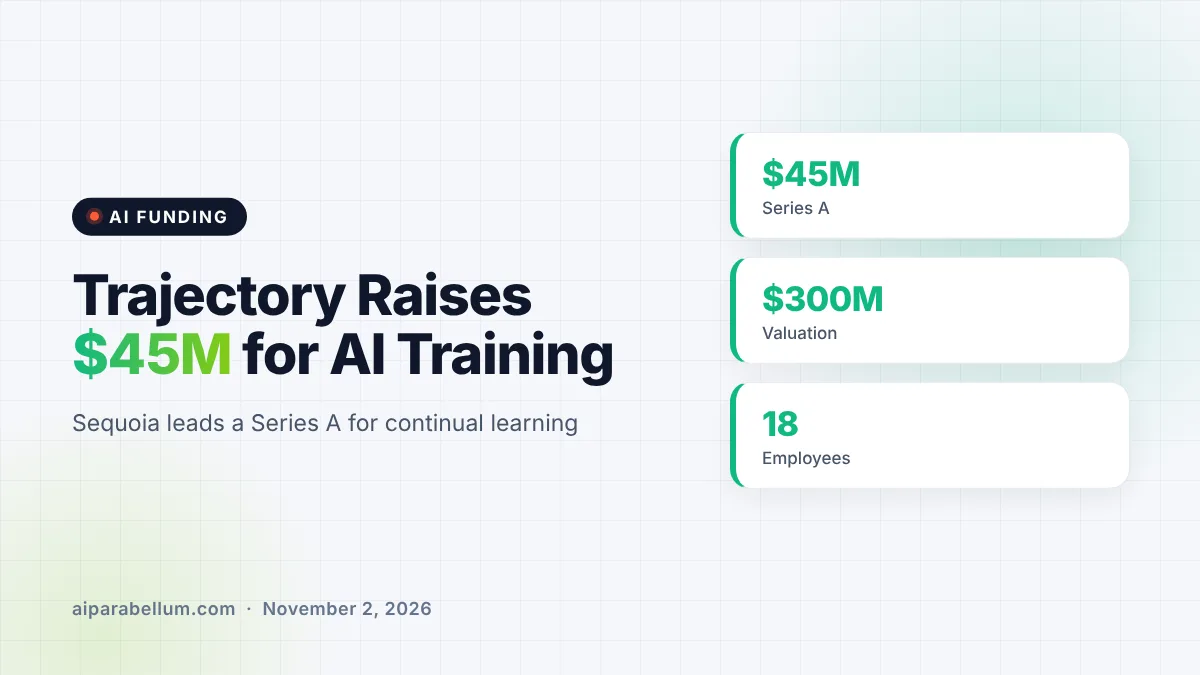
Trajectory, a young startup that wants to make AI model training something lawyers, doctors, and analysts can do themselves, has raised $45 million in a Series A round. Sequoia led the deal at a $300 million valuation, with Nvidia, Bessemer Venture Partners, and Bain Capital Ventures joining in. The company is also opening its post-training platform to the public, so any business can try teaching a model to get better at its own work.
Who Is Behind Trajectory
Trajectory was founded about a year ago by three Stanford classmates: Ronak Malde, Michael Elabd, and Arjun Karanam. The team is just 18 people today.
Malde was one of the researchers Google DeepMind brought over from Windsurf in an acqui-hire. Elabd also worked at DeepMind, and Karanam worked on generative foundation models at Apple. The startup has since hired researchers and designers from OpenAI, Stripe, and Netflix.
| Detail | What We Know |
|---|---|
| Round | $45 million Series A |
| Valuation | $300 million |
| Lead investor | Sequoia |
| Other investors | Nvidia, Bessemer Venture Partners, Bain Capital Ventures |
| Team size | 18 people |
| Named customers | Harvey, Rogo, Decagon, Mercor, Nvidia |
The Problem With Today’s AI Model Training
Whether a model comes from OpenAI, Anthropic, or the open-source world, it shares one big limit. It does not learn from its mistakes unless someone trains it again.
Companies that want a model tuned for law or finance usually fine-tune a general model. That often means hiring an in-house research team or paying costly consultants, often called forward-deployed engineers, to do the work.
Malde compares a foundation model to a very smart PhD student who keeps starting a new job. “But what the economy values is someone who worked on the job for 30 years,” he said.
How Continual AI Model Training Works
Trajectory’s answer is an approach called continual learning. Instead of training a model once and freezing it, the platform keeps improving it based on real feedback.
Here is the basic flow the company describes:
- A business starts with an open-source AI model.
- It connects Trajectory’s platform to its own applications.
- The platform collects feedback on how well the model performs.
- Trajectory uses that feedback to retrain the model so it improves at specialized tasks.
The founders say the key is that domain experts, not just engineers, define what good work looks like. Karanam says the team built its interface so non-technical customers can run post-training without help from a research lab.
Early Customers in Law and Finance
Legal AI company Harvey and finance AI company Rogo already use the platform to post-train open-source models. The goal is to make those models act more like seasoned lawyers or financial analysts by learning from past tasks.
Examples include reviewing a specific kind of legal contract or valuing a company with a particular method. If you have tried AI contract drafting yourself, you know how much generic models can miss on niche documents.
Humans in the Loop, and a Crowded Field
Trajectory’s approach has some overlap with recursive self-improvement, the idea that AI systems can upgrade their own abilities. Elabd argues that keeping people involved in training makes Trajectory’s version safer, since fully autonomous self-improvement could lead to unexpected or dangerous results.
The startup is not alone in trying to automate post-training. It names these companies as competitors:
- Thinking Machines Lab, founded by former OpenAI CTO Mira Murati, which makes the fine-tuning platform Tinker.
- Applied Compute, which was valued at $3.25 billion last month.
- Prime Intellect, which helps companies build and train their own AI agents.
Nvidia’s role as both investor and customer is worth noting, since the chipmaker has been pushing open models like its Nemotron family. Finance is another hot area for AI money, as the Ramp funding round showed.
What This Means for You
If your team relies on AI for specialized work, this funding is a sign of where the market is heading:
- Custom models are getting easier to build. Tools like Trajectory aim to remove the need for a dedicated research team.
- Your experts become the trainers. The people who know what good output looks like can shape the model directly.
- Open-source models get a boost. Trajectory starts from open models, which may lower costs compared with relying only on closed APIs.
- Expect more competition. With several well-funded rivals, pricing and features in this space could change quickly.
For more startup and funding stories, check our latest AI news roundup.
Sources
Reporting from TechCrunch, which interviewed Trajectory’s co-founders.
Conclusion
Trajectory is betting that the next step for business AI is not a bigger model but one that keeps learning on the job. With $45 million from Sequoia, Nvidia, and others, plus customers like Harvey and Rogo, the 18-person startup has room to test that idea at scale. Now that its platform is public, the real test is whether non-technical experts actually use it to improve their models. Rivals like Thinking Machines Lab and Applied Compute will make that race a close one to watch.