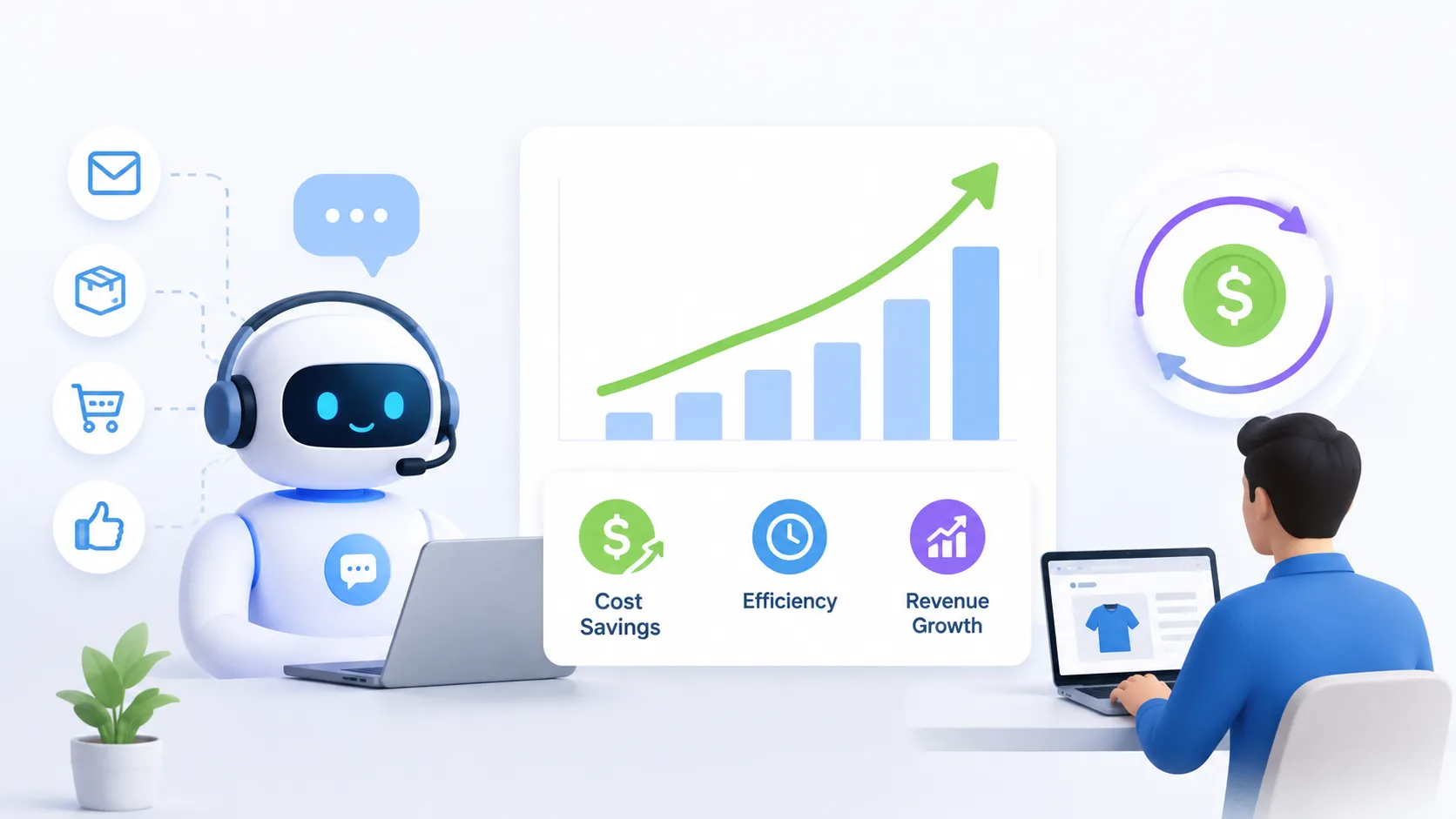
Your support team is drowning. Tickets pile up over the weekend, response times creep past the 24-hour mark, and hiring another agent means adding $45,000 to your annual payroll. Meanwhile, your competitors are quietly deploying AI customer support agents that handle thousands of conversations simultaneously without a coffee break.
For mid-market ecommerce businesses doing $5 million to $50 million in annual revenue, the question is no longer whether AI support works. It is whether the return on investment justifies the switch. And the answer, backed by real platform data, is more nuanced than most vendors want you to believe.
This article breaks down the actual costs, resolution rates, and human-handoff percentages from leading AI support platforms to give you a realistic ROI framework you can apply to your own store.
What AI Customer Support Agents Actually Do in Ecommerce
AI support agents are not the clunky chatbots of 2019 that looped customers through decision trees until they gave up. Modern platforms like Gorgias, Tidio, Intercom, and Zendesk AI use large language models to understand natural language, pull order data in real time, and resolve issues end to end.
For ecommerce specifically, these agents handle the high-volume, repetitive inquiries that eat up most of your support team’s day. Think order tracking, return requests, shipping updates, product availability questions, and discount code issues.
“Roughly 60 to 70 percent of ecommerce support tickets fall into fewer than 10 categories,” notes Mike Murchison, CEO of Ada. “AI handles these categories with near-perfect accuracy because the data is structured and the actions are predictable.”
Common Tasks AI Agents Resolve Without Human Help
- Where is my order / tracking updates
- Return and exchange initiation
- Cancellation requests before shipment
- Discount code validation and application
- Product size, color, and availability questions
- Subscription management (pause, skip, cancel)
- Password resets and account access
- Shipping policy and delivery timeline inquiries
These are exactly the tickets that cost you the most to handle manually. Not because they are complex, but because there are so many of them. A mid-market store processing 500 orders a day might generate 75 to 100 of these tickets daily.
The Real Cost of Human-Only Customer Support
Before calculating AI ROI, you need to know what you are currently spending. Most mid-market ecommerce brands underestimate their true support costs because they only count salaries.
A fully loaded customer support agent in the United States costs significantly more than their base pay suggests. Here is what the numbers look like.
| Expense | Annual Cost Per Agent |
|---|---|
| Base Salary | $38,000 to $48,000 |
| Benefits and Insurance | $8,000 to $12,000 |
| Payroll Taxes | $3,500 to $4,500 |
| Software Licenses (helpdesk, CRM) | $1,800 to $3,600 |
| Training and Onboarding | $2,000 to $5,000 |
| Management Overhead | $3,000 to $6,000 |
| Total Fully Loaded Cost | $56,300 to $79,100 |
A typical mid-market ecommerce brand runs a support team of 4 to 8 agents. That translates to $225,000 to $633,000 annually just for customer service operations.
Now add the hidden costs. Agent turnover in customer support averages 30 to 45 percent per year according to ICMI research. Every departure costs roughly $10,000 to $15,000 in recruiting, hiring, and training a replacement. For a team of six agents, that is two departures per year costing $20,000 to $30,000 in churn alone.
What AI Support Platforms Actually Cost
AI support pricing varies widely depending on the platform, ticket volume, and level of automation. Here is a realistic breakdown for mid-market ecommerce stores handling 2,000 to 8,000 tickets per month.
| Platform Tier | Monthly Cost | Annual Cost | What You Get |
|---|---|---|---|
| Entry-Level AI (Tidio, Chatfuel) | $300 to $800 | $3,600 to $9,600 | Basic automation, limited integrations |
| Mid-Range AI (Gorgias AI, Intercom Fin) | $1,000 to $3,000 | $12,000 to $36,000 | Deep ecommerce integration, order actions |
| Enterprise AI (Ada, Zendesk AI, Forethought) | $3,000 to $8,000 | $36,000 to $96,000 | Custom models, advanced analytics, full API |
Most mid-market stores land in the mid-range tier. A typical annual spend of $18,000 to $30,000 on AI support tools is common. That is roughly the cost of half a human agent, but with the capacity to handle the workload of two to three.
You also need to budget for implementation. Setup costs range from $2,000 to $10,000 depending on the complexity of your product catalog and the number of integrations required. Most platforms need 2 to 4 weeks to train on your data and go live.
Resolution Rates and Human-Handoff Data From Real Deployments
This is where vendor marketing and reality diverge. AI support companies love to claim 80 to 90 percent automation rates. The real numbers are lower, but still impressive enough to deliver strong ROI.
Based on aggregated data from platform case studies, third-party reviews, and industry reports from 2024 and 2025, here are the actual performance benchmarks for ecommerce AI support agents.
| Metric | Industry Average | Top Performers |
|---|---|---|
| Automated Resolution Rate | 40% to 55% | 60% to 72% |
| Human Handoff Rate | 45% to 60% | 28% to 40% |
| First Response Time | Under 30 seconds | Under 10 seconds |
| Customer Satisfaction (CSAT) | 78% to 84% | 85% to 91% |
| Average Handle Time (AI-resolved) | 1.5 to 3 minutes | Under 1.5 minutes |
| Containment Rate (no repeat contact) | 70% to 80% | 82% to 90% |
The automated resolution rate is the number that matters most for ROI. If your AI resolves 50 percent of tickets without human involvement, that is half your ticket volume handled at a fraction of the cost. Even the industry average of 40 to 55 percent represents a massive efficiency gain.
“The stores that hit 60 percent or higher automation rates all share one thing in common,” says Matt Schlicht, founder of Chatfuel. “They invest time in training the AI on their specific product catalog and support policies before launch, rather than expecting it to figure things out on its own.”
Building a Realistic ROI Framework
Let us walk through a concrete example. Imagine you run a mid-market ecommerce brand with the following profile.
- Monthly ticket volume: 4,000
- Current support team: 5 agents
- Average cost per ticket (human): $6.50
- Annual support spend: $312,000
Now you deploy a mid-range AI support platform at $2,000 per month. After a 30-day training period, it reaches a 50 percent automated resolution rate.
Year One ROI Calculation
| Line Item | Before AI | After AI |
|---|---|---|
| Tickets handled by humans/month | 4,000 | 2,000 |
| Human agents needed | 5 | 3 |
| Annual human support cost | $312,000 | $187,200 |
| AI platform cost (annual) | $0 | $24,000 |
| Implementation cost (one-time) | $0 | $5,000 |
| Total annual support cost | $312,000 | $216,200 |
| Annual savings | — | $95,800 |
| ROI | — | 330% |
A 330 percent return in year one is realistic, not exceptional. Year two ROI climbs higher because the implementation cost disappears and automation rates typically improve by 5 to 10 percentage points as the AI learns from more conversations.
But this framework only captures direct cost savings. The indirect benefits often matter just as much for ecommerce businesses.
The Revenue Impact Most ROI Calculators Miss
Cost savings are the easy part of the equation. The harder-to-measure but equally important metric is how AI support affects revenue.
Faster Response Times Drive Higher Conversion
When a potential customer has a pre-sale question at 11 PM on a Saturday, your human team is asleep. An AI agent responds in under 10 seconds. According to Forrester Research, 44 percent of online shoppers say that having a question answered by a live agent during a purchase is one of the most important features a website can offer.
AI fills that gap 24/7. Ecommerce brands using AI chatbots for support report 10 to 15 percent increases in conversion rates on pages where the chat widget is active. For a store doing $20 million in annual revenue, even a 5 percent lift translates to $1 million in additional sales.
Reduced Cart Abandonment
Shipping cost confusion, discount code failures, and sizing uncertainty are among the top reasons for cart abandonment. AI agents that proactively address these issues during checkout can recover 3 to 8 percent of abandoned carts. On a store with a 70 percent abandonment rate and $50 average order value, that represents significant recovered revenue.
Better Customer Retention
Fast, accurate support builds loyalty. A Salesforce study found that 89 percent of consumers are more likely to make another purchase after a positive customer service experience. When your AI resolves a return request in 90 seconds instead of making the customer wait 6 hours for a human reply, that experience compounds over time.
Brands that track net promoter scores before and after AI chatbot deployment typically see a 5 to 12 point improvement in NPS within the first six months.
Where AI Support Still Falls Short
No honest ROI analysis skips the limitations. AI customer support agents have real blind spots that can hurt your brand if you are not prepared.
Emotionally Charged Situations
When a customer’s wedding dress arrives damaged two days before the ceremony, they do not want to talk to a bot. They want empathy, urgency, and a human who will move mountains. AI agents are getting better at detecting emotional tone, but they still struggle to match the genuine compassion a trained support rep delivers.
The solution is smart escalation. Configure your AI to detect frustration signals and hand off to a human immediately rather than attempting to resolve the issue with another templated response.
Complex Product Issues
If you sell technical products, custom configurations, or items that require expert knowledge to troubleshoot, AI resolution rates drop significantly. A store selling consumer electronics might see 35 percent automation compared to 60 percent for a fashion brand with straightforward return policies.
Edge Cases and Policy Exceptions
Every ecommerce business has situations that fall outside standard policies. A loyal customer asking for a one-time exception on a return window. A wholesale order with custom terms. A PR crisis requiring careful language. These scenarios require human judgment that current automation cannot replicate.
How to Maximize Your AI Support ROI
The difference between a 40 percent and a 65 percent automation rate often comes down to implementation quality, not the platform you choose. Here are the steps that separate high-performing deployments from disappointing ones.
- Start with your top 10 ticket categories and build comprehensive training data for each one before going live
- Integrate your AI with your order management system, inventory database, and returns platform so it can take real actions, not just answer questions
- Set clear escalation rules based on sentiment, ticket complexity, and order value thresholds
- Review AI conversations weekly for the first 90 days to catch errors and refine responses
- Track cost per resolution separately for AI and human agents to measure true efficiency gains
- A/B test AI responses against your best human agent templates to continuously improve quality
“The merchants who treat AI deployment as a one-time project get mediocre results,” says Romain Lapeyre, CEO of Gorgias. “The ones who treat it as an ongoing optimization effort see automation rates climb month over month.”
Comparing Leading AI Support Platforms for Ecommerce
Choosing the right platform depends on your tech stack, ticket volume, and how deep you need the AI integration to go. Here is how the major players stack up for mid-market ecommerce.
| Platform | Starting Price | Ecommerce Focus | Avg Resolution Rate |
|---|---|---|---|
| Gorgias AI | $750/month | Shopify-native, deep order access | 50% to 62% |
| Intercom Fin | $0.99/resolution | Broad SaaS focus, good ecom plugins | 45% to 58% |
| Zendesk AI | $1,500/month | Multi-channel, enterprise-leaning | 42% to 55% |
| Ada | $2,500/month | Custom LLM training, API-first | 55% to 72% |
| Tidio | $299/month | SMB-friendly, Shopify/WooCommerce | 35% to 48% |
If you run a Shopify store, Gorgias is the natural starting point because of its native integration with order data. For multi-platform merchants or those with complex data workflows, Ada or Zendesk AI offer more flexibility at a higher price point.
When AI Support Does Not Make Sense
Not every ecommerce business should rush to deploy AI support. If you handle fewer than 500 tickets per month, the cost savings may not justify the platform expense and setup effort. A well-run team of two agents can handle that volume efficiently.
Luxury brands with high average order values also need to tread carefully. When a customer spends $2,000 on a handbag, they expect white-glove service. AI can assist behind the scenes with order lookups and data analysis, but the customer-facing interaction should remain human.
Similarly, if your product requires extensive consultation before purchase, like custom furniture or complex supplements, AI support may deflect customers who actually need guided selling. In these cases, AI voice agents working alongside human reps in a hybrid model produce better outcomes than full automation.
A 90-Day Pilot Framework to Test AI Support ROI
Instead of committing to a full deployment, start with a controlled pilot. Here is a 90-day framework that minimizes risk while generating real ROI data.
Days 1 to 30: Setup and Training
Choose one platform and integrate it with your ecommerce backend. Feed it your top 10 ticket categories, your return policy, shipping FAQs, and product catalog. Run it in “shadow mode” where it drafts responses for human agents to review but does not interact with customers directly.
Days 31 to 60: Controlled Launch
Activate AI for your three highest-volume, lowest-complexity ticket types. Track resolution rate, CSAT, and human handoff rate daily. Compare these metrics against your human-only baseline from the previous quarter.
Days 61 to 90: Expansion and Measurement
Expand to all eligible ticket categories. Calculate your cost per ticket for AI versus human resolution. Project annual savings based on actual performance data. At the end of 90 days, you will have hard numbers to justify a full rollout or an honest assessment of why it is not the right fit.
This phased approach typically costs $5,000 to $10,000 including platform fees and setup, which is far less than the cost of committing to a full year contract based on vendor promises alone.
Conclusion
The ROI of AI customer support agents in mid-market ecommerce is real but depends heavily on implementation quality and realistic expectations. With industry-average automated resolution rates of 40 to 55 percent, a mid-range platform costing $18,000 to $30,000 per year can replace two to three human agents and deliver 200 to 400 percent ROI in year one. Add in the revenue benefits of 24/7 availability, faster response times, and improved customer retention, and the case gets even stronger. The key is starting with a focused pilot, investing in proper training data, and treating AI as a complement to your human team rather than a wholesale replacement. For most mid-market ecommerce brands processing more than 2,000 support tickets monthly, the question is no longer if you should deploy AI support, but how quickly you can do it well.