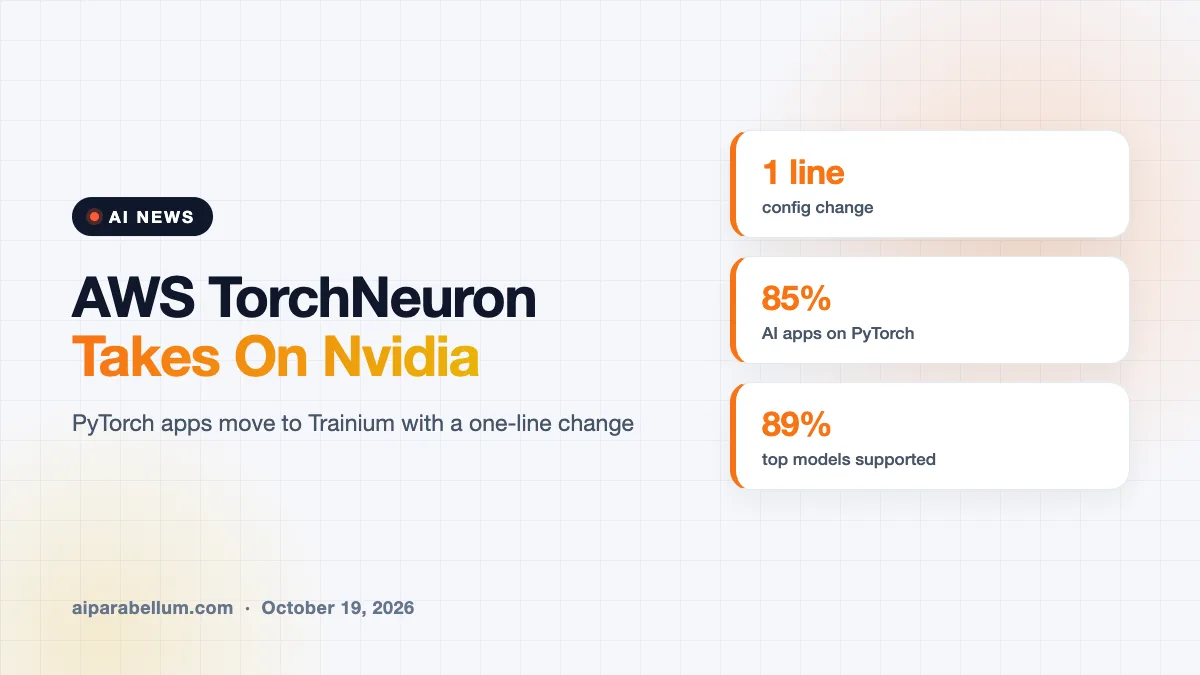
Amazon Web Services wants to make switching away from Nvidia almost effortless. Its new AWS TorchNeuron tool lets AI apps built with PyTorch run on Amazon’s own Trainium chips by changing a single line of configuration, with no code rewrite. It is Amazon’s most direct challenge yet to the software lock-in that keeps so many AI developers on Nvidia GPUs.
What AWS TorchNeuron Actually Does
AWS released TorchNeuron on October 19, 2026, and it enters public beta on October 20. Developers can install it with a standard pip command. It works as a PyTorch plugin that adds Trainium as a native device, so code written for other accelerators can run on Amazon’s hardware.
PyTorch is the free, open-source toolkit most developers use to build, train and run AI models. Amazon says about 85% of AI apps are written with it. Nvidia spent years making sure its CUDA software works smoothly with PyTorch, which made its GPUs the default choice for many teams.
TorchNeuron supports the features PyTorch developers already rely on. That includes eager execution, torch.compile and native distributed training tools like FSDP and tensor parallelism.
A Big Upgrade Over the Old Approach
Until now, running Hugging Face models on Trainium meant using a separate library called Optimum Neuron. It relied on a compiler-style setup with static shapes and frequent recompiles, which made the experience feel different from normal PyTorch work.
With TorchNeuron, Hugging Face says Trainium becomes “a device like any other” for its libraries. Transformers, Diffusers, Accelerate, PEFT and TRL now run on it directly, and Hugging Face recommends Neuron users switch to these libraries.
| Feature | Optimum Neuron (old) | TorchNeuron (new) |
|---|---|---|
| Top 100 text-generation architectures supported | 46% | 89% |
| Execution style | Lazy, compiler-style | Native eager mode plus torch.compile |
| Hugging Face libraries | Custom Neuron-specific code | Standard Transformers, Diffusers, PEFT and TRL |
| Saved checkpoints | Neuron-focused workflow | Standard checkpoints that load on any hardware |
Why TorchNeuron Takes Aim at Nvidia
Easy porting is not new on its own. PyTorch users can already move apps to AMD GPUs or Apple chips with a simple setting change. Amazon’s bigger argument is that moving to Trainium also puts startups on its full cloud platform.
AWS says Trainium handles both training and inference on the same chip. It claims that, combined with tight cloud integration, can save startups money even if its per-token price is not the lowest. The company points to voice AI firm Deepgram, which it says now processes 70% more audio per dollar after moving to Trainium.
Amazon is also going a step further. The company says it is contributing changes to PyTorch itself to remove code that ties the framework to specific chips. If that works, PyTorch could become less tilted toward Nvidia for everyone, not just Trainium users.
The Open Questions
There are reasons to stay cautious. PyTorch exists partly to hide hardware complexity, and pulling it away from Nvidia defaults could add configuration headaches. Some details also still need care on Trainium:
- Static shapes work best, so inputs may need padding to avoid recompiling.
- Some Transformers features, like asynchronous weight loading, are not yet supported.
- Performance tuning may still require Neuron-specific kernels for the best speed.
This push comes as rivals build their own silicon too, from Microsoft’s Maia chip to Nvidia’s growing family of open models like Nemotron 3.5 Super. Startups such as Tenstorrent’s open chips are chasing the same opening.
What This Means for You
If you build or fine-tune AI models, TorchNeuron could give you more room to shop around for compute. Here is how to think about it:
- Test before you switch. Since it is a public beta, try a small workload first and compare cost and speed against your current setup.
- Keep your code portable. Checkpoints saved on Trainium load on other hardware, so you are not locked in either way.
- Watch your total bill. Factor in storage, networking and engineering time, not just the price per chip hour.
Even if you never touch Trainium, more competition could push AI compute prices down over time. That would make AI coding tools and assistants cheaper to run. For hands-on help, see our guide to the best developer tools or browse our code assistant directory, and follow more updates on our AI news page.
Sources
This article is based on reporting from TechCrunch and the technical details in the Hugging Face blog on TorchNeuron support.
Conclusion
TorchNeuron is Amazon’s clearest attempt yet to break the habit of defaulting to Nvidia. By making Trainium a native PyTorch device and pushing PyTorch to be less tied to any one chip maker, AWS is attacking Nvidia’s software advantage rather than just its hardware. Whether developers follow depends on real-world cost and performance during the beta. Either way, more choice in AI compute is good news for anyone paying the bills.