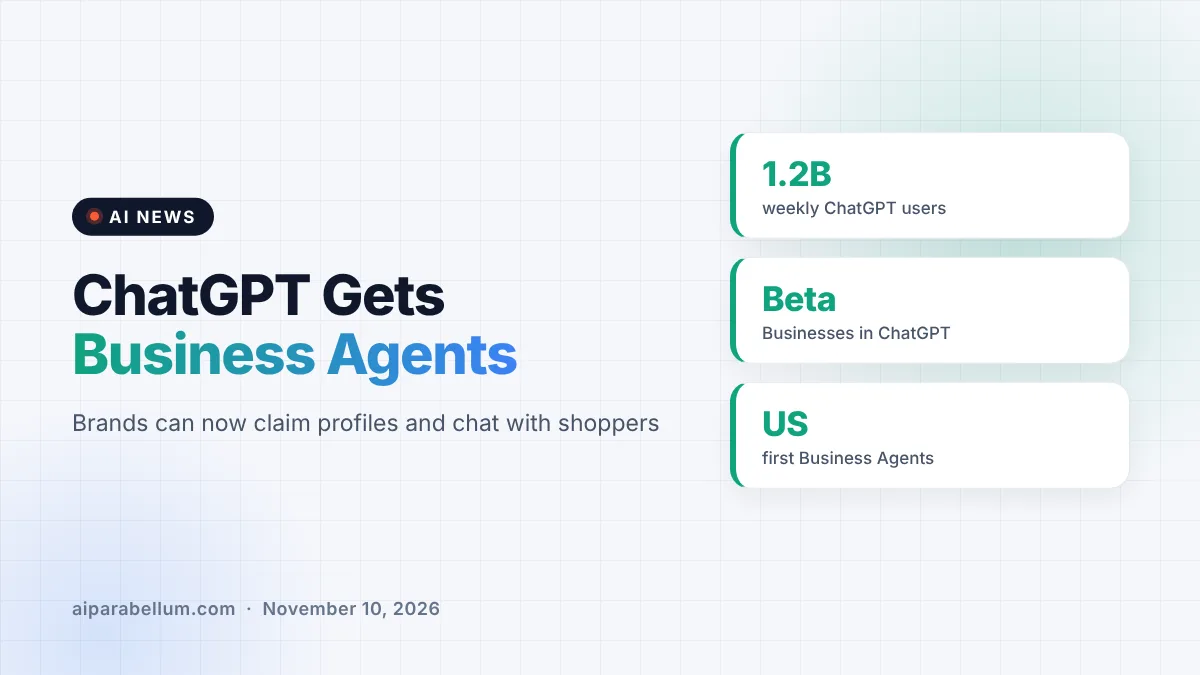
OpenAI is opening ChatGPT to businesses in a much more direct way. On November 10, 2026, the company launched Businesses in ChatGPT in beta, along with ChatGPT Business Agents: verified, brand-run chat agents you can talk to when a company shows up in an answer. Business Agents start with eligible ecommerce and online service businesses in the United States.
The launch has two parts. A tool called Business Hub lets companies claim and manage how they appear in ChatGPT, and Business Agents let them hold a separate, clearly labeled conversation with you about their products.
What ChatGPT Business Agents Actually Do
Picture asking ChatGPT to compare two pairs of running shoes. If one of the brands in the answer has set up a Business Agent, you can click through to its ChatGPT profile and start a chat with that agent. From there you can ask follow-up questions, like how two models differ or which one fits your needs.
OpenAI says the agent answers using the business’s own information. According to reporting on the launch, businesses can give their agent instructions and business context so it knows how to respond. That makes it closer to a smart storefront assistant than a neutral guide.
Kept Apart From Your Normal Chat
OpenAI stresses that these chats are clearly labeled and separate from your original ChatGPT conversation. The company also says they are distinct from ChatGPT’s own independent answers. In other words, the brand’s agent is not supposed to bleed into what ChatGPT tells you on its own.
Inside the New Business Hub in ChatGPT
Business Hub is the control panel behind all of this. Once a company claims and verifies its business, it can update key details and upload product feeds that include pricing and availability. OpenAI says this helps ChatGPT work from accurate, current information when people explore products.
Any eligible business located where ChatGPT is available can claim its listing. Existing OpenAI Enterprise customers and advertisers can go through their OpenAI representative instead. Shopify merchants can connect their store from Business Hub or from the Shopify admin, which speeds up verification.
Insights Without Sharing Your Chats
Business Hub also shows companies aggregated data about how people interact with them in ChatGPT. That includes:
- How often the business is mentioned in answers
- How many website clicks it gets from ChatGPT
- Discovery topics, meaning common themes in conversations where its website is cited
OpenAI says it does not share users’ conversations or Business Agent chats with businesses. Insights are only shown in aggregate, and only once there are enough conversations to meet certain privacy thresholds.
ChatGPT Business Agents at a Glance
| Feature | What it does | Who can use it now |
|---|---|---|
| Business Hub | Claim, verify and update a business profile and product feeds | Eligible businesses where ChatGPT is available |
| Engagement insights | Mentions, website clicks and discovery topics, in aggregate | Businesses that claim their profile |
| Business Agents | Brand-run chat agent reached from a ChatGPT answer | Eligible US ecommerce and online service businesses |
| Sponsored agents | Use a Business Agent as the landing spot for ChatGPT Ads | Businesses running ChatGPT Ads |
Where Ads Fit In
There is a clear advertising angle here. OpenAI says businesses can sponsor their Business Agent and use it as the destination for ChatGPT Ads, so a paid placement can lead straight into a chat with the brand. Sponsored placements are labeled and kept separate from ChatGPT’s responses, according to the company.
This builds on OpenAI’s recent push into advertising, including the ChatGPT ads expansion to dozens of countries. OpenAI says ChatGPT now reaches 1.2 billion people each week, which makes it a huge new storefront for brands.
How companies get verified is still a bit vague. OpenAI did not share specific verification methods, saying different businesses go through different processes.
What This Means for You
If you mostly use ChatGPT to research purchases, you will start seeing more ways to talk to brands directly. That can be handy, but keep in mind who you are talking to. A Business Agent works for the business, so treat it like a helpful salesperson, not an impartial reviewer.
- Check the label: a Business Agent chat is separate from your main ChatGPT conversation.
- Compare answers: use ChatGPT’s own response, or a tool like Perplexity or ChatGPT, to double-check claims.
- Watch for sponsored tags if an agent shows up through an ad.
If you run an online store or service in the US, this is worth a look now. Claiming your profile in Business Hub lets you fix outdated details and see how often ChatGPT mentions you. You can also compare it with other AI marketing tools and customer support agents you may already use.
Shopify sellers have the easiest path, since their eligible products already appear in ChatGPT through Shopify Catalog. Google is chasing a similar idea with its Universal Cart shopping push, so expect AI shopping to keep heating up.
What Comes Next for Businesses in ChatGPT
OpenAI calls this an early step. It plans to expand Businesses in ChatGPT and Business Agents to more markets and business categories over time. It also wants to build tools for organizations with more complex needs.
The company frames its goal as making ChatGPT more useful for decisions while giving businesses new ways to grow. For more updates like this, follow our latest AI news.
Sources
Primary source: OpenAI’s Businesses in ChatGPT announcement. Additional reporting from The Verge.
Conclusion
ChatGPT Business Agents turn ChatGPT into a place where brands can claim their profile, track how they show up and talk to shoppers directly. For users, the key is remembering that these agents speak for the business, even though OpenAI keeps them labeled and separate. For US online sellers, Business Hub is an easy first step worth taking early. Expect OpenAI to widen access to more countries and categories as the beta grows.