Hugging Face has released Carbon-X, an open DNA model that reads raw genetic sequences inside a normal chat and answers in plain English. The Carbon-X DNA model was built with researchers at Zhongguancun Academy in China and the Telethon Institute of Genetics and Medicine at the University of Naples Federico II in Italy. It’s aimed at researchers who want to know whether a DNA change is harmless or linked to disease, without sending sensitive data to a cloud service.
What the Carbon-X DNA Model Actually Does
You paste a DNA sequence into a chat message and ask a question about it. Carbon-X can predict whether a mutation is benign or pathogenic, spot regions that control gene activity, classify a sequence by the type of organism it came from, and predict the next bases in a sequence. Its answers can mix English explanations with DNA.
Earlier biology models tended to give researchers numbers or raw sequences back. Carbon-X puts DNA and language in the same conversation, so even people who aren’t trained bioinformaticians can ask questions about a sequence. Think of it as a chatbot that happens to speak fluent genetics.
The big idea here is simple: treat DNA as just another language a chat model can read, then let people talk to it like they talk to any assistant.
Key facts at a glance
| Detail | Carbon-X |
|---|---|
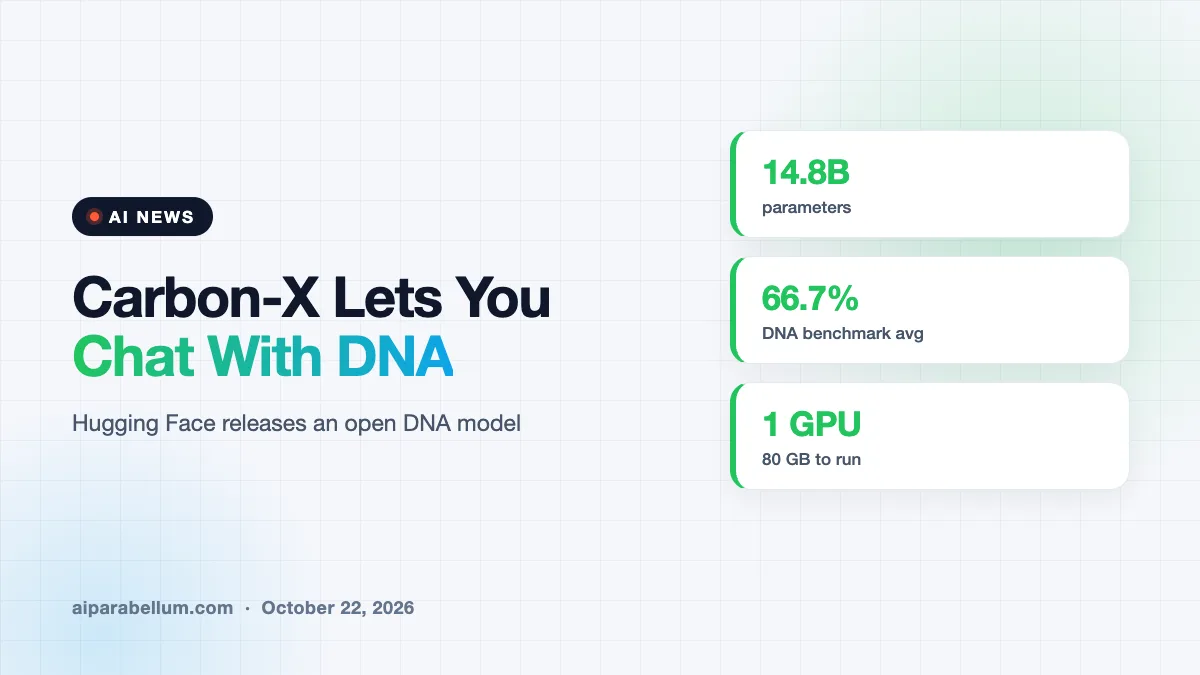
| Size | 14.8 billion parameters |
| Starting point | Qwen3-14B, extended with DNA tokens |
| Training data | About 302 billion tokens of DNA, biology text and English |
| How it reads DNA | Six letters (bases) per token |
| Context window | 40,960 tokens, about 49,000 DNA bases in training |
| Hardware | Fits on a single 80 GB GPU |
| Benchmark average | 66.7% across five DNA tests |
How Hugging Face Built Carbon-X
The team started with an existing language model and added a new set of DNA “words” to its vocabulary. Each DNA token covers six bases, so the model reads genetic code in small chunks while still using its normal vocabulary for English. Training first let only the new DNA pieces learn, then opened up the whole model.
After that, the model went through fine-tuning and reinforcement learning on DNA tasks with answers that code could check automatically. The DNA came from mammals, including humans, plus other animals, plants, fungi and protozoa. According to Hugging Face researcher Lewis Tunstall, the team left viruses out on purpose so the model would be harder to misuse.
Benchmarks and cost claims
Hugging Face says Carbon-X averages 66.7% across five DNA benchmarks, about 27 points better than the model it started from. The company says that puts it close to a leading frontier model while costing far less per problem. It also estimates that checking the 2.4 million uncertain variants in the ClinVar database would cost about $300 with Carbon-X, compared with tens of thousands of dollars or more on frontier models.
These are the company’s own numbers, and two of the five benchmarks were built by the team itself. Independent tests will matter before anyone treats the results as settled.
Why Running the DNA Model Locally Matters
Genetic data is about as personal as data gets. Many research teams face strict limits on uploading patient sequences to commercial AI services, which is why the developers kept the model small enough to run on a single GPU. When you run it on your own machine, your sequences don’t go to Hugging Face or anyone else.
That’s a different trade-off from big cloud models, which may be more capable but require sending data out. If you’ve followed the push toward on-device AI models, Carbon-X is the same idea applied to biology.
Limits You Should Know About
Hugging Face is upfront that Carbon-X is a research starting point, not a medical tool. It has not been clinically validated, and the developers say it hasn’t been tested yet with real lab experiments. Here are the main weak spots the team lists:
- It can miscount bases or mix up positions in long sequences, so exact edits are better done in code.
- It may guess at what a sequence is when you give it too little context.
- Splice-site and histone-mark questions remain weak, with scores near 30% to 35%.
- It reads and explains DNA but was not trained to design new sequences.
- You can’t upload a full human genome, only chunks of roughly 50,000 bases at a time.
It also ships with a ready-made skill for coding agents like Claude Code and Codex CLI, so an assistant can hand DNA questions to Carbon-X. If you’re curious about other AI research tools, this is one of the more specialized options to appear this year.
What This Means for You
Most people won’t download a 15-billion-parameter genetics model this week. Still, Carbon-X shows where open AI is heading: smaller, focused models that do one hard job well and keep your data private. Here’s how to think about it:
- If you’re a researcher, try it on variants you already understand before trusting it on new ones.
- If you’re a patient, don’t use it to read your own DNA results; talk to a genetic counselor instead.
- If you’re a developer, you’ll need serious GPU hardware, and the custom tokenizer won’t run on llama.cpp.
- Watch for outside benchmarks and lab results, which will show whether the claims hold up.
You can find Carbon-X alongside other open models on the Hugging Face hub, and tools like Hugging Chat show how far the platform’s chat tools have come. For more healthcare-focused AI coverage, browse our healthcare AI tools section or the latest AI news updates.
Sources
Primary source: Hugging Face’s Carbon-X model card. Additional reporting from Wired.
Conclusion
Carbon-X is a notable step toward AI that can talk about DNA as easily as it talks about email. It’s open, small enough to run on one GPU, and designed to keep sensitive genetic data private. The benchmark numbers are promising but come from the developers themselves, and the model has not been checked against real lab work. For now, treat it as a research helper that can point scientists toward the right questions, not a tool that gives medical answers.