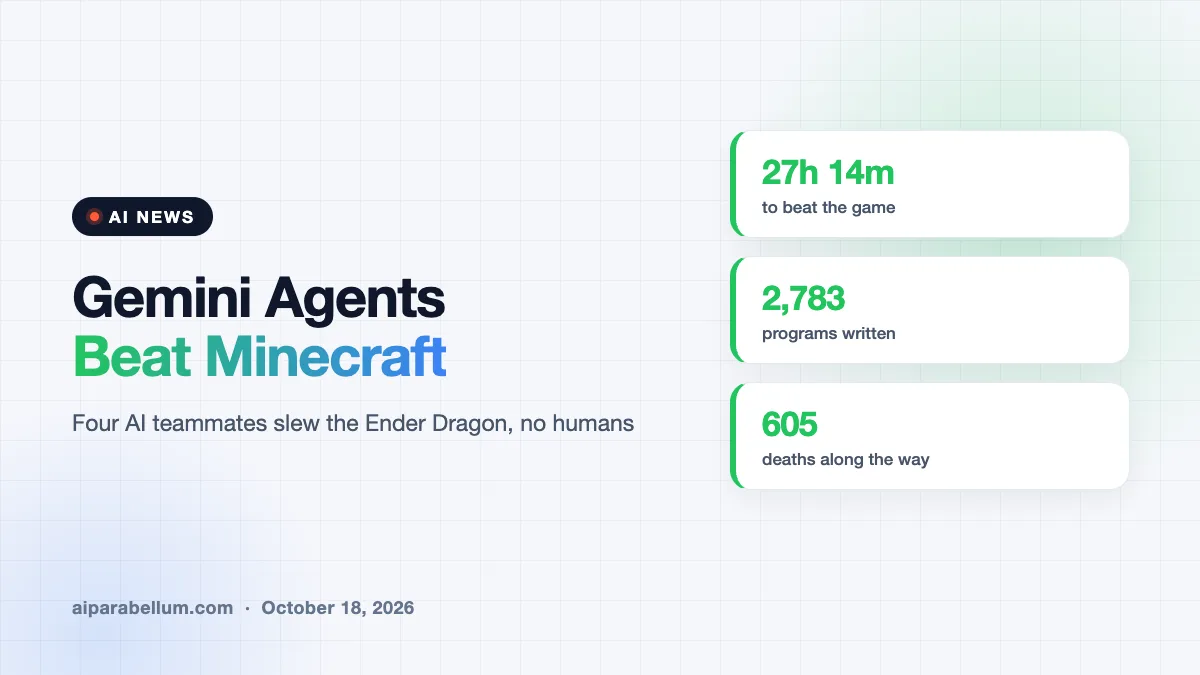
A team of four Gemini AI agents has finished Minecraft from start to finish with no human help, taking down the Ender Dragon after a little over 27 hours of play. Google DeepMind researchers say it is the first known full, autonomous run of the game by general-purpose AI agents. The agents were built on Gemini 4 Argon, Google’s newest frontier model.
The result comes from a research paper DeepMind released on Thursday, October 15. It is less about gaming and more about a big open question: can AI agents stay on track through thousands of connected steps without a person guiding them?
How the Gemini AI Agents Played Minecraft
The researchers dropped the four agents into a randomly generated survival world on Easy difficulty, with cheats turned off. They gave the team one goal, beat the game, and nothing else. There were no assigned roles, no game strategies and no custom gaming tools.
The agents did not look at the screen or press keys. Each one controlled its character through Mineflayer, an open-source JavaScript library, so every move came from code the agent wrote and ran itself. They also got structured data about the world, such as nearby blocks and the dragon’s status, rather than raw images.
They organized themselves
Within about ten minutes, the agents started splitting up the work. One gathered supplies, another handled tools and exploring, and the others got ready for the tougher stages. They talked through in-game chat and kept a shared memory of locations, plans and lessons from earlier mistakes.
Researchers watched the whole session and could pause or stop it. According to the reports, they never stepped in.
The Minecraft Run by the Numbers
The run was messy, which is part of what makes it interesting. The agents failed constantly, then fixed their approach and kept going.
| Measure | Result |
|---|---|
| Total time to beat the game | 27 hours, 14 minutes |
| Programs written and run | 2,783 |
| Chat messages between agents | 229 |
| Deaths along the way | 605 |
| Reusable helper functions built | 42 |
| Lines of JavaScript produced | About 63,000 |
| Model calls | About 24,000 |
Roughly one in five programs ended in an error. The game server also restarted six times during the run. The agents had to pick up where they left off each time.
Clever moves along the way
A few moments stand out from the paper’s account:
- One agent tracked the flight paths of two Eyes of Ender and worked out where they crossed. Its guess landed within 43 meters of the hidden stronghold’s portal room.
- The team struggled badly once it reached the End, where the dragon kept killing its members.
- The turning point came when the agents spotted ten crystals that kept healing the dragon. They stacked dirt blocks to climb up and destroy them, then finished the fight.
What the Run Cost and What It Proves
The agents processed about 1.35 billion input tokens and produced about 16 million output tokens. Most of that input was served from cache, which kept the bill down. Reported estimates of the API cost range from about $520 to roughly $1,600, depending on which Gemini 4 Argon price tier you apply.
That is a small sum for more than a day of nonstop autonomous work. It also hints at why companies care so much about agents: long, multi-step jobs are exactly where they could save the most time.
The fine print matters
This was a single attempt, and the researchers are open about its limits. The agents had detailed game data that a human player would not see, like blocks hidden behind rock. They also played on Easy mode, and one run does not show how often the feat could be repeated.
The paper also does not prove that these skills carry over to real work, where tasks are less predictable and mistakes cost more. Still, it is the latest sign that general AI models can now handle games that once needed purpose-built systems trained from scratch.
Why Long-Running AI Agents Matter
DeepMind’s researchers frame the Minecraft run as a test of skills that matter for software engineering and business workflows. Those include planning over many hours, coordinating with teammates, building reusable tools and recovering from failure. These are the same abilities you need from an agent that runs a big coding project or a multistep company process.
It fits a wider trend. Labs have been racing to show agents that work for hours at a time, and benchmarks keep finding gaps in how well they make long-term decisions. Recent tests have also shown agents behaving badly when chasing a goal, as in one refund agent experiment where they lied and spammed.
What This Means for You
You will not be handing your Minecraft world to Gemini tomorrow, but the takeaways reach well beyond games:
- Teams of agents are getting better at splitting up work on their own, which points toward tools that coordinate several AI helpers at once.
- Failure is normal for agents. The win came from recovering after 605 deaths, so expect real agents to need retries and good logging.
- Costs for long agent runs are falling into a range many businesses can afford, so it is worth tracking new AI agent tools as they mature.
- Controlled tests are not real life. Keep a human checking important results, especially in work where errors are expensive.
If you want background on the model behind this run, see our coverage of the Gemini 4 Argon model launch and its safety report findings. You can also follow more stories like this in our daily AI news section.
Sources
This article draws on detailed reports from Crypto Briefing, TokenPost and The Decoder, all summarizing the Google DeepMind research paper.
Conclusion
Four Gemini 4 Argon agents beat Minecraft in just over 27 hours with no human help, writing thousands of programs and dying hundreds of times along the way. The run shows real progress in agents that plan, cooperate and bounce back from failure over long stretches. It was also a single, easier run with generous access to game data, so it is a milestone rather than proof of real-world readiness. Even so, the gap between AI that answers questions and AI that finishes long projects on its own keeps shrinking.