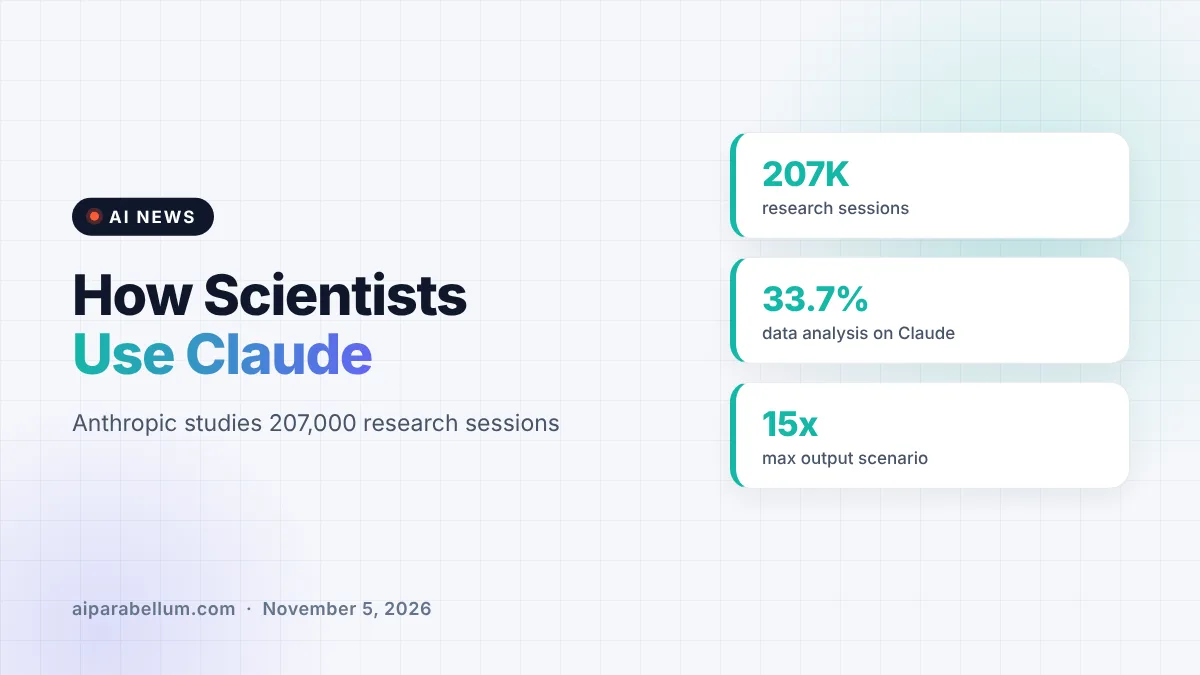
Anthropic has released a new study on how scientists use Claude for research, based on more than 207,000 research sessions on Claude and Claude Code. The short version: researchers lean on AI most for analyzing data and writing, and much less for coming up with ideas or collecting data. The report also sketches how much faster science could move if AI keeps improving.
What the Study of Scientists Using Claude Measured
The team looked at 207,049 sessions on consumer plans between August 2 and September 30, 2026. About 128,900 came from the regular Claude chat and Cowork apps, and about 78,100 came from Claude Code, the agentic coding tool that reads and runs code on a user’s files.
Anthropic says it used privacy-preserving methods for this. A language model labeled each session only with a field, subfield and research task from a fixed list, and those labels were the only thing the researchers kept. No datasets, hypotheses or unpublished findings were stored, and results are reported only in groups large enough to protect individual accounts.
The task list comes from a taxonomy called SciNet. It covers 7,262 research tasks across 34 fields and 318 subfields, from drafting manuscripts to very narrow jobs like predicting how a material absorbs light.
Which Fields Use Claude the Most
Bigger fields generally produce more sessions, but some punch well above their size. The formal sciences, meaning computer science, mathematics and statistics, use Claude far more than their share of the world’s researchers would predict. Lab-heavy fields such as chemistry, plus medicine, where researchers spend a lot of time with patients, use it less.
The gap is especially wide on Claude Code. Computer science makes up only 4.3% of the world’s researchers but accounts for 32.7% of Claude Code research sessions. Artificial intelligence and machine learning alone, at about 1.2% of researchers, accounts for 15.2% of those sessions.
Top fields on regular Claude
- Computer science: 11.9% of sessions
- Engineering: 8.4% of sessions
- Medicine: 7.7% of sessions
- Computational subfields such as computational biology and neuroscience are strong adopters too
What Researchers Actually Ask Claude to Do
Data analysis is the biggest use by far, and writing comes close behind on the chat side. Idea generation and data gathering get much less attention, even though scientists say those matter most. Here is how session share compares with the share of time researchers usually spend on each type of work.
| Task type | Claude sessions | Claude Code sessions | Researcher time |
|---|---|---|---|
| Data analysis | 33.7% | 48.1% | 27.6% |
| Writing and communication | 32.0% | Not given | 16.0% |
| Data gathering | 11.5% | 11.9% | 28.6% |
| Ideation and hypotheses | 4.2% | 2.1% | 7.1% |
A companion survey of 528 scientists, mostly in the life and health sciences and already using AI, told a similar story. They ranked ideation first and data gathering second for producing important results, yet both show up less in their AI use. Anthropic suggests the reasons differ: much data collection is physical, while scientists may prefer to generate ideas themselves or see AI as weaker at that.
Claude Science handles harder work
The report also looked at Claude Science, which links Claude to many research tools and databases. More than half of its sessions come from biology and biomedical sciences, and ideation makes up about 8% of its use, roughly double its share on regular Claude. Over 70% of Claude Science sessions run with a high degree of AI autonomy, compared with 23.7% on Claude and 64.1% on Claude Code.
How Much Faster Could Research Get?
Anthropic built a score for how well AI can, in theory, handle each research task. The tasks in the top fifth on that score get two to four times as much Claude use as researcher time would predict, while mostly physical tasks in the bottom fifth get very little. In plain terms, scientists seem to use AI where it already works well.
Using a simple model, the company sketches a few scenarios. If today’s capabilities were widely adopted, output in some fields could roughly double. If AI could do all non-physical research work, computer science and statistics could see up to a 15-fold increase, while chemistry and biology would rise about three- or fourfold because lab work stays a bottleneck.
About 40% of surveyed researchers expect AI to carry out full research projects on its own by 2030. Anthropic also flags risks, including less human oversight of dangerous research and changes to what research careers look like.
What This Means for You
If you use AI for research, school or analysis at work, this study is a useful reality check on where tools like Claude AI help most today.
- Lean on AI for data cleaning, analysis and code, where usage and capability are both highest.
- Use it for drafts and summaries, but check every claim before it goes into a paper or report.
- Treat AI brainstorming as a starting point, since even heavy users still do most idea work themselves.
- Try specialized science tools for niche domain tasks, as they appear to handle deeper work than general chat.
For practical tips, see our guide on Claude for coding and our roundup of AI research tools. You can also read how Claude helped design protein binders and map a bacterial vault particle, or catch up in our AI news hub.
Sources
Primary source: Anthropic’s report on how researchers use Claude.
Conclusion
Anthropic’s study gives one of the clearest pictures yet of how scientists use AI in daily work. Claude is a heavy-duty helper for data analysis, code and writing, especially in computer science and math, but it plays a smaller role in lab work and big-picture ideas. Specialized tools like Claude Science hint at where that could change. Whether research output really doubles or jumps much further will depend on how fast AI improves and how widely labs adopt it.