OpenAI has published a National Community Compact that sets out what towns can expect when the company builds an AI data center, which it now calls a compute campus, near them. The company says it will cover its full power costs, publish water and electricity use, and stop asking public officials to sign broad NDAs. Alongside the compact, it released a policy blueprint urging federal, state and local lawmakers to apply similar rules to every developer.
What the OpenAI Community Compact Promises
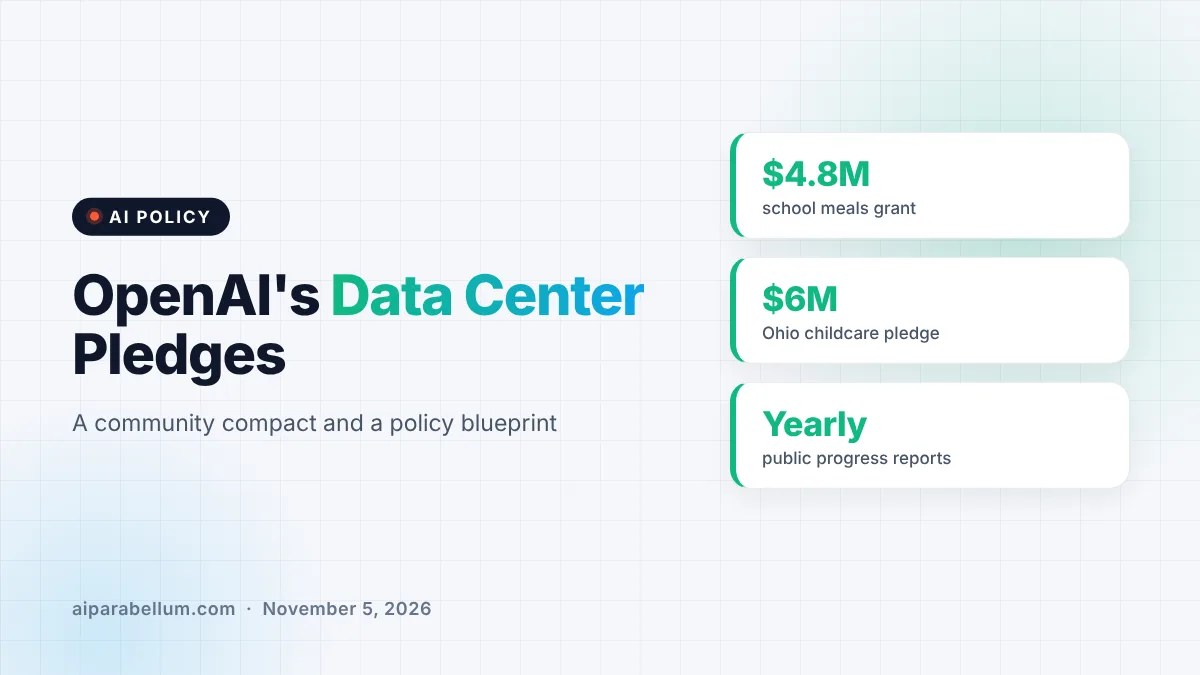
The compact applies to future campuses that OpenAI owns and operates. Each one will get its own local version, shaped by residents, but every version shares a common core. OpenAI says it will engage residents early enough for their input to change plans, give them a local point of contact for the life of the campus, and report publicly every year on how it is doing.
The shared commitments fall into three groups:
- Energy costs: OpenAI says it will pay the full cost of the electricity it uses and the grid upgrades needed to serve it. It also promises financial assurances before major spending starts, so other utility customers are protected if a project shrinks, slips or gets canceled.
- Local resources: every campus gets a water plan that favors closed-loop or low-water cooling, plus published site-level water and power use. Construction plans and independent noise studies come out before operations begin and every year after.
- Jobs and investment: the company will publish expected job counts, work with unions and training providers, report on hiring and apprenticeships, and invest in local priorities residents help pick.
One of the more pointed promises is about secrecy. OpenAI says it will not use non-disclosure agreements with public officials, apart from narrow protections for security details, trade secrets and competitively sensitive information.
Real examples from Georgia and Ohio
OpenAI points to two places where this approach has already played out. In Effingham County, Georgia, residents helped shape a $4.8 million grant that pays for free school meals for all 14,000 students in the county. In Pike County, Ohio, families named childcare as a top need, which led to a joint $6 million commitment from OpenAI and SB Energy.
OpenAI Data Center Policy Blueprint
The second document goes beyond OpenAI’s own sites. The company argues that voluntary pledges are only a starting point and that families should get the same basic protections no matter who builds near them. It asks policymakers at every level to write clear rules for the whole industry.
| Blueprint area | What OpenAI proposes |
|---|---|
| Accountability | Public reporting on water, energy, noise and hiring for compute campuses |
| Secrecy | Narrow limits on when developers can require officials to sign NDAs |
| Tax incentives | Public terms, measurable commitments and a way to claw back benefits |
| Local suppliers | Developers share purchasing plans early so local firms can bid |
| Workforce | Hiring forecasts that unions and colleges can use to train residents |
The tax incentive idea stands out. If a state or town gives a developer a break, OpenAI says the terms should be public, tied to measurable goals, and recoverable if the developer falls short.
Why OpenAI Is Making Data Center Pledges Now
The timing is not subtle. According to Bloomberg Law, the commitments landed two days after US voters backed candidates at many levels of government who support limits on data centers and closer oversight of AI. Local fights over power bills, water and noise have become a real obstacle for the AI buildout.
OpenAI frames the compact as the next step in work it started in January with its Stargate Community commitments. It also follows the company’s Grid Protectors program, which lets future campuses cut power use when the grid is under stress. Taken together, the company is trying to show it can grow without pushing costs onto neighbors.
Our take: putting numbers, reports and a no-NDA rule in writing gives residents something concrete to check, which is more than most data center pledges offer.
What This Means for You
If you live near a planned AI campus, these documents give you a checklist to hold any developer to, not just OpenAI. If you mostly use tools like ChatGPT at work, the bigger story is that the cost and politics of computing power now shape how fast AI products can grow.
- Ask local officials whether a proposed data center will publish water, power and noise data each year.
- Check whether any tax break comes with public terms and a way to recover the money.
- Watch for annual reports from OpenAI campuses to see whether the promises hold up.
- Follow state rule-making, since the blueprint is aimed at lawmakers as much as at residents.
The open questions
The compact covers only campuses that OpenAI owns and operates, not every facility that runs its models through partners. Pledges are also only as good as the reporting behind them. The first annual reports will show whether the company follows through, and whether lawmakers turn the blueprint into binding rules, a debate that echoes recent calls for binding AI rules elsewhere.
For more coverage of how AI companies are handling oversight, see the FTC safety probe story and our full AI news feed.
Sources
Primary source: OpenAI’s announcement of the National Community Compact and Compute Campus Policy Blueprint. Additional reporting from Bloomberg Law and Unite.AI.
Conclusion
OpenAI is betting that clear, checkable promises will ease growing local resistance to AI data centers. Its compact commits the company to pay its own power costs, publish resource use and drop broad NDAs with officials at campuses it owns. The policy blueprint then asks lawmakers to make similar rules apply to everyone. Whether that wins over skeptical communities will depend on the reports that follow, not the pledges themselves.