Meta has acquired Conductor, an AI coding startup whose app lets developers run several coding agents side by side in separate workspaces. The Conductor acquisition gives Meta a team that has spent the past year building tools for agent-driven software work. Meta confirmed the deal but has not shared the price or any other terms.
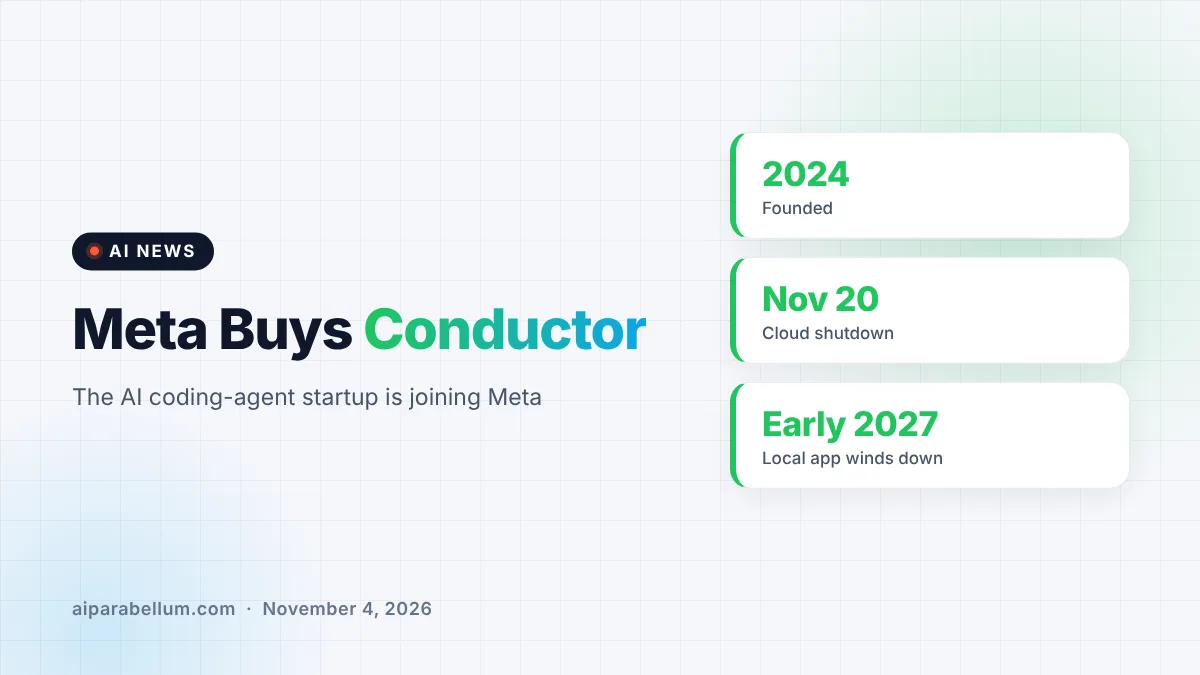
For current Conductor users, the news comes with a timeline. The cloud version shuts down this month, and the local app will be phased out in early 2027 while the team works on something new inside Meta.
What Conductor Built Before the Meta Deal
Conductor was founded in 2024 and launched its main product in July 2025. Its idea was simple to explain but hard to pull off: instead of chatting with one coding assistant, you hand out pieces of a project to a group of agents that work in parallel. Each agent gets its own compartmentalized workspace, so they can tackle different parts of the code at the same time.
The startup did not build its own AI models. The agents inside Conductor come from major labs such as Anthropic and OpenAI, so the app works as a control room for tools like Claude and Codex. Developers could run those agent teams in the cloud, on their own Mac, or start them from a phone.
Founder and CEO Charlie Holtz announced the news on the company’s site, writing that Conductor has “big, crazy plans for the next interface.” He also said he was looking forward to working with Alexandr Wang, Meta’s chief AI officer, and Nat Friedman, who leads product at Meta Superintelligence Labs.
Key Facts at a Glance
| Detail | What We Know |
|---|---|
| Buyer | Meta (deal confirmed, terms not disclosed) |
| Startup | Conductor, founded in 2024 |
| Product launch | July 2025 |
| What it does | Runs multiple AI coding agents in parallel workspaces |
| Cloud shutdown | Read-only Nov 13, fully off Nov 20, 2026 |
| Local app | New models and critical fixes until early 2027 |
How the Conductor Acquisition Fits Meta’s AI Push
Meta spent much of the past year trying to catch up with rivals in AI products. In August it launched Muse Code, its own coding agent, and the company says its Muse agents have passed 10 million users. You can read more about that broader effort in our coverage of Meta’s frontier push.
Buying Conductor adds people who have thought hard about how developers manage many agents at once. That matters because the coding race is shifting from single assistants to coordinated agent teams. OpenAI made a similar move this week when it agreed to acquire Pierre Computer to strengthen Codex.
Conductor is also not Meta’s first AI deal this year. The company earlier bought Moltbook, a viral agent platform, and it keeps pouring money into its AI plans, as our report on Meta’s AI spending shows.
What Happens to Conductor Users Now
The company has laid out a wind-down plan on its announcement page and changelog. New users can no longer sign up or download the app. Existing free users cannot upgrade, but people already on the pro plan keep pro features at no charge.
Here is the schedule current users need to know:
- November 13, 2026: Conductor Cloud becomes read-only.
- November 20, 2026: Conductor Cloud shuts down, and the company begins deleting cloud user data.
- Early 2027: the local Mac app stops getting new models and critical bug fixes and starts winding down.
- At final shutdown: Conductor says it will delete all remaining user data.
Conductor also says it has never sold or trained on user data and still will not. Holtz has teased that Meta will have something new for Conductor fans to use early next year, but no details are public yet.
What This Means for You
If you use Conductor Cloud, act before November 20. You can move a cloud workspace and its chats to your Mac by right-clicking it and choosing Transfer to local. To grab a full copy of your data, go to Settings, then Account, then Export data.
If you rely on the local app, you have a bit more time, but it is smart to plan your next tool now. A few practical steps:
- Export your Conductor data this week, even if you plan to keep using the local app.
- Test an alternative workflow, such as running Claude Code or Codex directly in your own git worktrees.
- Watch for Meta’s follow-up product early next year if you liked the parallel-agent approach.
For developers comparing tools in the meantime, our guide to Cursor and Replit is a good place to start. You can also follow the latest moves in this space on our AI news page.
Sources
Primary source: Conductor’s announcement and Conductor changelog. Additional reporting from TechCrunch.
Conclusion
Meta’s purchase of Conductor is a small deal on paper, but it signals how seriously the company is chasing the AI coding market. The startup’s parallel-agent approach fits the direction the whole industry is moving, where developers manage teams of agents instead of a single assistant. Conductor users should export their data and move cloud workspaces before November 20. After that, the big question is what Meta and the Conductor team ship early next year.