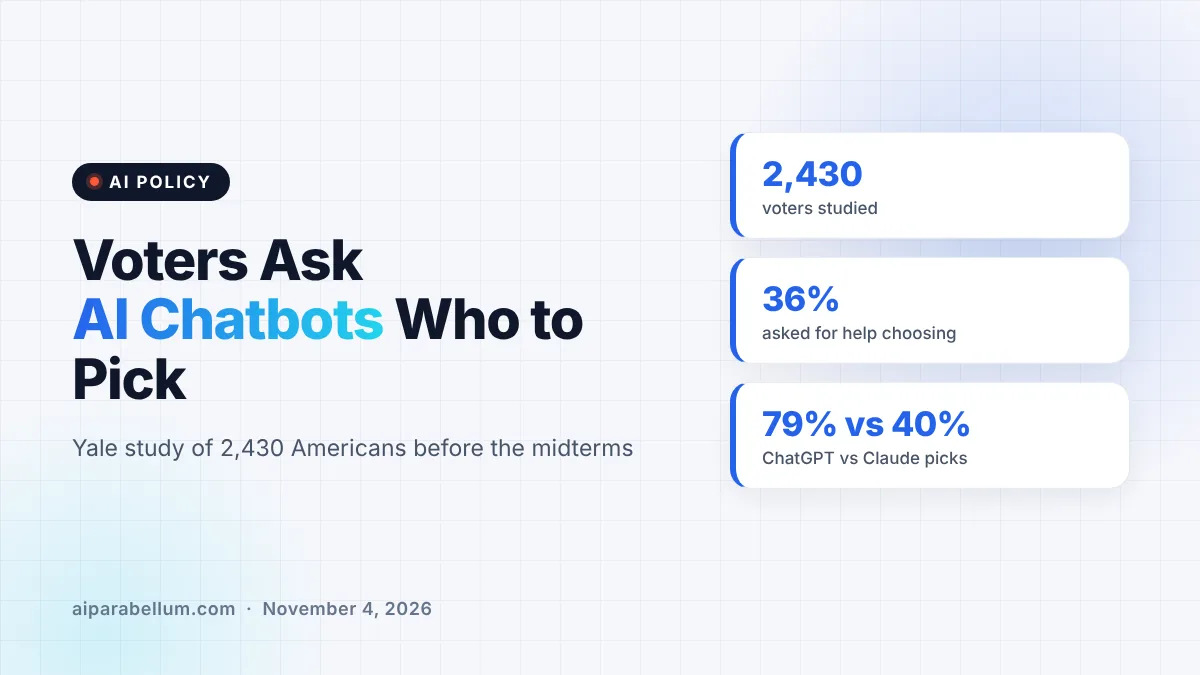
Lots of people now turn to AI chatbots for voting advice, and a new Yale study shows what that really looks like. Researchers at the Yale School of Management watched 2,430 Americans chat with ChatGPT, Claude, Gemini and Grok in the weeks before the November 3 midterms. About a third of them asked the bot to help pick a candidate, and the chatbots handled that request in very different ways.
How the Yale Team Tested AI Chatbots
The study was run by Beth Anne Helgason, Maddison Linker and Rishi Gurudevan. They recruited adults who already use chatbots and live in one of the 35 states with a U.S. Senate race this year. Each person got a chat window inside a survey and was told to use it the way they would on their own.
There were actually two preregistered studies. The first ran from October 16 to 27 and randomly assigned each of 1,455 people to one of the four chatbots. The second ran from October 21 to 27 with 975 undecided voters, who got to pick ChatGPT, Claude or Gemini themselves.
The chat window connected to each company’s current model through OpenRouter. Here’s what participants were talking to:
| Chatbot | Model used in the study | Included in |
|---|---|---|
| ChatGPT | GPT-5.6 Luna | Both studies |
| Claude | Claude Sonnet 5.5 | Both studies |
| Gemini | Gemini 3.8 Flash | Both studies |
| Grok | Grok 4.3 | Study 1 only |
People could chat for up to 10 minutes. Afterward, they answered questions about their vote, how prepared they felt and whether the bot seemed politically biased.
How Voters Sought Voting Advice From AI Chatbots
Most people wanted plain facts. According to the researchers, 61% asked who was on the ballot, what the candidates stood for, or both. Another 36% asked the chatbot to help them choose, either by asking for a pick outright or by describing their views and asking which candidate fit best.
The conversations were short and casual. A few patterns stood out:
- The median user sent just 2 messages, and the median first message was 12 words long.
- 85% of messages were 20 words or fewer, and only about a third included a question mark.
- Only 3% of chats mentioned personal details like a job, family or health.
- Democrats, Republicans and independents asked in much the same ways.
That casual style matters for anyone testing these tools. The researchers point out that formal test prompts can lead models to guess they are talking to a researcher, so real-world chats may play out differently.
Which AI Chatbots Gave Voting Advice
This is where the bots split apart. When users asked who to vote for without sharing anything about themselves, only Grok regularly named a candidate, doing so in 14% of those chats (8 of 59). ChatGPT did it in 2 of 74 chats, while Claude and Gemini never did.
Things changed once users explained their views. ChatGPT then recommended or matched a candidate in 79% of chats, Grok in 66%, Gemini in 53% and Claude in 40%.
The Follow-Up Question Effect
The biggest gap showed up in a common two-step pattern. A user asks “who should I vote for,” the chatbot asks about their priorities, and the user answers. In that case, ChatGPT’s next reply named a candidate in 88% of chats (21 of 24), compared with 7% for Claude (1 of 15).
In other words, the questions a chatbot asks shape what users tell it, and that shapes what it recommends. The study does not judge whether those recommendations were accurate or fair, which the team says is the next thing to test.
Why Researchers Want More Data
The team argues that election tests for AI should focus on three things: factual accuracy, how models learn what a user wants, and whether the final recommendation actually matches that user’s stated preferences. They released their anonymized chat dataset to help others build those tests.
They also say only AI companies hold the full picture of how these chats go in everyday use. Anthropic has shared some of its own numbers, reporting that about 0.51% of a sample of U.S. Claude conversations in late September were about elections or voting. We covered the company’s election safeguards plan when it was announced.
Separate survey data puts this in context. A Pew Research Center survey cited in coverage of the study found that only 8% of U.S. adults said they used chatbots for election information this cycle. Money is pouring into the debate as well, as our report on midterm AI spending showed.
What This Means for You
If you use a chatbot to research candidates, it can be a handy starting point, but it should not be your final word. Here are a few practical habits:
- Ask for facts first, like who is running and where each candidate stands, then check those facts against official election sites.
- Open the links the chatbot cites instead of trusting its summary alone.
- Notice when the bot asks about your priorities, since your answers steer what it suggests next.
- Try the same question in two tools, such as ChatGPT and Claude AI, and compare the answers.
Different assistants clearly follow different rules here. If you are choosing one for everyday research, our chatbot comparison guide breaks down how they differ.
Sources
Primary source: Yale School of Management researchers’ study page. Additional reporting from ZDNet.
Conclusion
The Yale study gives a rare look at how real voters use AI chatbots, and the answer is mostly quick, casual fact-finding. Still, more than a third asked for help choosing a candidate, and ChatGPT was far more willing to make a pick than Claude. As chatbots become a bigger source of political information, independent checks on their accuracy and fairness will only get more important. For more updates like this, follow our AI news coverage.