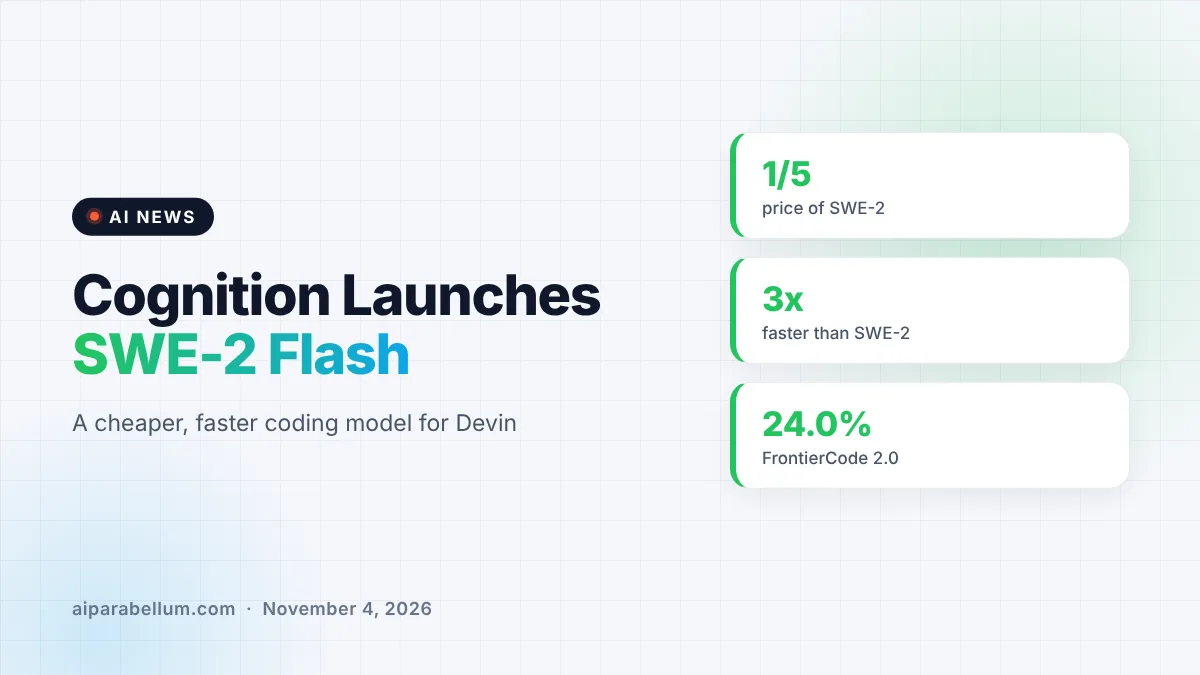
Cognition has released SWE-2 Flash, a new coding model built to handle everyday software work at a lower cost and higher speed. The SWE-2 Flash coding model is available now in Devin Desktop and the Devin CLI, and Cognition says it costs one-fifth as much as its larger SWE-2 model while running about three times faster. The company is also keeping the model’s weights private for now, citing cybersecurity risks.
What SWE-2 Flash Is
SWE-2 Flash is a smaller sibling of SWE-2, which Cognition calls its most advanced coding model. The idea is simple: many tasks that software agents handle don’t need the biggest model available. Things like code review, small features, automations and documentation updates can often be done well by a lighter model.
Cognition describes SWE-2 Flash as a “fully American coding model.” That phrase matters because the company built it on top of Inkling-Small, a base model from Thinking Machines, a US lab. Inkling-Small has 276 billion total parameters, with 12 billion active at a time.
Key facts at a glance
| Detail | SWE-2 Flash |
|---|---|
| Maker | Cognition |
| Base model | Inkling-Small from Thinking Machines |
| Base model size | 276B total, 12B active parameters |
| Price vs. SWE-2 | About one-fifth |
| Speed vs. SWE-2 | About 3x faster |
| Where to use it | Devin Desktop and Devin CLI |
| Open weights | No, not publicly for now |
How Cognition Trained SWE-2 Flash
For the first time, Cognition added a mid-training stage before reinforcement learning. In that stage, the team fed the base model a few trillion tokens of scientific articles, blogs, code and other material. Training ran in three phases, so the model saw the rarest, highest-quality data near the end.
After that came large-scale reinforcement learning. Cognition says most of the gains came from better and more varied practice tasks, not big changes to the training recipe. The team says it audited task instructions, environment setups and checkers, and added new task types to build broader problem-solving skills.
Benchmark jumps over the base model
Cognition shared a few numbers that show how far the extra training moved the model. These are the company’s own results, so independent tests will tell the fuller story.
- Terminal-Bench 4.0: from 0.9% for the base model to 20.0%
- FrontierCode 2.0: from 3.2% to 24.0%
- ExploitBench, a cybersecurity test: from 11.3% to 34.8%
Cognition also claims SWE-2 Flash beats every American open-weight model on leading evaluations, including models about three times its size.
Why SWE-2 Flash Weights Stay Private
Cognition says it deliberately trained SWE-2 Flash for cybersecurity work to help defenders. The catch is that the same skills could help attackers too. The company points to a recent surge in cyberattacks as the reason it isn’t publishing the weights openly yet.
Instead, Cognition says it is building a program to share the weights securely with trusted industry partners and research labs. That would let companies and governments run and fine-tune the model on their own infrastructure, including on-premises. The company says more details are coming in a few weeks.
This approach sits between fully open models and closed models behind an API. It’s a growing debate across the industry, and it echoes the concerns we covered when AI agent security became a funding magnet this year.
What This Means for You
If you already use Devin, you can try SWE-2 Flash today for routine coding jobs. Cheaper, faster models are a good fit for tasks you run often, where saving money and time adds up quickly.
- Use SWE-2 Flash for code review, small features, docs updates and automations.
- Keep the larger SWE-2 for hard, multi-step problems where quality matters most.
- Treat the benchmark numbers as company claims until outside testers confirm them.
- If you need on-premises control, watch for Cognition’s weight-sharing program details.
If you are comparing tools, it helps to see how other coding assistants work in practice. Our guide on using Cursor AI covers working inside a real project. You can also read how Claude Code helped on the Linux kernel, or learn how to explain legacy code with an AI assistant.
The Bigger Shift Toward Small Coding Models
Cognition’s launch reflects a wider trend. Coding agents now run many tasks in the background, and paying top-model prices for every small job gets expensive. Smaller, tuned models let teams spread work across cheaper options without giving up too much quality.
The “American” framing is also worth noting. Many strong open-weight coding models today come from labs outside the US, and some companies want a domestic option for sensitive work. For more launches like this one, browse our latest AI news coverage.
Sources
Primary source: Cognition’s SWE-2 Flash announcement.
Conclusion
SWE-2 Flash gives Devin users a faster, cheaper model for the everyday coding work that makes up much of a developer’s day. Cognition’s own benchmarks show big gains over its Thinking Machines base model, though outside testing will matter. The decision to hold back open weights over cyber risks, while planning controlled access for partners, is the part to watch next. For now, it’s a practical option for anyone who wants to cut agent costs without switching platforms.