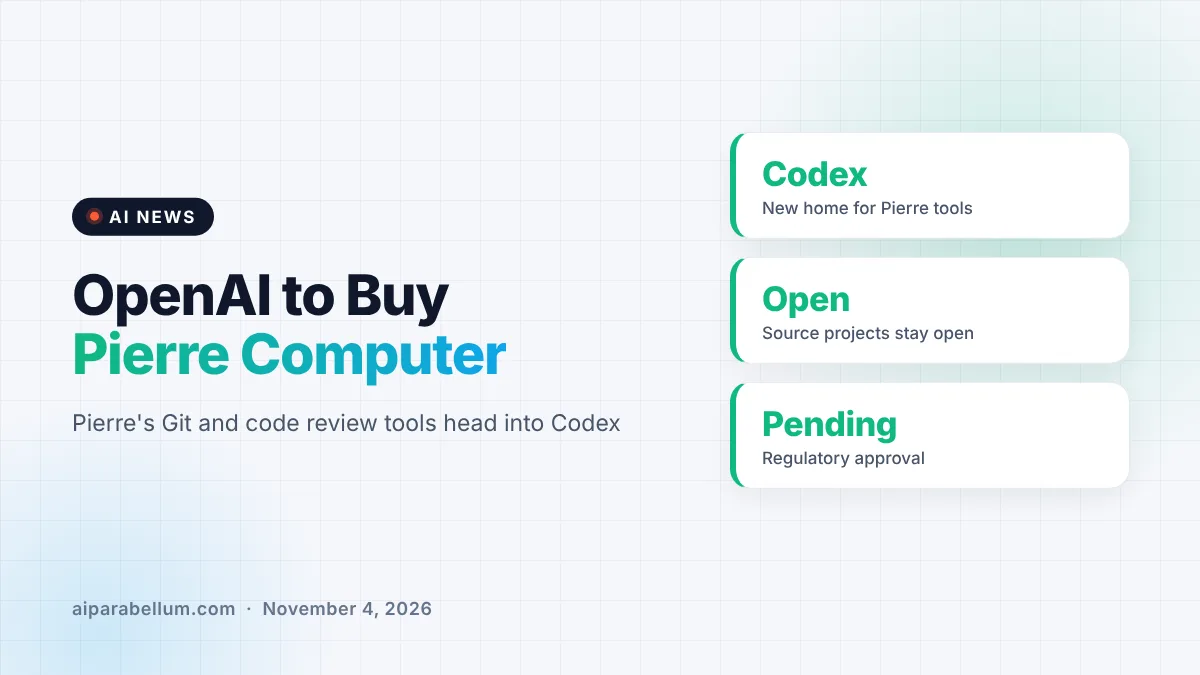
OpenAI says it will acquire Pierre Computer Company, a small developer tools startup whose code-review libraries already run inside the Codex app. The OpenAI Pierre acquisition, announced on November 4, 2026, is a clear sign that OpenAI wants Codex to handle more than writing code. It wants a say in where code is stored, reviewed and shipped too.
What the OpenAI Pierre Acquisition Includes
Pierre is best known for Code Storage, a service that lets apps save code and track its history using Git. It also builds a set of open-source tools that developers use to browse and review code.
If you have looked through files or checked a change in Codex, you have probably used Pierre’s work already. OpenAI says its Trees and Diffs libraries power those views today.
The Pierre tools at a glance
| Pierre product | What it does | Status after the deal |
|---|---|---|
| Trees | Lets developers move quickly through a project’s files | Stays open source, already used in Codex |
| Diffs | Shows what changed in code, with an Edit mode for fixing lines in place | Stays open source, already used in Codex |
| Highlights | Fast syntax highlighting that updates as code is typed or streamed by an agent | Stays open source |
| Code Storage | A Git-based service for storing code and its history inside apps | Keeps running while features move into Codex |
OpenAI did not share a price for the deal. The company says closing still depends on customary conditions, including regulatory approvals, and the two firms stay separate until then.
Why OpenAI Wants Pierre’s Git Tools
OpenAI frames the purchase around a simple problem. As coding agents do more work in parallel, the systems built around Git have to keep up with a lot more branches, changes and reviews.
Earlier this week, OpenAI described Pando, its in-house source control backend built for both engineers and agents. Pierre’s team would add strong review and navigation tools on top of that kind of plumbing. OpenAI says it wants Codex to cover everything from the first branch an agent creates to the moment code is deployed.
OpenAI also praised the startup’s craft. It pointed to the Edit mode in Diffs, which lets a reviewer fix a line right where they spot the problem, as an example of the care it wants to bring into Codex.
A New Front Against GitHub
The deal puts OpenAI closer to territory long held by Microsoft’s GitHub. Axios, which first reported the purchase, framed it as OpenAI joining a growing group of companies challenging GitHub as AI agents take on more coding work.
That matters because GitHub has been the central hub for software teams for years. As agents write more code, the volume that repositories must store and serve keeps climbing, which gives rivals an opening. We have already seen startups build a GitHub rival forge aimed at coding agents.
The twist here is that Microsoft is one of OpenAI’s closest partners. A Codex that stores, reviews and ships code would compete more directly with a key Microsoft product.
What Happens to Pierre Customers
OpenAI made a few promises about the transition. They are worth noting if you rely on any Pierre project today.
- Pierre’s open-source projects will remain open source, and OpenAI says it will keep contributing to them.
- Code Storage customers can keep using the service after the deal closes.
- OpenAI plans to fold Code Storage features into Codex over time.
- Until closing, Pierre keeps operating as an independent company.
What This Means for You
If you are a developer, expect Codex to grow from a coding assistant into a fuller workspace. Better file browsing, faster diffs and built-in review tools are the most likely early changes, since Pierre’s libraries already sit inside the app.
If your team depends on GitHub, nothing changes today. Still, it is a good moment to think about how your AI code review setup and repo hosting might shift as AI companies compete for that layer.
Here are a few practical steps to consider:
- If you use Code Storage, watch for migration notes once the deal closes.
- If you build on Trees, Diffs or Highlights, keep an eye on their open-source repos for new releases.
- If you are weighing AI coding tools, compare how each one handles review, not just code generation.
For more context on how AI tools are changing software work, see our earlier story on Claude Code and the Linux kernel, or read our guide on using an assistant to explain legacy code.
Takeaway: the AI coding race is moving past who writes the best code. The next fight is over where that code lives and how humans check what agents produce.
You can follow more stories like this on our AI news page.
Sources
Primary source: OpenAI’s Pierre acquisition announcement. Additional reporting from Unite.AI.
Conclusion
OpenAI’s plan to buy Pierre Computer is small in headcount but big in direction. By bringing Pierre’s review tools and Code Storage into Codex, OpenAI is reaching for the layer where code is stored and checked, not just written. The deal still needs regulatory approval, and Pierre’s open-source projects will stay open. For developers, the real question is how quickly Codex starts to feel like a full alternative to the tools they use every day.