Anthropic’s biology lab says Claude helped it solve the first 3D structure of a vault particle found in prokaryotes, the simple single-celled life that includes bacteria. Vault particles are giant hollow protein barrels that scientists have puzzled over for 40 years. The Claude vault particle research shows how far AI-assisted biology has come, and also where the model still slipped up.
What Vault Particles Are and Why They Matter
A vault is a huge, hollow shell made of protein. It sits in nearly every cell of the human body and is roughly three times the mass of a ribosome, one of the cell’s best-known machines. Researchers first spotted vaults in 1986 and named them after the arched ceilings of cathedrals.
The strange part is that nobody knows what they do. Ideas have included moving molecules around the cell, shielding cells from toxic drugs and helping with immune defense, but none has been proven. Mice bred without vault parts still grow up normally, which makes the puzzle even harder to crack.
Scientists had already spotted distant relatives of the vault protein in bacteria and in phages, the viruses that infect bacteria. What no one had shown, according to Anthropic, is that those proteins actually build complete vault-like particles. Bacteria grow fast and are easy to work with, so a bacterial vault could make the mystery much easier to study.
How Claude Helped Map the Vault Particle
The team says it built Claude into almost every step of the project, with human scientists directing the work. Here is the rough order of what happened:
- Claude Science searched about 15 billion predicted proteins and found vault relatives in 29 bacterial groups and four archaeal groups, though in fewer than 1% of sequenced species.
- The team picked 44 candidate proteins, and Claude turned each one into a DNA design ready to order.
- Of 24 moved into E. coli bacteria, 15 produced usable protein, and seven formed vault-like particles under the microscope.
- Claude ran the cryo-electron microscopy processing software step by step while researchers advised on key choices.
One detail stands out. Claude first argued against the faster isolation method the team wanted to try, then helped make it work anyway. It even suggested loading raw cell contents straight onto an expensive column, an idea the researchers say they doubted but that paid off.
The structure they found
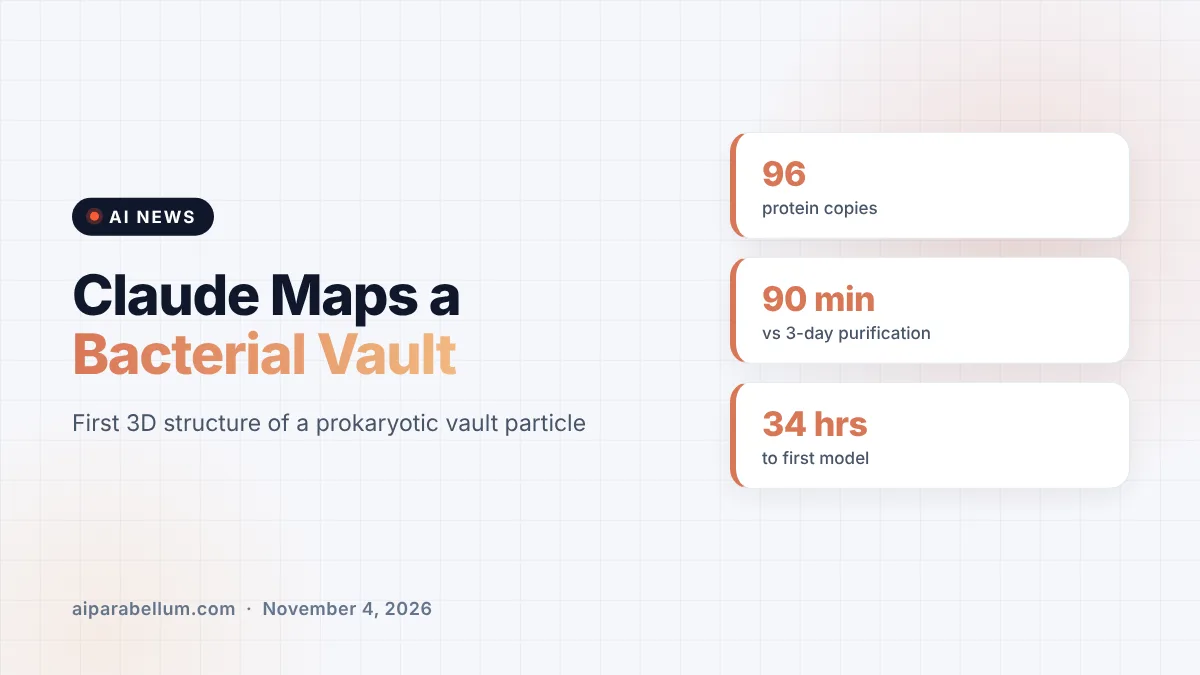
The mapped vault comes from a phage protein the team calls L05. It is built from 96 copies of a single protein, compared with 78 in the mammalian version. It is shorter and wider than a human vault, yet holds about 25% more volume because of its rounder shape.
| Feature | Phage vault (L05) | Mammalian vault |
|---|---|---|
| Protein copies | 96 (48 per half) | 78 (39 per half) |
| Size | About 54 x 45 nanometers | About 67 x 40 nanometers |
| Repeating wall segments | Seven | Nine |
| Inner volume | About 25% larger | Baseline |
Claude also flagged a small, unidentified molecule tucked into a pocket on each of the 96 protein copies. Its shape resembles coenzyme A, a common helper molecule, which Anthropic calls an early hint at a possible function. The team stresses that the vault’s actual job remains unknown.
Speed Gains From the Claude Vault Research
The time savings are the headline for anyone curious about AI in the lab. Anthropic says a purification that normally takes about three days took roughly 90 minutes from cells to microscope grid. A first full structural model was ready in 34 hours, a job the team estimates would normally take weeks.
The whole project, from screening to a solved structure, took under four months. Anthropic says most of it could be done by a typical lab using existing Claude products. The exception was the cryo-EM analysis, which used hundreds of GPUs at once.
Where Claude Made Mistakes
Anthropic is open about the errors. One protocol Claude wrote included a growth additive that blocks DNA from getting into cells, which cost the project two weeks. Early in the microscopy work, it skipped a standard step and produced a flawed map mixed with its own mirror image.
The researchers say they caught mistakes fast in areas they knew well, but lost time in unfamiliar ones. They shared their lab notes with the people who train Claude, and they report that newer models made fewer errors as the project went on. This mirrors earlier results from the same lab, such as its protein binder work.
What This Means for You
You probably are not running a cryo-EM lab, but this research still offers useful lessons for anyone using AI for serious work:
- AI can stretch your skills. The team had little structural biology experience and still finished the project.
- Expertise still matters. Errors were caught quickly only where the humans knew the field well.
- Pushback is a feature. Claude questioned an approach before helping make it work, which is the kind of exchange worth encouraging.
- Check the basics. A single wrong ingredient cost two weeks, so verify protocols before acting on them.
If you want to try similar workflows, our overview of Claude AI and our list of research AI tools are good places to start. You can also see how Claude has handled other technical problems, like quantum circuit design, or browse the latest AI news.
Sources
Primary source: Anthropic’s vault particle research post.
Conclusion
Anthropic’s vault study does not solve the 40-year mystery of what these particles do, but it gives researchers a simpler bacterial system to study and a detailed new structure to work from. It also shows Claude speeding up real lab work, cutting days down to hours in some steps. The honest list of mistakes is just as useful, since it shows where human judgment still has to steer. The team says it plans to release the structures and more data soon and is inviting other scientists to help figure out what vaults are for.