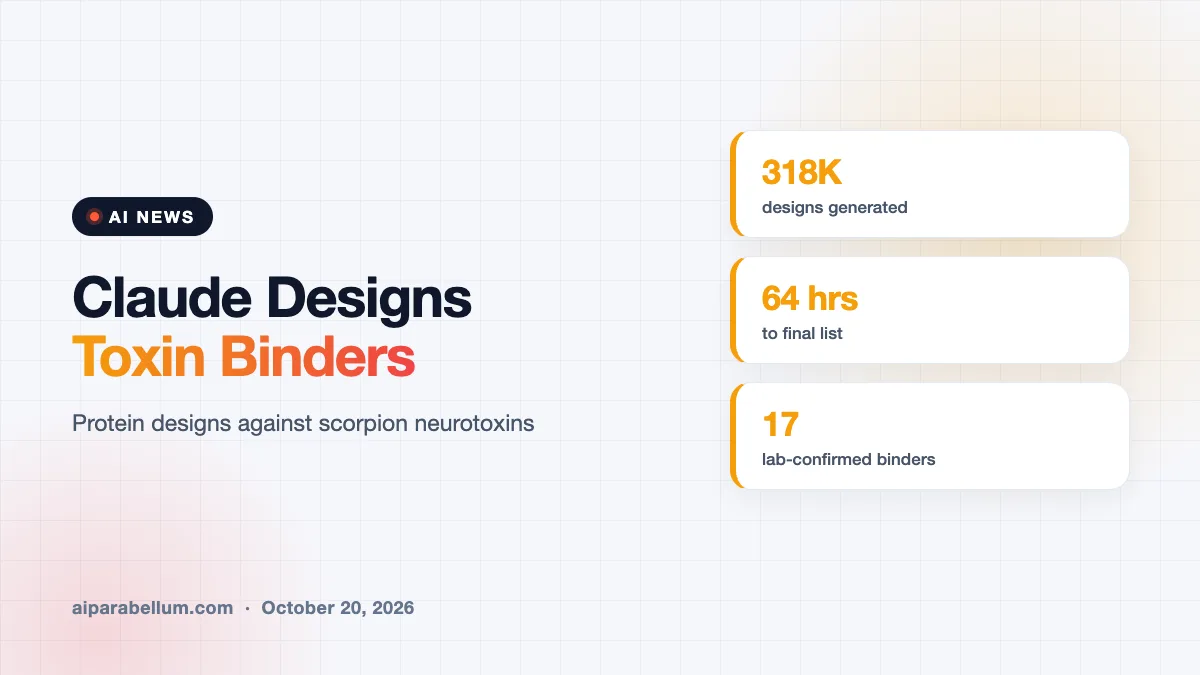
Claude protein design just took on one of medicine’s most neglected problems. Anthropic says an internal Claude research model spent about 64 hours designing small proteins meant to latch onto dangerous scorpion neurotoxins, and lab tests confirmed 17 of them as real binders. It is not an antivenom yet, but it shows how fast AI can now move the earliest stage of drug discovery.
What Claude Protein Design Achieved
The project started with a question from the investment research firm Citrini Research: could AI help a group of motivated nonexperts tackle a real health problem? Anthropic’s life science team picked scorpion stings, which hit 1.2 million or more people a year and cause over 3,250 deaths, mostly among children in places with limited medical care.
Claude worked from one main prompt plus four follow-ups. It picked the toxin structures, chose the target spots on each toxin, set its own quality thresholds and decided how to use 12 different design tools.
Here is the campaign by the numbers, as reported by Anthropic:
| Step | Result |
|---|---|
| Designs generated | 318,484 |
| Design-toxin pairs screened | 553,052 |
| Time to final list | About 64 hours |
| Designs picked by Claude | 180 (plus 31 added with the team) |
| Designs lab-tested | 211 |
| Confirmed binders | 17 |
| Compute used | Roughly 10,000 GPU hours |
Five Toxins From Four Regions
The team aimed at five neurotoxins from scorpions in Mexico, Brazil, North Africa and the Middle East. Each design targeted the part of the toxin that grabs onto sodium channels in nerves, since blocking that spot could, in theory, stop the toxin from working.
Claude was asked to build four kinds of binders:
- Binders for each of the five toxins on its own
- Binders covering the two related “beta-family” toxins
- Binders covering the three “alpha-family” toxins
- Binders that hit all five toxins at once
The multi-toxin goal mattered because one molecule that covers several toxins would make a cheaper, more universal treatment. That part did not work out. None of the multi-toxin designs bound more than one target, which Anthropic says could come down to model limits, prompting, the tools or plain biology.
How the Lab Tests Worked
Two contract labs, Adaptyv Bio and Twist Bioscience, made the proteins in different ways and measured binding strength. To count as a binder, a design had to show binding in every test at both labs, reach a set strength threshold and avoid sticking to an unrelated human protein.
Among single-toxin designs, 11 of 60 passed, or about 18%. Anthropic says that hit rate is typical for protein design work, including its own earlier study.
The Strongest Protein Designs From Claude
The two best designs target Cn2, a toxin from a Mexican scorpion. Both bound it tightly at each lab, in the single-digit nanomolar range.
Competition tests suggest they attach at or near the same spot as an antibody already shown to neutralize Cn2 in mice. That is a promising sign, though the binders have not been tested in cells or animals.
The takeaway: finding a protein that sticks to a toxin is getting fast and cheap. Turning it into a safe, affordable drug is still the hard part.
Why This Is Not an Antivenom Yet
Anthropic is clear that it is not claiming an antivenom. The tests used lab-grown toxins rather than venom milked from scorpions, and no design has been checked for neutralizing effect in cells or protection in mice.
Two outside experts reviewed the work and called it a promising first step. Their shared view is that binding is no longer the main bottleneck; safety, cost and access are.
Anthropic is releasing all 211 designs and their lab data so other researchers can build on them. It also says it has made its models about four times faster on average, and that a simpler single-agent setup on one GPU for 24 hours reached similar computer-predicted scores.
What This Means for You
Most readers won’t design proteins, but this story shows where AI agents are heading. It follows earlier work where Claude tackled quantum circuit design with little hand-holding.
- Long, mostly autonomous AI work sessions are becoming real, not just demos.
- Results still need human checking and lab proof before anyone acts on them.
- Open data releases like this one let smaller teams test ideas without huge budgets.
- Drug discovery is drawing big bets, like the AstraZeneca insitro deal, so expect more news here.
If you want to try the assistant yourself, our Claude AI overview is a good start, and our list of AI research tools covers other options. You can follow more stories like this on our AI news page.
Sources
Primary source: Anthropic’s research post on scorpion toxin binder design.
Conclusion
Claude designed hundreds of thousands of candidate proteins in under three days, and 17 held up in two independent labs as binders against dangerous scorpion toxins. The multi-toxin goal fell short, and nothing has been tested in cells or animals yet, so a real antivenom is still far off. Still, the speed and the open data release make this a meaningful step for neglected diseases. It is also a clear sign that AI agents are moving from writing code to doing early-stage science.