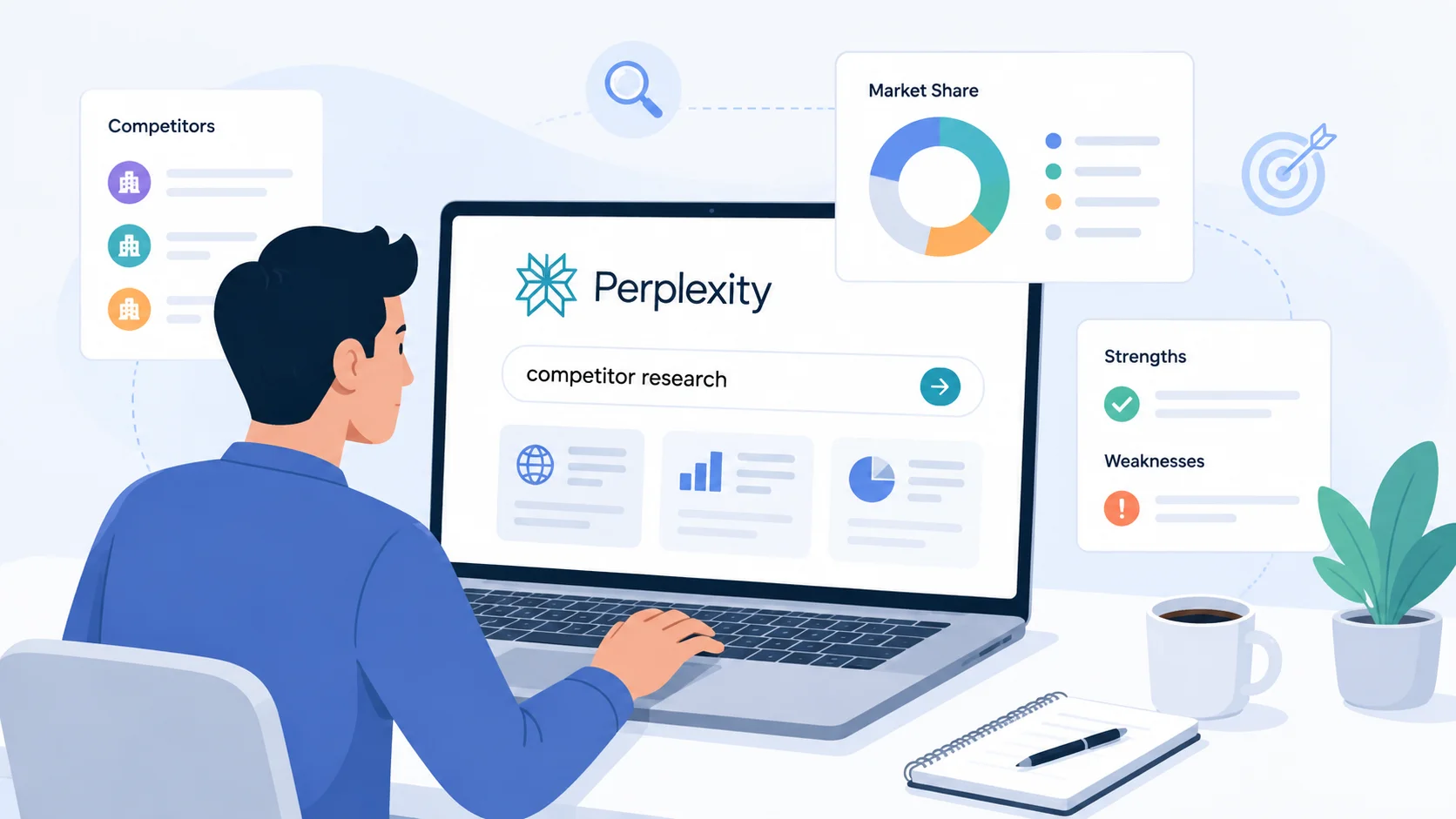
Competitor research used to mean hours of manual searching, opening dozens of tabs, and piecing together information from scattered sources. Perplexity changes that by combining search with AI-powered synthesis, giving you structured answers with cited sources in seconds.
If you want to understand what your competitors are doing, how they position themselves, and where the gaps are, Perplexity is one of the fastest ways to get there.
Why Perplexity Works for Competitor Research
Traditional search engines give you links. Perplexity gives you answers. When you ask about a competitor’s pricing strategy, product features, or market positioning, it pulls information from multiple sources, synthesizes it into a coherent response, and cites everything so you can verify.
This matters for competitor research because the information you need is rarely in one place. A competitor’s pricing might be on their website, their product updates on a blog, their customer complaints on Reddit, and their hiring plans on LinkedIn. Perplexity searches across all of these and brings the pieces together.
Setting Up Your Competitor Research Workflow
Before you start asking questions, set up a structured approach. Random queries produce random results. A systematic workflow produces actionable intelligence.
Step 1: Build Your Competitor List
Start by asking Perplexity to identify your competitors. A prompt like “What are the main competitors to [your product] in [your market]?” gives you a starting list with brief descriptions of each company. You can refine this by asking for direct competitors, indirect competitors, or emerging players separately.
Step 2: Create a Research Framework
Organize your research into categories so you cover everything systematically. Use this framework as a starting point.
| Research Category | What to Ask Perplexity | Why It Matters |
|---|---|---|
| Pricing | “What is [competitor] pricing structure and plans?” | Reveals positioning and target market |
| Product features | “What features does [competitor] offer that others do not?” | Identifies differentiation and gaps |
| Customer sentiment | “What do customers complain about with [competitor]?” | Uncovers opportunities you can exploit |
| Content strategy | “What topics does [competitor] blog about most?” | Shows their SEO and thought leadership focus |
| Funding and growth | “What is [competitor] latest funding and employee count?” | Signals their trajectory and resources |
| Partnerships | “What integrations or partnerships has [competitor] announced?” | Reveals ecosystem strategy |
Step 3: Use Collections for Ongoing Tracking
Perplexity Pro lets you create Collections, which are saved threads organized by topic. Create a collection for each competitor and add new findings over time. This turns one-time research into a living competitive intelligence database.
Effective Prompts for Competitor Research
The quality of your research depends entirely on how you ask. Generic questions get generic answers. Specific, targeted prompts get actionable insights.
Analyzing Positioning and Messaging
Ask Perplexity: “How does [competitor] describe their product on their homepage and marketing pages? What language and value propositions do they emphasize?” This reveals how they position themselves, which audience they target, and what problems they claim to solve.
Follow up with: “How has [competitor] messaging changed in the last 12 months?” This shows you whether they are pivoting, expanding into new markets, or doubling down on their core offering.
Finding Weaknesses
Ask: “What are the most common negative reviews of [competitor] on G2, Capterra, and Reddit?” Perplexity pulls from review sites and forums to surface recurring complaints. These complaints are your opportunities.
You can go deeper with: “What features do users most frequently request from [competitor] that they have not built yet?” This tells you where demand exists but supply does not.
Your competitor’s biggest weakness is usually hiding in their customer reviews. Perplexity just makes it faster to find.
Tracking Product Updates
Ask: “What new features or products has [competitor] launched in 2024 and 2025?” This keeps you current on their roadmap without manually checking their changelog every week.
Using Perplexity Pro for Deeper Research
The free version of Perplexity handles basic competitor research well. Pro unlocks features that make a real difference for serious competitive intelligence.
- Pro Search uses more advanced models and searches more sources, giving you deeper and more nuanced answers.
- File uploads let you feed in a competitor’s annual report, pitch deck, or whitepaper and ask questions about it directly.
- Focus modes let you narrow searches to academic papers, Reddit discussions, YouTube videos, or specific websites.
- Collections keep your research organized and easy to revisit when preparing for strategy meetings or product planning.
Comparing Multiple Competitors at Once
One of the most powerful uses of Perplexity for competitor research is side-by-side comparison. Instead of researching each competitor individually, ask comparison questions.
“Compare the pricing, key features, and target market of [Competitor A], [Competitor B], and [Competitor C].” Perplexity generates a structured comparison with cited sources, saving you hours of manual spreadsheet work.
You can also ask for comparative strengths: “What does [Competitor A] do better than [Competitor B], and vice versa?” This surfaces differentiation points you might use in your own positioning.
Limitations to Know About
Perplexity is powerful, but it has blind spots you should understand before relying on it exclusively.
- It cannot access gated content like paid reports, private Slack communities, or internal company documents.
- Information about very recent events (last 24-48 hours) may not be indexed yet.
- It occasionally synthesizes information from outdated sources. Always check the citation dates.
- For financial data and exact revenue figures, verify with primary sources like SEC filings or Crunchbase.
Perplexity is your research assistant, not your research department. Verify the insights that matter most before acting on them.
Building a Competitive Intelligence Routine
The real value of using Perplexity for competitor research comes from consistency. Set up a weekly or biweekly routine.
- Monday: Check for new product announcements or feature launches from top three competitors.
- Wednesday: Search for recent customer reviews, social media mentions, or press coverage.
- Friday: Update your competitive comparison document with any new findings.
This takes about 30 minutes per session and keeps you consistently informed instead of scrambling before a quarterly review.
Conclusion
Perplexity turns competitor research from a tedious, multi-hour task into a focused 30-minute workflow. Use it to map competitor positioning, surface customer complaints, track product launches, and build side-by-side comparisons. The key is asking specific, targeted questions and organizing your findings in Collections so the intelligence compounds over time. Start with your top three competitors, build the habit, and you will never be caught off guard by a competitive move again.