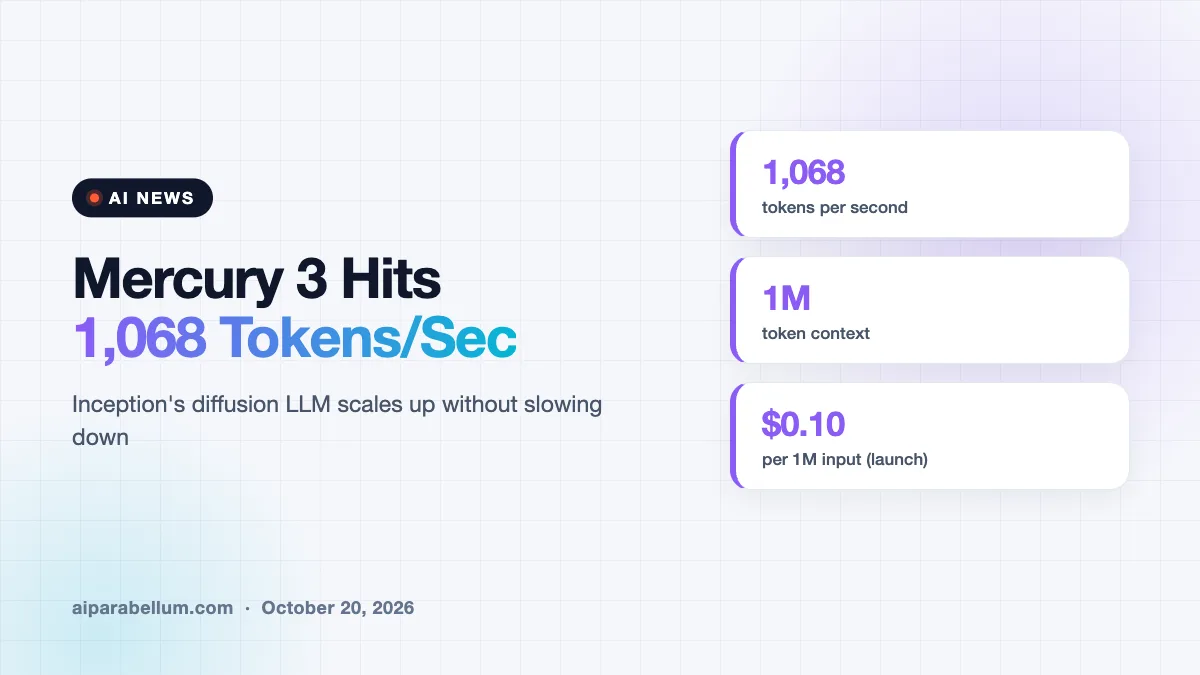
Inception has released Mercury 3, a new diffusion LLM that the company says runs at 1,068 tokens per second while matching or beating popular speed-focused models. Instead of writing one word at a time, the model drafts a whole answer and refines it in parallel. Inception says Mercury 3 proves this diffusion approach can scale up without losing its speed edge.
How a Diffusion LLM Works
Most chatbots today are autoregressive. They produce text one token after another, and each new token has to wait for the one before it. That waiting is a big reason long answers take time.
A diffusion model starts with a rough draft of the full response. It then improves every part of that draft over a few passes at the same time. Fewer step-by-step waits means faster output on the same hardware.
The open question has been whether this method holds up as models get bigger. Inception’s answer is that it does: Mercury 3 is more than 40 times larger than Mercury 1, and the company says benchmark quality has roughly tripled while speed stayed above 1,000 tokens per second.
Mercury 3 Diffusion LLM Specs and Pricing
Inception has not shared the model’s parameter count. It is available only through an API, with no open weights. Here are the key numbers from the launch:
| Feature | Mercury 3 |
|---|---|
| Speed | 1,068 tokens per second on NVIDIA GPUs |
| Context window | 1M tokens, up from 260K in Mercury 2.5 |
| List price | $0.20 per 1M input, $0.70 per 1M output tokens |
| Launch price | 50% off: $0.10 input, $0.35 output |
| Cached input | 90% off the input price |
| Where to get it | Inception API, OpenRouter, Baseten, Vercel |
| API style | OpenAI compatible |
Because the API follows the OpenAI format, developers can swap it into an existing app with few changes. Enterprise plans add dedicated capacity, autoscaling and data retention controls.
How It Stacks Up Against Rivals
Inception compares Mercury 3 with GPT-6 Luna and Claude Haiku 5.5, two models built for speed and low cost. The company says Mercury 3 is on par or better on quality while running 4 to 8 times faster. These are company-run benchmarks at medium settings, so independent tests will matter.
Based on Inception’s own table, Mercury 3 leads on 8 of 12 tests. Its biggest wins are in agentic coding and following instructions. Haiku 5.5 still comes out ahead on some longer coding and long-context retrieval tests, so it is not a clean sweep.
The pitch is not “smartest model ever.” It is “good enough for most jobs, and fast enough that users stop waiting.”
Who Is Already Using It
Inception named early-access partners using Mercury 3 for real-time work:
- A web agent test on 50 live Mind2Web navigation tasks, where it completed half
- Smart-glasses search from Octen, with a median generation time of 0.9 seconds
- RevisionDojo tutoring, where hints and marked answers return in about a second
- Lorikeet customer support agents across chat, voice and email
The company also offers Mercury Voice, tuned for fast first responses in voice bots, and Mercury Decide, a model for high-volume classification.
What This Means for You
If you build apps where speed is the whole experience, Mercury 3 is worth a test. Think voice assistants, live chat, support agents and tools that run many model calls in a row. For those, shaving seconds off each step adds up fast.
A few practical tips before you switch:
- Run your own evals, since the published benchmarks come from Inception.
- Use the launch discount and free starting tokens to test real workloads cheaply.
- Compare it against your current Claude setup or other fast models on your toughest prompts.
- Check long-context tasks carefully, since that is where rivals still edged ahead.
For everyday users, faster models mean smoother AI agents and voice tools. Speed-first releases like the recent MiniMax Flash model show this is becoming a real race.
Sources
Primary source: Inception’s Mercury 3 announcement. Additional reporting from MarkTechPost.
Conclusion
Mercury 3 is the strongest sign yet that diffusion language models can grow without giving up their speed. Inception claims frontier-level quality for a speed-focused model, a 1M-token context window and a low launch price. The benchmarks are self-reported, and rivals still win some tests, so careful testing is wise. Still, for developers chasing real-time AI, this release makes diffusion a serious option. Catch more model launches on our AI news page.