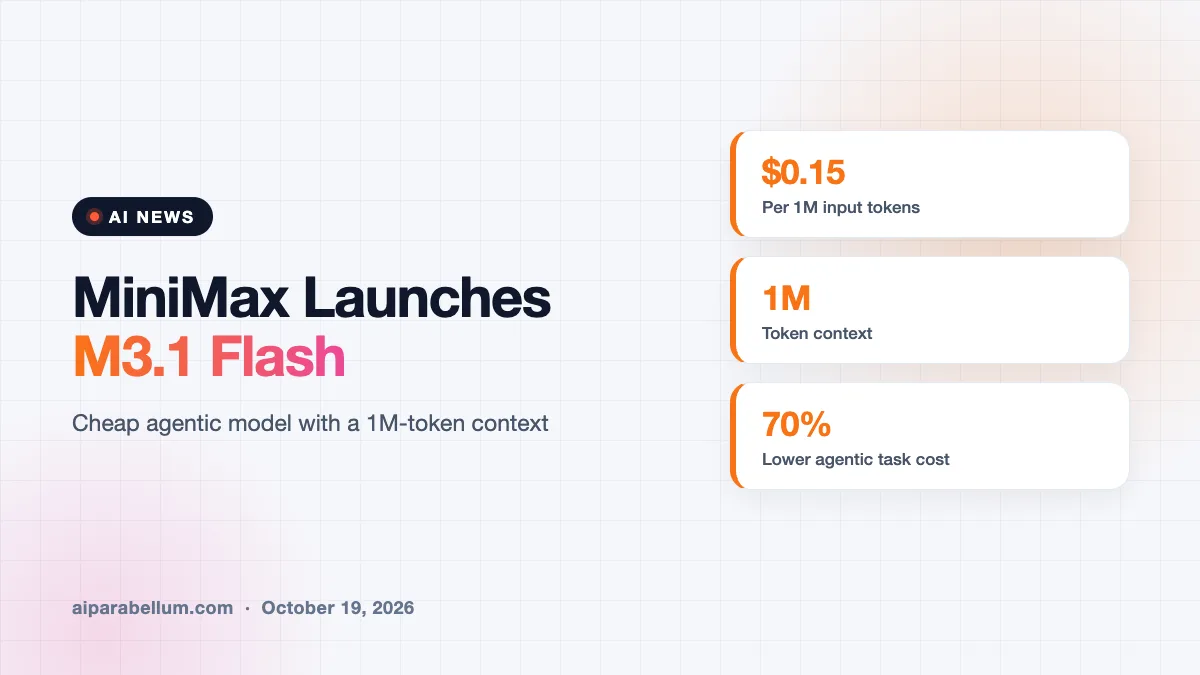
Chinese AI company MiniMax has launched MiniMax M3.1 Flash, a low-cost model built for coding, office automation and visual reasoning. It went live on the company’s API on October 19 at $0.15 per million input tokens, and MiniMax says open weights will be released later.
What Is MiniMax M3.1 Flash?
M3.1 Flash is a multimodal mixture-of-experts model. It has about 428 billion total parameters, but only around 23 billion are active for any given request, which helps keep it fast and cheap.
The model takes text, images and video as input and replies in text. Its context window is 1 million tokens, enough to hold a large codebase or a long stack of documents at once.
The Mystery Model Gets a Name
MiniMax also confirmed that a stealth model called “Space Bunny” was an earlier build of M3.1 Flash. That anonymous test model processed more than 200 trillion tokens before the official reveal.
MiniMax M3.1 Flash Pricing and Speed
Price is the headline here. M3.1 Flash charges a flat rate with no extra fee for long prompts, which is unusual for a model with such a big context window.
| Detail | MiniMax M3.1 Flash |
|---|---|
| Input price | $0.15 per 1M tokens |
| Output price | $0.60 per 1M tokens |
| Cached input | $0.015 per 1M tokens |
| Context window | 1,000,000 tokens |
| Size | About 428B total, about 23B active |
| Speed claim | Nearly 3x faster than MiniMax M3 |
| Open weights | Coming later, license not yet shared |
Per token, that’s half the standard rate of the larger MiniMax M3. MiniMax says the new model runs nearly three times faster than M3 and cuts overall usage cost on agentic tasks by 70%, though it hasn’t explained how it calculated that cost figure.
How It Stacks Up on Benchmarks
MiniMax says M3.1 Flash reaches near-frontier scores on agentic office work. Keep in mind that every number below comes from MiniMax itself, and no one has independently tested them yet.
- Office automation: it leads Automation-Bench at 62.2, ahead of the 50.3 MiniMax lists for Claude Opus 5.
- Finance tasks: it ties Opus 5 on BankerToolBench at 76.2.
- Coding: results are mixed, with 73.7 on DeepSWE but only 38.1 on Terminal Bench 4.0, where Opus 5 scores 51.8.
- Computer use: it scores 61.7 on OSWorld V2, which MiniMax says is the top result among Chinese models.
- Security: it reaches 82% on CyberGym, a test of finding and validating software vulnerabilities.
The weak spot is hard, hands-on coding. On some coding tests, the recent DeepSeek V4.1 Flash scores higher at a similar price point.
The pitch isn’t that M3.1 Flash beats the best models everywhere, but that it gets close on everyday agent work for a fraction of the price.
Things Developers Should Know Before Switching
M3.1 Flash always reasons before it answers, and you can’t turn that off. Instead, you pick one of five effort levels: Low, Medium, High, Xhigh or Max, with Max as MiniMax’s recommended default.
That has real migration effects. Requests that try to disable thinking will return an error, and reasoning now arrives in a separate field, so apps that read inline think tags from M3 will need updates.
On the plus side, the model supports both Anthropic-compatible and OpenAI-compatible API formats. It’s also available through MiniMax’s M Plan subscription and its MiniMax Code desktop app.
What This Means for You
If you build apps on top of AI models, cheap agent-capable models like this keep pushing prices down. It’s another sign that Chinese labs are competing hard on cost, following recent releases like StepFun’s Step 5.
- Test it on your own tasks before trusting the benchmark table.
- Budget for reasoning tokens, since thinking is always on and adds cost and delay to simple calls.
- Check your parsing code if you used MiniMax M3 before.
- Wait for the weights and license details if you plan to self-host. One report puts the release at October 23, but MiniMax hasn’t confirmed a date.
If top coding quality matters most, compare it with the newer Claude Opus 5.5. You can also explore AI coding assistants or follow more model launches on our AI news page.
Sources
This article is based on MiniMax’s official launch post, MiniMax, published October 19, 2026, plus a same-day technical breakdown by MarkTechPost covering model size, context window, API details and benchmark comparisons.
Conclusion
MiniMax M3.1 Flash is a budget model with big ambitions: a 1 million token context, strong office-automation scores and a price that undercuts most rivals. Its coding results are uneven, and all of its benchmarks are self-reported for now. The always-on reasoning is a trade-off worth testing before you switch. Once the open weights arrive, it could become a popular choice for teams running AI agents on a tight budget.