
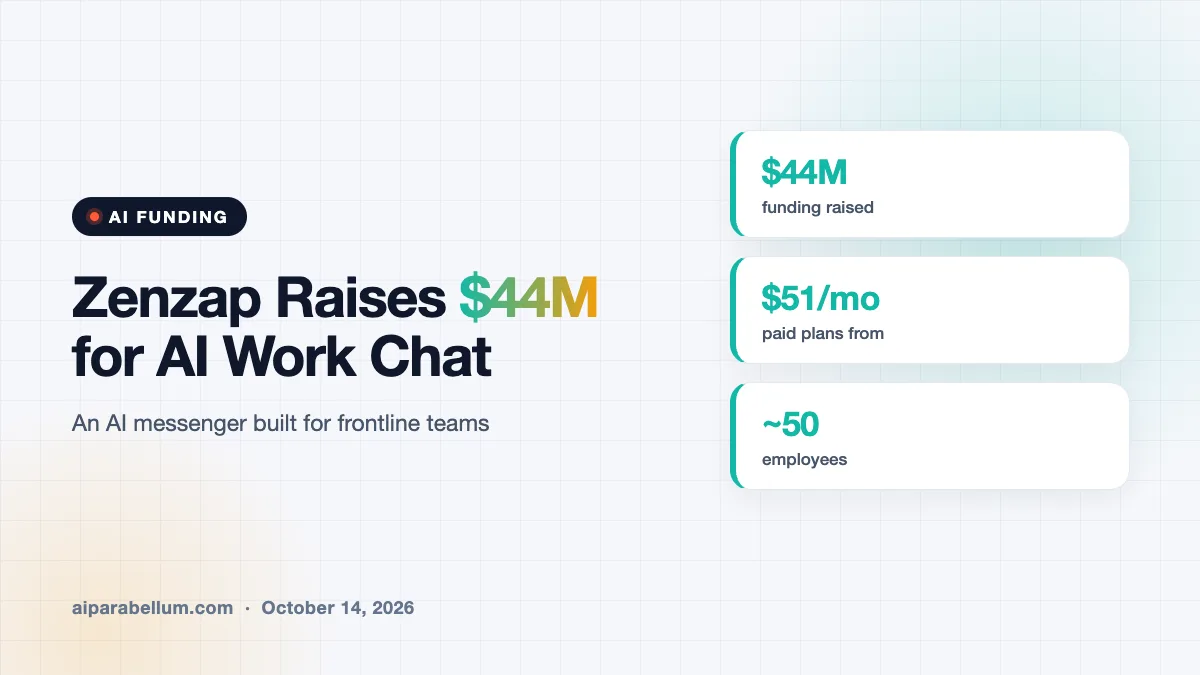
Zenzap, a workplace messaging app with built-in AI, has raised $44 million to take on the consumer chat apps that many businesses still use to run their teams. The Zenzap funding comes from Bessemer, Lightspeed and The Garage, along with a few well-known individual backers.
The startup is chasing a huge but often ignored group: shift workers, store managers and field crews who coordinate their day on their phones. Today, many of them rely on WhatsApp groups that IT departments can’t control.
Who Is Behind the Zenzap Funding
Besides the three venture firms, the round includes Wix President Nir Zohar and Yoram Tietz, a former GM at EY. It is the first time founder Guy Weiss has raised outside money. He bootstrapped his earlier company, e-commerce marketing platform StuccoMedia, and sold it in 2015.
Weiss started Zenzap in 2022 with co-founders Noam Neumann and Jonatan Bien after meeting Bessemer partner Adam Fisher. He first funded the app himself and worked out of Bessemer’s office. Fisher later convinced him the business would need venture capital to grow.
| Detail | Zenzap |
|---|---|
| Funding raised | $44 million |
| Venture backers | Bessemer, Lightspeed, The Garage |
| Founded | 2022 |
| Team | About 50 people in the U.S., Tel Aviv and Europe |
| Paid plans | From $51 per month for up to 20 users |
| Named clients | FedEx, Dollar General, Taco Bell, Starbucks, Casey’s, Regal |
How the Zenzap AI Chat App Works
On the surface, Zenzap looks like any messenger, with group chats and direct messages. Underneath, it adds work tools such as task management, calendar links and shift scheduling. The free tier also includes AI-powered voice chat and search.
Paid plans unlock voice and video calls, smart task sorting, task templates and more file storage. They also let teams search across the whole workspace with AI and turn any message into a task.
AI agents on a credit system
Zenzap also sells AI agents that automate common workflows, plus AI transcription for voice notes and calls. These extras run on a credit-based pricing model, so companies pay for what they use. Weiss says each industry sets up its own workflows with AI on a self-serve basis.
Why Workplace Messaging Needs a Rethink
Weiss argues that consumer apps can’t safely carry an AI agent inside a company because they don’t meet IT rules. At the same time, he says Slack and Microsoft Teams were not designed for everyday mobile use by hourly staff. Zenzap wants to sit in that gap.
The company targets a wide range of sectors, from hospitality and construction to healthcare and fast food. Weiss said branches of chains like IHOP and McDonald’s use the app to plan shifts and talk about supplies. Even Bessemer’s investment team uses it to discuss deals.
The personal and work divide
Fisher believes most workers outside tech have no real loyalty to any work platform. In his view, the rise of personal and work AI agents makes it urgent to keep job chats separate from personal ones. That separation is the core of Zenzap’s pitch.
What This Means for You
If your team still runs on a WhatsApp group, products like Zenzap are aimed squarely at you. Here are a few practical points to weigh:
- Check your data risk. Work chats on personal apps can expose schedules, customer details and files outside IT control.
- Compare costs. Zenzap’s paid plans start at $51 a month for up to 20 users, while AI agents and transcription cost extra credits.
- Think mobile-first. If most of your staff never sit at a desk, a phone-first tool may fit better than a desktop-heavy platform.
- Test the AI features. Workspace search and message-to-task tools only help if your team actually uses them day to day.
Zenzap enters a crowded field of AI productivity tools, and its agent features echo how AI agents are replacing older automation software. If voice notes are a big part of your workday, see our guide on how to transcribe audio free.
Workplace AI safety is also drawing money, as seen when Harmonic Security raised $50M for safer workplace AI. For more, browse our AI agent tools or the latest AI news.
Sources
This article is based on reporting from TechCrunch, including interviews with Zenzap founder Guy Weiss and Bessemer partner Adam Fisher.
Conclusion
Zenzap’s $44 million raise is a bet that the next big workplace chat battle will be fought on the phones of frontline workers, not on office laptops. By pairing a familiar messenger with tasks, scheduling and AI agents, it hopes to pull teams off consumer apps without forcing them into tools built for desk jobs. Big-name clients give it a credible start, though the client list comes from the company itself. The real test will be whether hourly workers choose it over the chat apps already on their phones.
