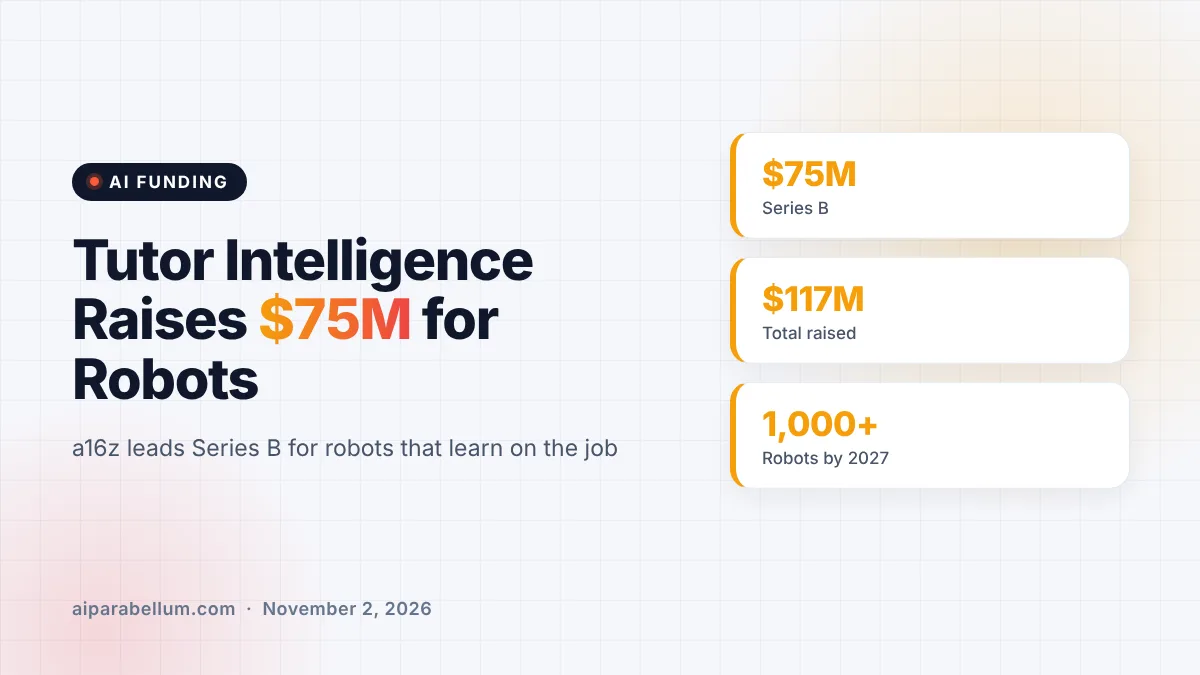
Tutor Intelligence, a Massachusetts robotics startup, has raised a $75 million Series B round led by Andreessen Horowitz. The funding will help the company train its own robot foundation models and build more of the AI robot workers it rents to factories and warehouses by the hour. It brings the company’s total funding to $117 million.
Inside the Tutor Intelligence Funding Round
The company announced the round on November 2, 2026. Andreessen Horowitz, often called a16z, led the deal. Two earlier backers came back too: Union Square Ventures, which led the Series A, and Neo, which led the seed round.
Tutor says the money will go to three things. It wants to train better “frontier” models for robots, manufacture more machines, and get those machines into more workplaces. The company says all of its robots will be built in and deployed from the United States.
| Detail | What Tutor Intelligence reported |
|---|---|
| Round size | $75 million Series B |
| Lead investor | Andreessen Horowitz (a16z) |
| Other investors | Union Square Ventures, Neo |
| Total raised | $117 million |
| Headquarters | Watertown, Massachusetts |
| Robot models | Sonny and Cassie |
| Growth target | More than 1,000 robots under contract by end of 2027 |
How Tutor’s AI Robot Workers Learn on the Job
Chatbots learned to write and code by reading huge amounts of internet text. Robots don’t have a giant library like that for the physical world, so they have to learn from real practice. Tutor’s plan is to get that practice on actual customer sites.
The company sends fleets of internet-connected robots into real factories and warehouses. Remote human operators, which Tutor calls “tutors,” help guide the machines when they need it. Every task the robots finish creates fresh training data, and that data feeds the next version of Tutor’s models.
Better models then let the robots handle more kinds of jobs, which leads to more deployments and even more data. Tutor describes this as a flywheel where each new robot makes the whole fleet smarter. It’s a similar idea to how many AI agents improve with real-world use, just applied to physical work.
Meet Sonny and Cassie
Tutor currently offers two robots. Cassie handles pallets and cases, such as stacking boxes at the end of a production line or taking mixed pallets apart. Sonny is built for more general hand-like tasks, like picking individual items from shelves.
According to the company, its robots already handle everyday goods for some of the largest US manufacturing and logistics networks. That includes breakfast cereal, snacks, candy, cosmetics, home goods and toys.
Robots Sold Like Hourly Labor
Tutor’s business model is a big part of its pitch. Instead of selling a costly machine up front, it charges businesses by the hour or by the pick, much like paying a temp worker. Its website lists robot work starting at $14 an hour.
- No large upfront purchase for customers on the usage plan
- No long-term contract, with month-to-month terms
- Tutor handles setup, maintenance and support
- Robots get regular software and model upgrades at no extra cost
- Buyers can also purchase the robots outright with a yearly service plan
The company says its robots now work in almost four times as many facilities as a year ago. It also says nearly a third of customers that received robots in the past 12 months were existing customers ordering more. Those are company claims, but they help explain why investors are betting on it.
Why the Tutor Intelligence Funding Matters
This round fits a bigger trend. Investors have poured money into robotics startups this year, from Dream Labs’ robot AI to Machenta’s robot learning work. Big AI labs are also circling the space, including OpenAI’s humanoid plans.
In a post announcing the investment, a16z general partner Raghu Raghuram, the former CEO of VMware, said the firm is excited to lead the round. He also said Tutor treats deployment as the way to solve robotics research problems, not just the end goal.
CEO Josh Gruenstein put the demand side plainly. “We can hardly build robots fast enough,” he said.
What This Means for You
You probably won’t buy a Tutor robot yourself, but this kind of automation could quietly shape the goods on your shelf. Here’s what to keep in mind:
- Warehouse and factory automation is moving from pilot projects to paid, everyday work.
- Pay-per-hour robots lower the barrier for mid-size businesses that can’t afford big machines.
- Human “tutors” are still in the loop, so these jobs shift rather than vanish overnight.
- If you run a business, watch how AI business tools and robot labor start to blend in operations planning.
For more funding and launch stories like this one, check our latest AI news coverage.
Sources
Primary source: Andreessen Horowitz’s Series B announcement. Additional details from Tutor Intelligence’s press release on Yahoo Finance and pricing from Tutor Intelligence’s website.
Conclusion
Tutor Intelligence’s $75 million Series B shows that investors are ready to back robots that learn on real job sites rather than in labs. With a16z leading, a pay-by-the-hour model and a goal of more than 1,000 robots under contract by the end of 2027, the company is betting that deployment itself is the fastest path to smarter machines. Whether that flywheel scales as promised is the next thing to watch.