Open any AI-generated blog post and start counting the em dashes. I’ll wait. Somewhere around the fourth one in two paragraphs, you’ll also trip over a sentence like “This isn’t just a tool, it’s a revolution.” Once you notice these two habits, you can’t unsee them, and neither can your readers.
Why AI Writing Overuses Em Dashes in the First Place
Tools like ChatGPT learned to write by studying billions of pages of text. Em dashes show up heavily in the polished web writing it trained on, because human editors love them in small doses. The model absorbed the pattern without absorbing the restraint.
There’s a second reason too. An em dash lets the model bolt two ideas together without committing to a period or a comma. It’s the path of least resistance, so the model takes it constantly.
And What About “It’s Not Just X, It’s Y”?
This one is a rhetorical crutch. The structure creates instant drama by knocking down a small idea and replacing it with a bigger one. It sounds impressive exactly once.
The problem is that AI models reach for it in every third paragraph. Your product isn’t just software, it’s a movement. Your morning coffee isn’t just a drink, it’s a ritual. Readers stop trusting the words because everything gets inflated.
Elmore Leonard had a rule that applies perfectly here: “If it sounds like writing, I rewrite it.” That construction always sounds like writing.
Prompt Fixes That Actually Work
The good news is you can kill both habits at the source. Models follow style commands surprisingly well when you make them explicit and specific. Vague requests like “write naturally” do almost nothing.
Try lines like these in your prompt:
- Use em dashes no more than once per 300 words, or not at all.
- Never use the construction “it’s not just X, it’s Y” or any variation of it.
- Do not use “isn’t just,” “more than just,” or “not only, but also.”
- Prefer periods over dashes. Short sentences are fine.
- State claims directly instead of contrasting them with a weaker version.
Stack these with a few good prompt examples of your own writing, and the output changes dramatically. Showing the model two or three paragraphs in your voice works better than any abstract instruction.
A Reusable Style Block You Can Paste Anywhere
I keep a saved style block and paste it at the start of every writing session. Steal this one and tweak it to taste.
Style rules for all writing in this chat:
1. Maximum one em dash per 300 words. Zero is better.
2. Banned phrases: "it's not just", "isn't just", "more than just",
   "not only... but also", "in today's fast-paced world".
3. Replace any banned phrase with a direct statement.
4. Vary sentence length. Some short. Some longer.
5. If a sentence sounds dramatic when read aloud, flatten it.
Models like Claude respect persistent instructions like this for the whole conversation. If the tic creeps back in after a long session, just paste the block again.
Common AI Tics and What to Do Instead
Em dashes and false contrasts are the big two, but they travel with friends. Here’s a quick reference table for your editing pass.
| AI Tic | Why It Happens | The Fix |
|---|---|---|
| Em dash overload | Easy way to join ideas without choosing punctuation | Swap most of them for periods or commas |
| “It’s not just X, it’s Y” | Cheap drama learned from marketing copy | State the claim directly, once |
| Rule of three everywhere | Triads feel balanced, so models default to them | Cut one item or add a fourth |
| “Delve,” “tapestry,” “landscape” | Overrepresented in training data | Use plain words a friend would say |
Edit Like a Human After You Generate
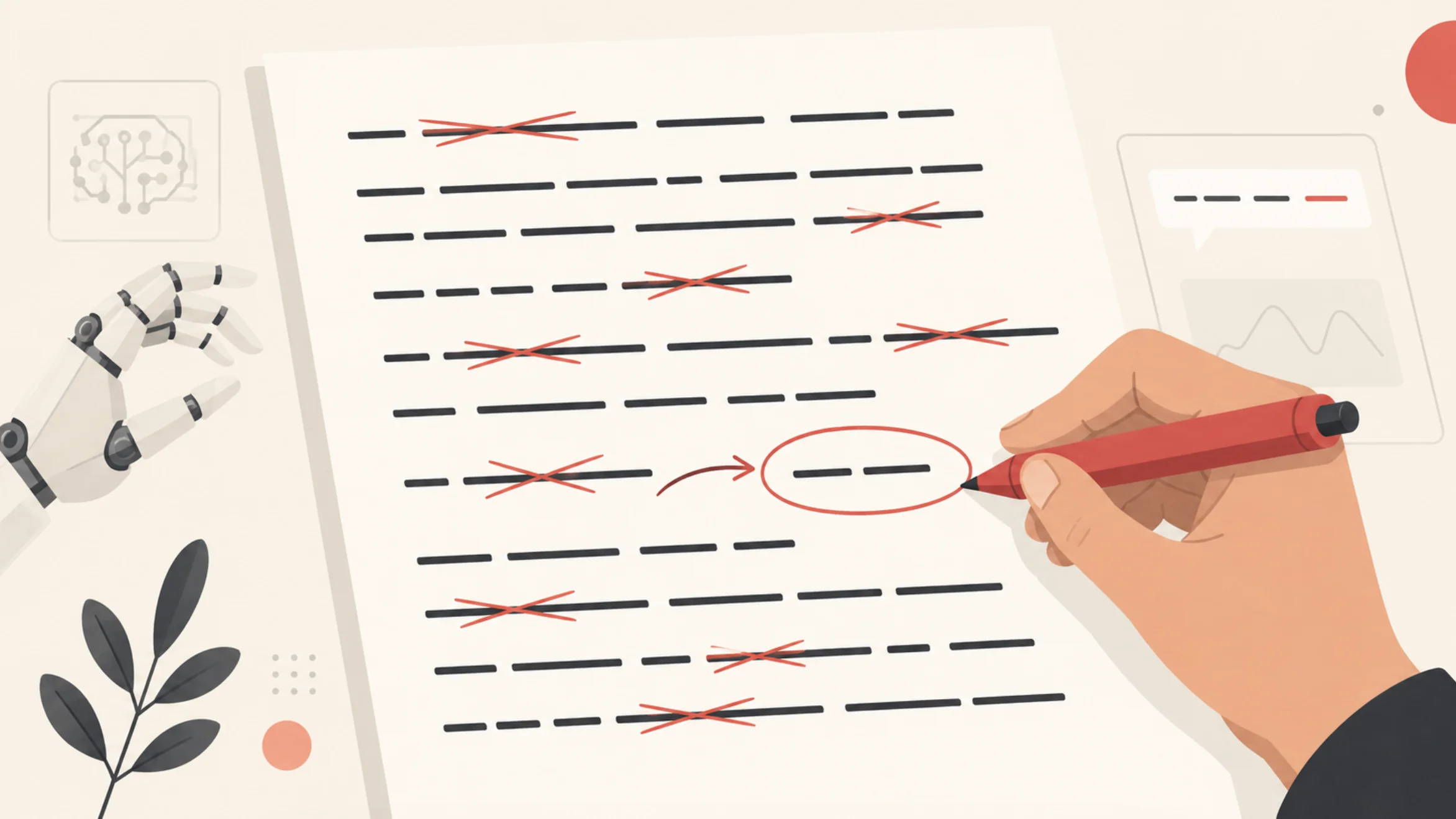
No prompt catches everything, so budget five minutes for a cleanup pass. Run a find for the em dash character and judge each one on its own. Keep the one that genuinely earns its place and rewrite the rest.
Then search for “not just” and “isn’t just.” Every hit gets rewritten as a plain statement. “It’s not just fast, it’s efficient” becomes “It’s fast and efficient.” Shorter, calmer, more believable.
If the stakes are high, tools that humanize AI text can smooth over the remaining patterns for you. And running a draft through a detector like GPTZero gives you a rough sense of whether the robotic fingerprints are gone. Treat both as a second opinion, not a verdict.
As Strunk and White put it a century ago, “Omit needless words.” The advice predates AI by a hundred years, and it fixes most of what AI gets wrong.
Conclusion
AI writing leans on em dashes and “it’s not just X, it’s Y” because both patterns are baked into its training data, and it will keep using them until you say otherwise. Ban the phrases explicitly, cap the dashes, show the model samples of your real voice, and finish with a quick find-and-edit pass. Do that, and your drafts stop sounding like every other AI article on the internet. That’s the whole trick.