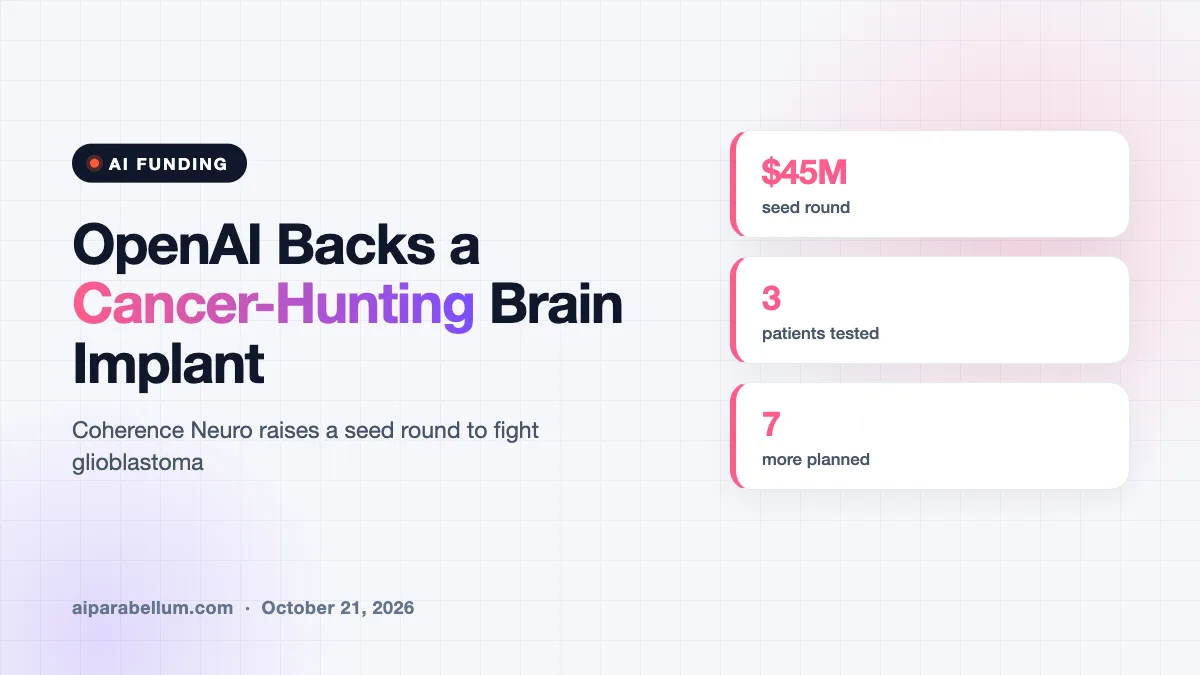
OpenAI’s venture fund is putting money into a brain implant built to spot and fight brain cancer. San Francisco startup Coherence Neuro has raised a $45 million seed round, with backing from the OpenAI Startup Fund and Peter Thiel’s Founders Fund, to take its cancer-sensing brain implant toward a long-term clinical trial.
The deal is small next to the giant AI rounds you see every week. Still, it says a lot about where AI money is heading: toward raw human data that today’s chatbots have never touched.
What the Coherence Neuro Brain Implant Does
Most brain-computer interface companies focus on helping paralyzed people move a cursor or speak again. Coherence is chasing a different goal. It is building AI models that read faint electrical signals linked to brain tumors.
The company says it can already pick up these signals in animals and tell whether a cancer is growing, shrinking or coming back. Its device is also designed to send mild electrical pulses meant to slow tumor growth. Over time, the plan is for the implant to learn each patient’s cancer signals and respond in real time.
Early tests in people
This summer, Coherence ran a short first test in three patients who were already having brain tumor surgery at the Royal Melbourne Hospital in Australia. The implant stayed in place for about 30 minutes before it was removed, which served as an early safety check on its recording ability.
Next, the team is testing both recording and stimulation in seven more patients. The new money is meant to fund a trial where the device stays in long-term for people with glioblastoma, one of the most aggressive brain cancers.
The Cancer Brain Implant Round at a Glance
| Detail | What we know |
|---|---|
| Company | Coherence Neuro, San Francisco |
| Round | $45 million seed |
| Named backers | OpenAI Startup Fund, Founders Fund |
| Target disease | Glioblastoma first, other cancers later |
| Human testing so far | 3 patients for about 30 minutes, 7 more planned |
| Next milestone | Long-term implant clinical trial |
Why OpenAI Wants In on Brain Data
CEO and cofounder Ben Woodington argues that brain-computer interfaces are a natural fit for AI. These devices produce huge streams of neural data that no human team could sort through by hand. AI models can turn those raw signals into something useful, like a sign that a tumor is changing.
This is not OpenAI’s first step into the space. In January, OpenAI invested directly in Merge Labs, a brain-computer interface company cofounded by Sam Altman that launched with $252 million. You may have followed other big bets in our healthcare AI coverage, and this one fits the same pattern of AI labs reaching past text and code.
Who gets the data
Here is where things get interesting. Woodington told reporters that OpenAI will not have access to the company’s brain or health data, and that nothing in the deal requires sharing it. That differs from the Merge Labs deal, where OpenAI said it would work with the startup on scientific foundation models.
The real prize in health AI may not be bigger models. It may be new kinds of data that only devices inside the body can collect.
Ian Hathaway, a partner at the OpenAI Startup Fund, praised the startup’s plan for a cancer therapy that improves as it learns from data. Founders Fund has a long track record here too, having backed Neuralink and CTRL-labs, the neural wristband maker that Facebook bought in 2019.
What This Means for You
For now, this is early-stage medical research, not a product you can get from your doctor. Still, it is worth watching for a few reasons:
- It shows AI labs see medical and brain data as the next frontier, much like the push into healthcare AI agents this month.
- Data privacy promises matter. If you ever join a trial for a connected medical device, ask who can see your data and for what purpose.
- Glioblastoma has few good options today, so any therapy that adapts to a patient in real time would be a big deal if it works.
- Human results are still very limited. A 30-minute safety check in three people is a starting line, not proof.
If you follow how OpenAI spends beyond ChatGPT, this joins other unusual bets like its humanoid robot plans. You can find more stories like this on our AI news page.
Sources
Reporting from WIRED.
Conclusion
Coherence Neuro’s $45 million seed round puts OpenAI’s money behind a brain implant that aims to detect and treat cancer from inside the skull. The science is early, with only brief tests in a handful of patients so far. The company says OpenAI will not see its patient data, which sets this deal apart from OpenAI’s tighter Merge Labs partnership. If the long-term glioblastoma trial goes well, it could show how AI and medical devices team up on hard diseases. For now, treat it as a promising signal of where AI investors are looking next.