You have found the perfect job listing. The requirements match your experience, the company looks great, and you are ready to apply. But then you hit the part every job seeker dreads: the cover letter.
Writing a compelling cover letter takes time, energy, and a level of self-promotion that most people find uncomfortable. So naturally, the question comes up: can AI just write it for you? And more importantly, will an AI-written cover letter actually get you interviews?
The answer is more nuanced than a simple yes or no. AI can absolutely help you write a strong cover letter, but only if you use it the right way.
How AI Cover Letter Writers Work
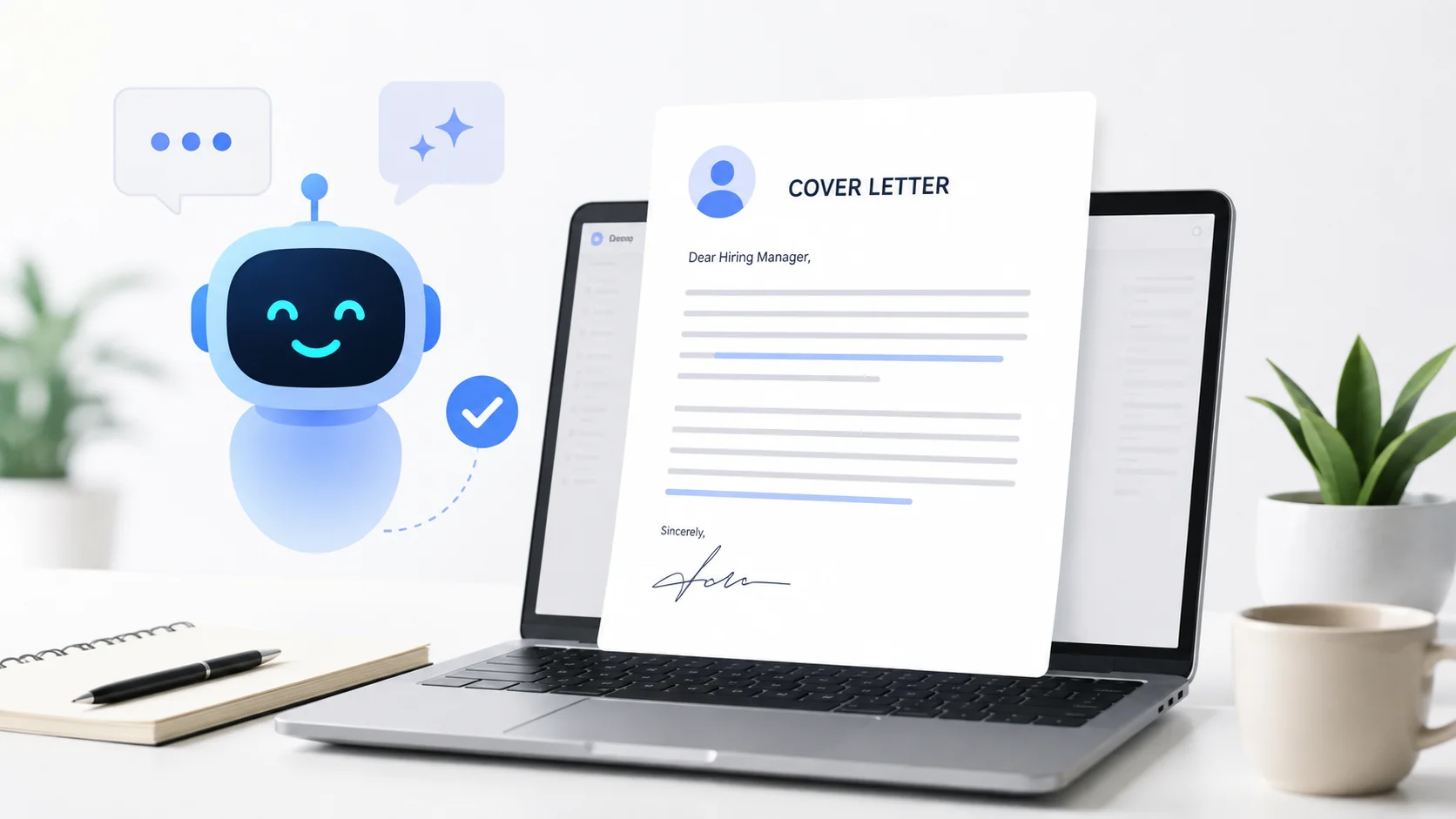
AI cover letter tools use large language models to generate professional text based on the information you provide. You typically paste in a job description, add your resume details, and the AI produces a tailored cover letter within seconds.
The technology behind these tools is the same that powers ChatGPT and other generative AI platforms. The model has been trained on millions of examples of professional writing, which means it understands the structure, tone, and conventions that cover letters follow.
Most AI cover letter generators follow a standard process. They analyze the job posting for key requirements, match those against your experience, and produce a letter that highlights the overlap. Some tools even adjust the tone based on the industry or company culture.
What AI Gets Right About Cover Letters
There are several things that AI handles surprisingly well when it comes to cover letter writing.
Structure and Formatting
AI never forgets the basics. It produces cover letters with proper openings, body paragraphs that address the job requirements, and professional closings. For people who struggle with where to start or how to organize their thoughts, this alone is valuable.
Keyword Matching
AI excels at identifying important keywords from a job description and weaving them naturally into the cover letter. This matters because many companies use applicant tracking systems (ATS) that scan for specific terms before a human ever reads your application.
Professional Tone
The tone of an AI-generated cover letter is consistently professional. It avoids the common mistakes job seekers make, like being too casual, too desperate, or too generic. The output reads like it was written by someone who has written hundreds of cover letters before.
Speed
What takes most people 30 to 60 minutes, AI does in under a minute. If you are applying to multiple positions, this time savings adds up quickly. Instead of spending an entire weekend writing cover letters, you can generate drafts for a dozen applications in the time it takes to drink a cup of coffee.
AI does not eliminate the work of writing a cover letter. It compresses the hardest part, getting the first draft on paper, into seconds instead of hours.
Where AI Cover Letters Fall Short
Despite the strengths, AI-generated cover letters have clear limitations that can hurt your chances if you are not careful.
Generic Language
AI tends to default to safe, generic phrasing. Sentences like “I am excited about the opportunity to contribute to your team” and “My skills align perfectly with this role” show up in nearly every AI-generated cover letter. Hiring managers read hundreds of these and can spot the pattern.
Missing Personal Stories
The most effective cover letters include specific stories from your experience that demonstrate your value. AI does not know about the time you saved a client relationship at the last minute or the project where you exceeded targets by 40 percent. Without these details, the cover letter reads like a summary of your resume rather than a compelling narrative.
Lack of Company-Specific Insight
A great cover letter shows that you have researched the company and understand its challenges, culture, and goals. AI can pull surface-level information, but it cannot replicate the genuine enthusiasm that comes from actually knowing why you want to work somewhere specific.
The AI Detection Problem
Some employers are now using AI detection tools to flag applications that appear to be entirely AI-generated. Whether or not this is fair, it is a reality. Submitting a cover letter that reads like pure AI output can signal to hiring managers that you did not put in the effort.
AI Cover Letter Quality Comparison
Here is how AI-generated cover letters compare to human-written ones across the factors that matter most to hiring managers.
| Factor | AI-Generated | Human-Written | AI + Human Edited |
|---|---|---|---|
| Structure | Excellent | Varies widely | Excellent |
| Keyword optimization | Strong | Often missed | Strong |
| Personal stories | Weak | Strong | Strong |
| Authenticity | Low | High | High |
| Time to create | Under 1 minute | 30-60 minutes | 10-15 minutes |
| ATS compatibility | High | Moderate | High |
The sweet spot is clearly the hybrid approach. Use AI to generate the foundation, then add your personal touch to make it authentic and memorable.
How to Use AI to Write a Cover Letter the Right Way
The best results come from treating AI as a starting point rather than the final product. Here is a step-by-step approach that consistently produces strong cover letters.
Step 1: Give AI Detailed Input
The quality of the output depends entirely on the quality of the input. Do not just paste a job description and hope for the best. Include your relevant experience, specific achievements with numbers, and any details about the company that matter to you.
The more context you provide, the more targeted the AI output will be. Think of it like briefing a writing assistant who is talented but knows nothing about your career.
Step 2: Review and Remove Generic Phrases
Read through the AI draft and cut every sentence that could apply to any candidate at any company. Replace those lines with specific details from your experience. If a sentence does not add something unique about you, it is taking up space.
Step 3: Add Your Voice
Rewrite at least two or three sentences to sound like you actually talk. If you are naturally direct, cut the fluff. If you are enthusiastic, let that come through. Hiring managers want to hear a real person, not a polished AI template.
This is where tools that help you humanize AI text can be useful. The goal is to keep the structure and professionalism while making the voice authentically yours.
Step 4: Include a Specific Story
Add at least one concrete example from your work history. Something like “At my previous role, I implemented a new onboarding process that reduced training time by three weeks” is infinitely more compelling than “I have experience improving processes.”
Step 5: Customize the Opening
The first sentence matters more than anything else. Replace whatever AI gave you with something that shows you know the company. Reference a recent product launch, a company value that resonates with you, or a specific reason this role excites you.
Popular AI Tools for Cover Letter Writing
Several AI tools specialize in or work well for cover letter creation. Here is what is available in 2026.
| Tool | Approach | Price | Strength |
|---|---|---|---|
| ChatGPT | General AI with custom prompting | Free / $20 month | Flexible, handles complex instructions |
| Resume Worded | Resume and cover letter optimization | Free tier available | ATS-focused feedback |
| Jasper AI | Professional content generation | From $39/month | Consistent professional tone |
| Copy.ai | Marketing and professional copy | Free tier available | Quick templates and variations |
For most job seekers, ChatGPT is the most flexible option because you can give it detailed instructions and iterate on the output through conversation. Dedicated resume maker tools offer more structured workflows but less customization.
What Hiring Managers Think About AI Cover Letters
The hiring world is split on this topic. Some managers do not care how you wrote the cover letter as long as it is good. Others view AI-generated applications as a sign of low effort.
What nearly all hiring managers agree on is that personalization matters. A cover letter that clearly addresses the specific role, references the company by name with genuine insight, and includes real examples from the candidate’s experience will always outperform a generic one, whether AI was involved or not.
Hiring managers are not looking for perfect prose. They are looking for evidence that you understand the role and can do the job. How you get to that point matters less than the result.
The risk is not using AI. The risk is using AI lazily and submitting something that reads like everyone else’s AI-generated cover letter. If you put in the work to customize and personalize the output, most hiring managers will never know or care that AI helped.
Tips for Making AI Cover Letters Stand Out
Here are practical tips that separate a forgettable AI cover letter from one that gets you interviews.
- Research the company before prompting AI. Feed specific details about the company’s recent news, products, or challenges into the prompt.
- Include numbers and metrics from your past roles. Quantified achievements stand out far more than vague descriptions.
- Keep it under one page. AI sometimes generates cover letters that run too long. Trim ruthlessly.
- Match the company’s communication style. If the job posting is casual and fun, your cover letter should reflect that tone.
- Read it out loud before submitting. If any sentence sounds robotic or unnatural, rewrite it in your own words.
- Never submit without proofreading. AI can introduce subtle errors or make claims about your experience that are not accurate.
Should You Disclose That AI Helped
This is a common question with no universal answer. Most career experts say there is no need to disclose AI assistance for a cover letter, just as you would not disclose that a friend reviewed your application or that you used a template.
The exception is if the job posting specifically asks about your process or if honesty about productivity tools is part of the company culture. In tech-forward companies, mentioning that you used AI strategically might even work in your favor, as it shows you know how to leverage modern tools effectively.
AI Cover Letters for Different Career Levels
How well AI works for cover letters depends partly on where you are in your career.
- Entry-level candidates benefit the most because they often struggle with professional writing conventions. AI provides a solid foundation that they can build on with academic projects and internship experiences.
- Mid-career professionals should focus heavily on adding specific achievements and leadership examples that AI cannot generate on its own.
- Senior and executive candidates need the most customization. At this level, a generic-sounding cover letter is a red flag. AI can handle the structure, but the content must reflect deep industry knowledge and strategic thinking.
Regardless of career level, treating AI as a text generation tool for the first draft and not the final product is the approach that delivers the strongest results.
Common Mistakes When Using AI for Cover Letters
Avoid these pitfalls that consistently lead to weak AI-generated cover letters.
- Submitting the AI output without any edits. This is the fastest way to blend in with hundreds of identical-sounding applications.
- Letting AI fabricate experience you do not have. Some AI tools will invent achievements if your input is too thin. Always fact-check every claim.
- Using the same AI-generated cover letter for every application. Each job posting deserves a customized version, even if the base structure stays the same.
- Ignoring the job description keywords. If the posting emphasizes collaboration and you only talk about independent work, the AI missed the mark and you need to redirect it.
- Skipping the interview preparation step. Your cover letter sets expectations. If AI wrote claims you cannot back up in an interview, you have created a problem for yourself.
Conclusion
AI can write a good cover letter for jobs, but it cannot write a great one without your help. The technology handles structure, keyword optimization, and professional tone exceptionally well. Where it falls short is in the personal details, genuine enthusiasm, and specific stories that make hiring managers stop and pay attention. The most effective approach is to use AI for the heavy lifting of the first draft and then invest 10 to 15 minutes adding your voice, your stories, and your genuine interest in the role. That combination of AI efficiency and human authenticity is what produces cover letters that actually land interviews.