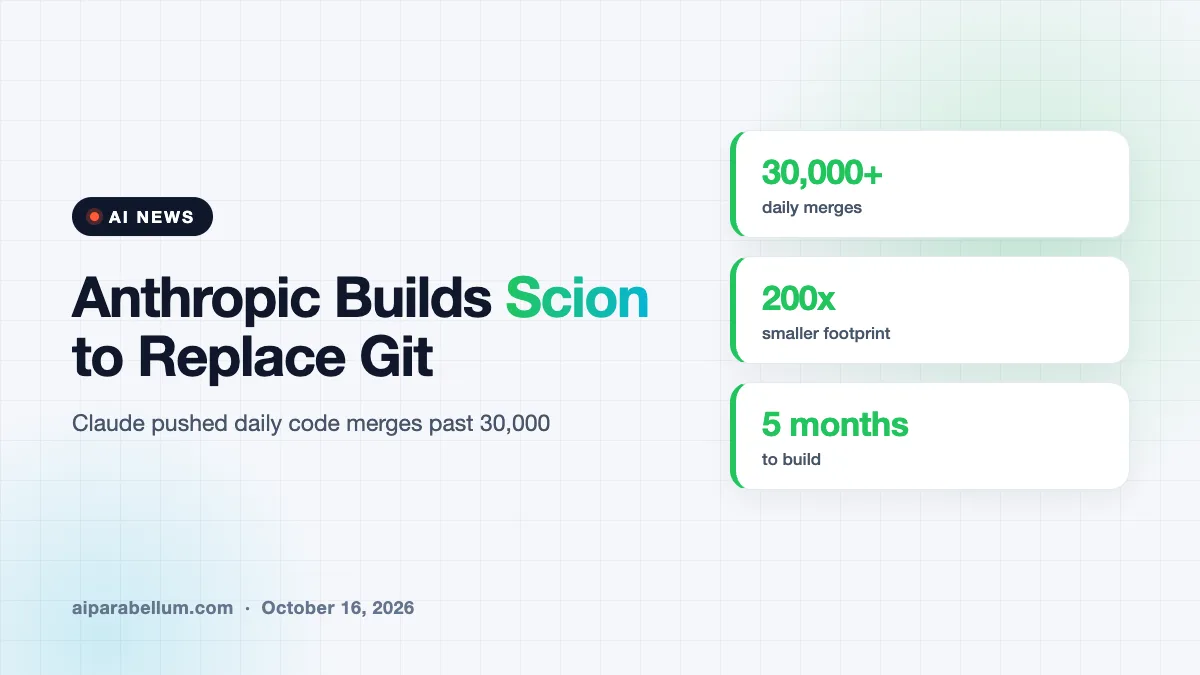
Anthropic has built Scion, an in-house source control system, because its old git setup couldn’t keep up with how much code Claude now writes. The company says daily code merges jumped from about 2,500 in May 2026 to more than 30,000 by September. Anthropic Scion took a seven-person team five months to build and migrate, and Claude did much of the coding.
There’s a catch for everyone else, though. Anthropic says it won’t release Scion publicly or open source it, but it shared the design so other teams can learn from it.
Why Anthropic Outgrew Git
For most of software history, writing code was the slow part. Anthropic says that’s no longer true inside the company, where Claude writes code faster than the surrounding tools can handle it.
The new choke point is the infrastructure built for human-scale work: source control, builds and continuous integration (CI). The company also warned that removing one bottleneck just leads to even more code being produced.
The size of the problem is hard to picture. Here are the numbers Anthropic shared:
| Metric | Figure Anthropic Reported |
|---|---|
| Daily merges in May 2026 | About 2,500 |
| Daily merges in September 2026 | More than 30,000 |
| Main branch size | About 100 GB |
| CI code checkouts per day | Around 25 million |
| Git traffic if fetched naively | Over 600 PB per day |
Git was designed so every developer keeps a full copy of the code and can work offline. That makes sense for people on laptops, but it’s wasteful for AI agents and CI jobs that are always online.
How Anthropic Scion Works
Scion flips git’s model by putting most of the work on the server instead of the client. Its main ideas are easy to follow, even if you’re not a version control expert:
- Always-on server access, so tools fetch only the data they need when they need it
- Source control through an API, so a CI job can ask about code history without a local copy of the repo
- Horizontal scaling, so capacity grows without running hundreds of git mirrors
- A “changeset” as the basic unit of work, stored as an entry in a write-ahead log
A changeset is similar to a git commit. The difference is that it lists the files that changed and points to their compressed contents in blob storage, rather than pointing to a full snapshot of the project tree.
The Results So Far
Anthropic says Scion uses about 200 times less CPU and memory than its old git-mirroring setup. It also says CI and research jobs can now check out code roughly two orders of magnitude faster.
The company isn’t the first to move away from git at huge scale. Google, Microsoft and Meta have each built their own systems for giant codebases over the years.
What Claude Did, and What Engineers Did
Claude was both the cause of the problem and a big part of the fix. When Claude Mythos Preview became available internally, engineers had it rewrite an early pipeline that moved data from git into Scion, and the new version used 20 times less memory and ran four times faster.
The same small team also built a code review interface called Antique, a code search tool and a handful of other systems. Anthropic says this kind of work would normally take a large engineering team years.
Humans still mattered a lot. Anthropic said engineers often had to tell Claude “no,” because agents sometimes broke core system rules to follow a pattern that should never have been allowed.
The takeaway: AI can write the code, but people still have to guard the design rules that keep a system sound.
Why You Can’t Use Scion Yet
Anthropic was blunt that Scion isn’t meant to replace git for general use. It’s built around Anthropic’s own setup, and moving to it would take a lot of migration work for most companies.
Cost is another reason. Anthropic noted that it can spend far more on AI tokens for internal work than most businesses would want to. Instead of a public release, the company says it wants to work with GitHub, GitLab and the open source community to bring some of Scion’s ideas into git.
What This Means for You
Most teams won’t hit 30,000 merges a day anytime soon. Still, if your developers lean heavily on coding agents, the same kind of strain could show up in smaller ways. A few practical lessons stand out:
- Watch your CI queues and checkout times as agent use grows
- Expect review to become a bottleneck before writing code does
- Keep humans in charge of architecture rules, since agents may bend them
- Follow git hosting updates, since some of Scion’s ideas may arrive there
Tooling for agent-heavy teams is growing fast, from agent tracing tools to automated review, and Claude is even showing up in Linux kernel development. If you’re getting started, see how to tame Claude Code prompts, or browse our code assistant tools. You can find more stories like this in our AI news section.
Sources
This article draws on reporting from The Register and The New Stack, both covering Anthropic’s own write-up on Scion.
Conclusion
Scion is a glimpse of a problem that AI coding is creating across the industry: tools built for human speed can’t keep up with machine speed. Anthropic solved it for itself with a custom system, built quickly with Claude’s help. It won’t share the code, but it has shared the thinking behind it. For most teams, the near-term lesson is to watch where AI-made code piles up next. Source control, CI and review are all likely pressure points.