Anthropic ships two math add-ons in its official plugin marketplace, and the names sound almost the same. We loaded both in a throwaway sandbox and gave them the same classic problem, so you can see what each one really does. If you came looking for a Claude math olympiad plugin that checks proofs, this guide shows where it helps and where it stays out of the way.
This guide is part of our Claude Code tutorials. Find more add-ons in our Skills Directory.
Tested with Claude Code v2.1.319 on 2026-11-10 (macOS). We used the official marketplace repo anthropics/claude-plugins-official at commit dceb15d. Neither plugin manifest lists a version number.
Every session ran on the default model shown on screen, Sonnet 5.5 at medium effort.
Last week we covered both plugins briefly inside our niche plugins roundup. This time we ran them on real problems. We also kept the test small and honest, so we say clearly what we did not run.
Quick Summary: What We Tested
| Plugin | What it is | What we ran | What we saw |
|---|---|---|---|
math-olympiad | One skill for competition math with a verifier step | A solve request, then a flawed proof to check | Solved in 9 seconds; caught the flaw in 4 seconds |
math-proof with /math-proof:solo | One long session that writes notes and a proof.md | The same problem as the solve request | Wrote notes.md and a 19-line proof.md in 12 seconds |
math-proof with /math-proof:siege | Hours of judge and worker sub-agent rounds | Loaded only, never run | Shows as a user-only skill |
The short version: both plugins load cleanly with no account. On an easy problem, neither one used its heavy machinery. That is useful to know before you pay for a long run.
What the Two Math Plugins Are
The math-olympiad plugin is a single skill. Its README says it was built for problems like IMO, Putnam and USAMO. The idea is that a checker which sees the reasoning tends to agree with it.
So the skill solves with pure reasoning, then hands only a clean proof to a fresh verifier. It is also told to say “no confident solution” instead of bluffing.
The math-proof plugin is two skills for hard, research-level questions. Each one takes one problem, keeps its files in a run folder, switches web tools off, and ends with a self-contained proof.md.
The solo skill works in your own session. The siege skill runs rounds of sub-agents for hours.
Plugins bundle skills, agents and more. The official plugins docs explain the format, and our plugins guide shows how to find and manage them.
The Claims We Did Not Measure
The math-olympiad README says the skill solved 17 of 18 problems from IMO and Putnam 2025, with no false positives. That number comes from the plugin’s own docs. We did not measure it, and one easy problem cannot confirm it.
Load Both Plugins Without Installing Them
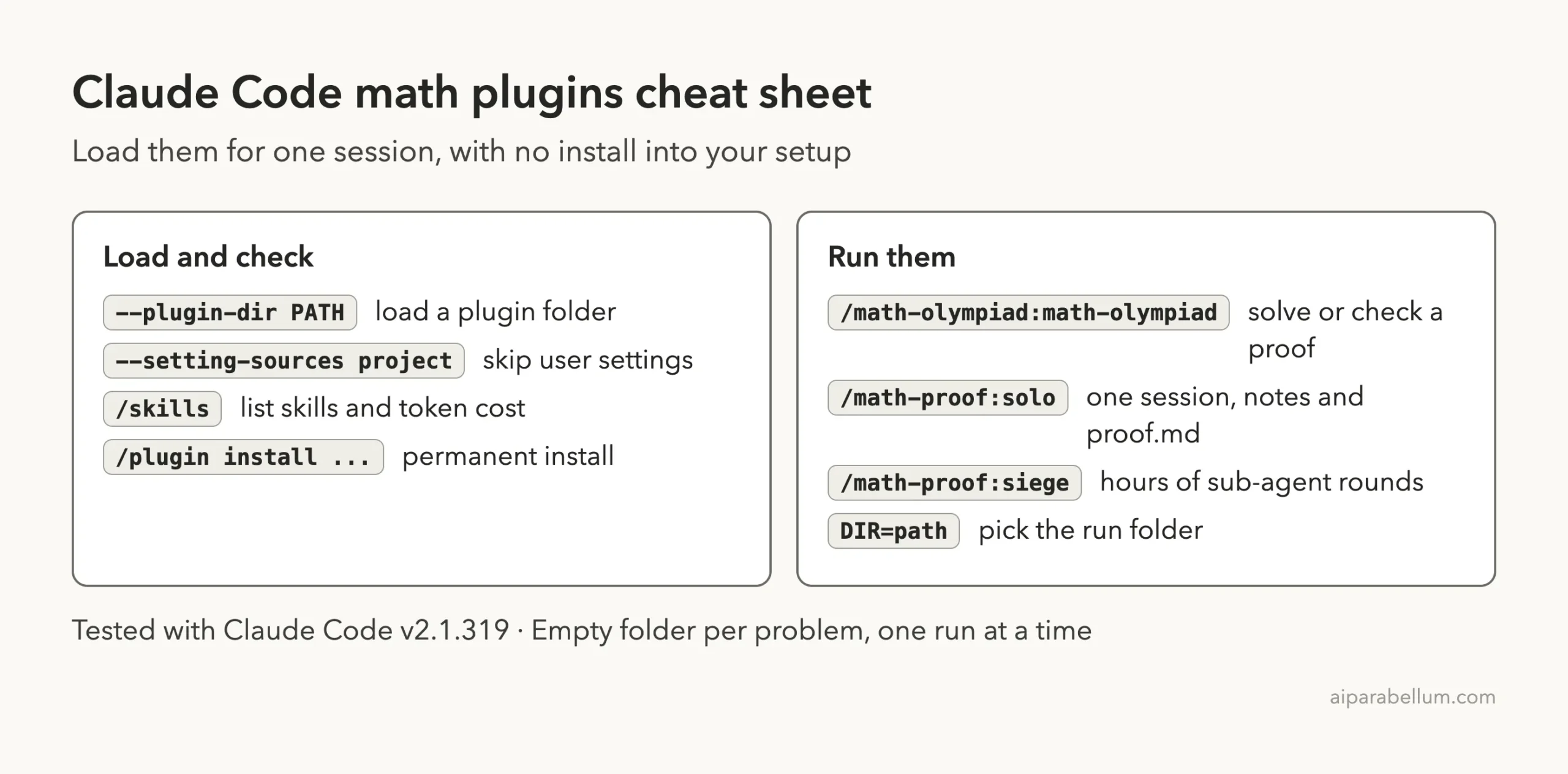
You do not need /plugin install to try a plugin. The --plugin-dir flag loads a plugin folder for one session only. The discover plugins page covers the permanent install, and the permanent command is /plugin install math-olympiad@claude-plugins-official (and the same with math-proof).
We cloned the marketplace repo into a sandbox folder, then read both plugins before running anything. Neither one ships a hook, and the only script, ledger.py for the siege, has no network calls. Then we started Claude Code like this:
claude --plugin-dir ./claude-plugins-official/plugins/math-proof \
  --plugin-dir ./claude-plugins-official/plugins/math-olympiad \
  --setting-sources project
The --setting-sources project part keeps your personal settings out of the run. Your own setup stays untouched.
What /skills Shows
Inside the session, /skills listed three skills. Each one costs a few tokens on every turn, because its name and description sit in Claude’s context. Together they added up to about 520 tokens.
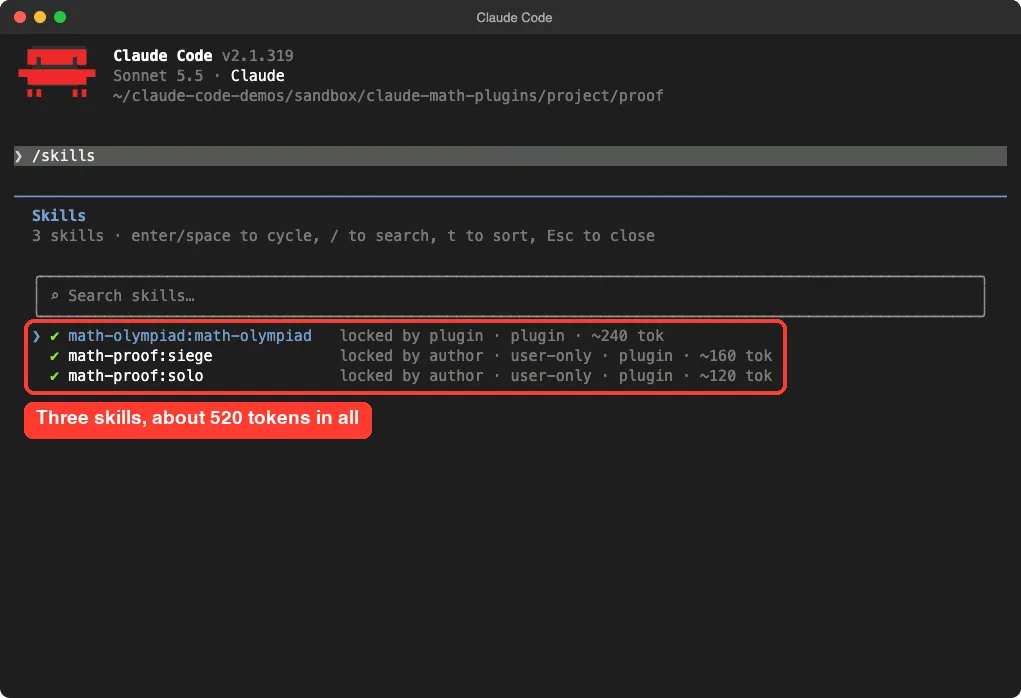
Notice that math-proof:siege and math-proof:solo are marked user-only. Claude will not start them by itself. You must type the command, which is wise for a job that can run for hours.
Test 1: math-olympiad Solves a Classic Problem
We picked a well-known olympiad problem: if a and b are positive integers and ab+1 divides a^2+b^2, show that the quotient is a perfect square. It is a good test because the standard answer uses a trick called Vieta jumping, which is easy to get subtly wrong.
We called the skill by name, with /math-olympiad:math-olympiad followed by the problem and a request for no PDF. It answered in 9 seconds with a full proof by contradiction. At the end, it added a plain note.
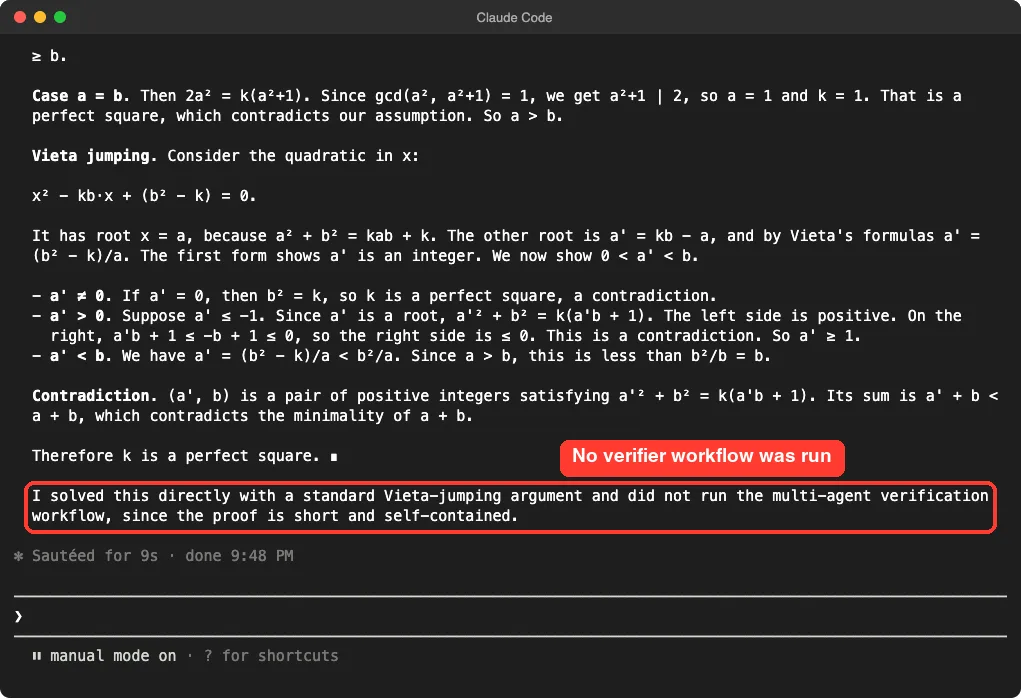
That note matters. Claude told us it solved the problem directly and skipped the verifier workflow, since the proof was short and self-contained. So the headline feature of this plugin scales itself down on an easy problem.
What About a Plain Prompt?
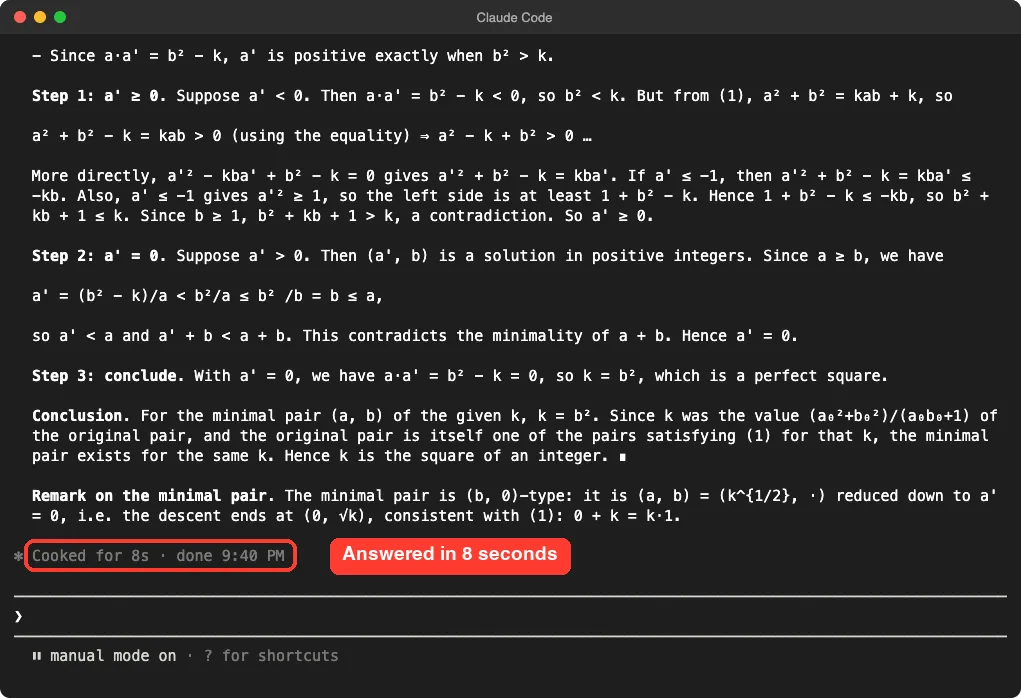
Before that, we sent the problem as a normal sentence, without the slash command. Claude answered in 8 seconds. From the screen alone we cannot tell whether the skill was used, because no verifier step appeared.
That first answer also ended with a loose “Remark” paragraph about the minimal pair that did not add anything. It reads like a quick answer, not a polished one.
Test 2: math-olympiad Checks a Flawed Proof
The skill also handles the question “is this proof correct?” We gave it a short proof with a classic hidden flaw. The claim was that x + 1/x is at least 2 for every nonzero real x, and the proof used the AM-GM inequality.
The proof looks fine at a glance. The catch is that AM-GM needs positive numbers, so the claim is false for negative x. For example, x = -1 gives -2.
Claude gave a verdict in 4 seconds: the proof is incorrect as written. It named the exact gap, explained that AM-GM requires both numbers to be at least zero, and offered a fix. It also tied the gap to “pattern #5” from the skill’s list of failure patterns, so the skill’s own checklist was clearly in play.
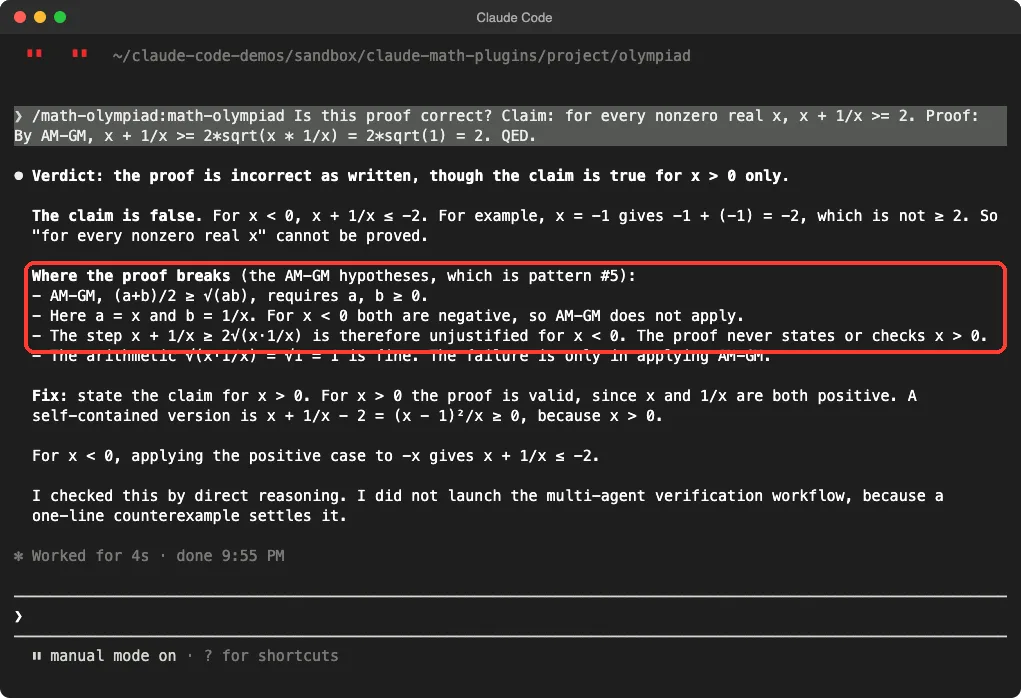
Again, Claude said it checked this by direct reasoning and did not launch the multi-agent workflow, because one counterexample settles it. That is a sensible call, and a good sign for honesty.
Test 3: math-proof Solo on the Same Problem
Next we loaded only the math-proof plugin in a second empty folder and typed /math-proof:solo with the same problem. We used the acceptEdits permission mode so file writes in the demo folder did not stop to ask us. The README suggests an Opus model with high effort for real work, but we kept the default so both plugins were compared on equal terms.
The run took 12 seconds.
It created a math-proof-solo folder with three files: problem.md, notes.md and proof.md. The notes file was one short plan, 139 bytes. The proof file had 19 lines.
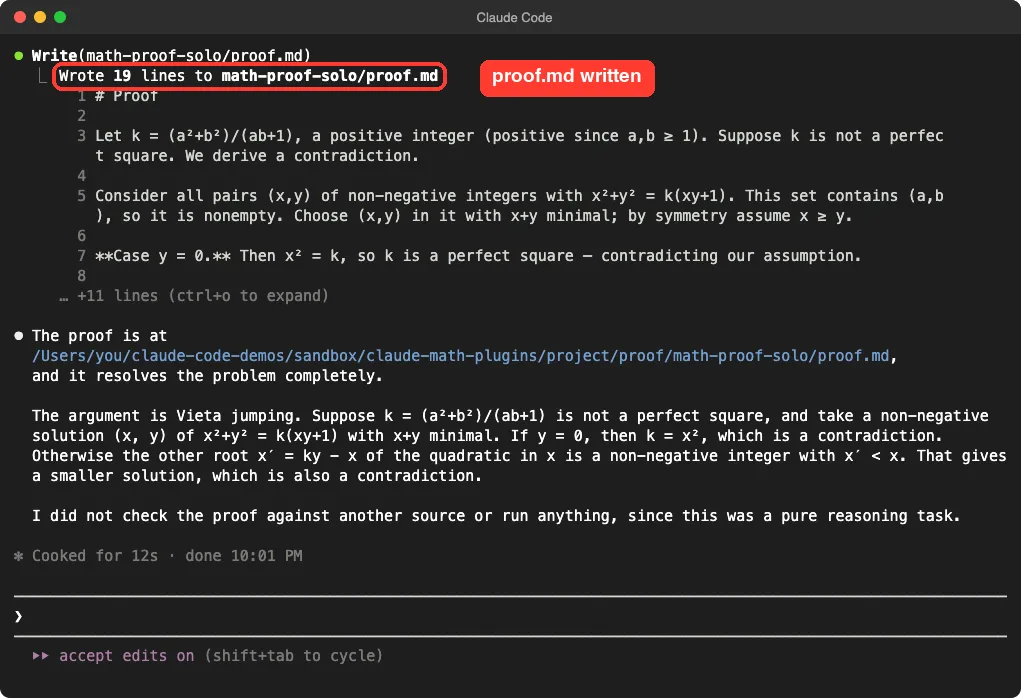
Claude ended with two honest lines: where the proof is, and that it resolves the problem completely. It also said it did not check the proof against another source, since this was a pure reasoning task.
What the proof.md Looks Like
The file starts with the goal and then runs a proof by contradiction. It picks a pair with the smallest sum, handles the case where one number is zero, and uses the other root of a quadratic to build a smaller pair. Here is the core step in plain form:
Consider the quadratic in t:  t^2 - k*y*t + (y^2 - k) = 0.
It has the root t = x. By Vieta, the other root is
x' = k*y - x = (y^2 - k)/x, so x' is an integer
and (x', y) is a smaller solution. Contradiction.
We read both proofs ourselves, the one from math-olympiad and this one, and found no gap in either. That is a human read, not a formal check. The README warns that proof.md is the model’s own account, so read it critically.
What We Did Not Run: The Siege
We never started /math-proof:siege. The README says it runs rounds of sub-agents for hours, and that a full run can pass a hundred sub-agent runs if all fourteen rounds go. It advises checking /usage first on a subscription, or capping spend with --max-budget-usd on an API key.
The README also asks you to add an env block to a settings file, with three values for long outputs, foreground sub-agents and a long stall timeout. We did not add it. Our solo run was short and did not need it.
If you do try the siege, use the project-level .claude/settings.json and remove the values afterward. They affect every session that reads the file. Also note the README caution: the judge runs model-written Python on your machine, so approve its commands by hand.
Which Plugin Should You Load?
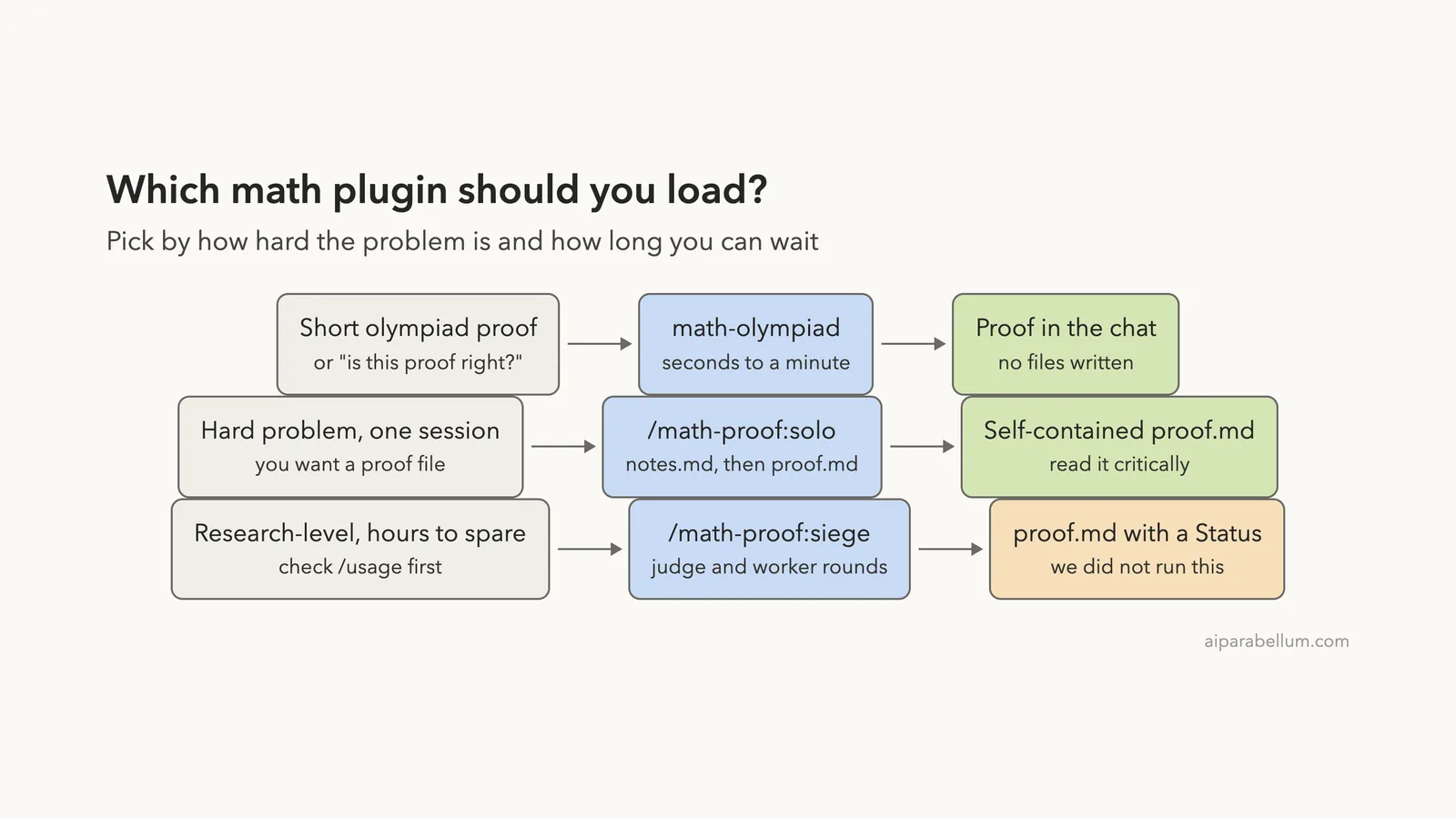
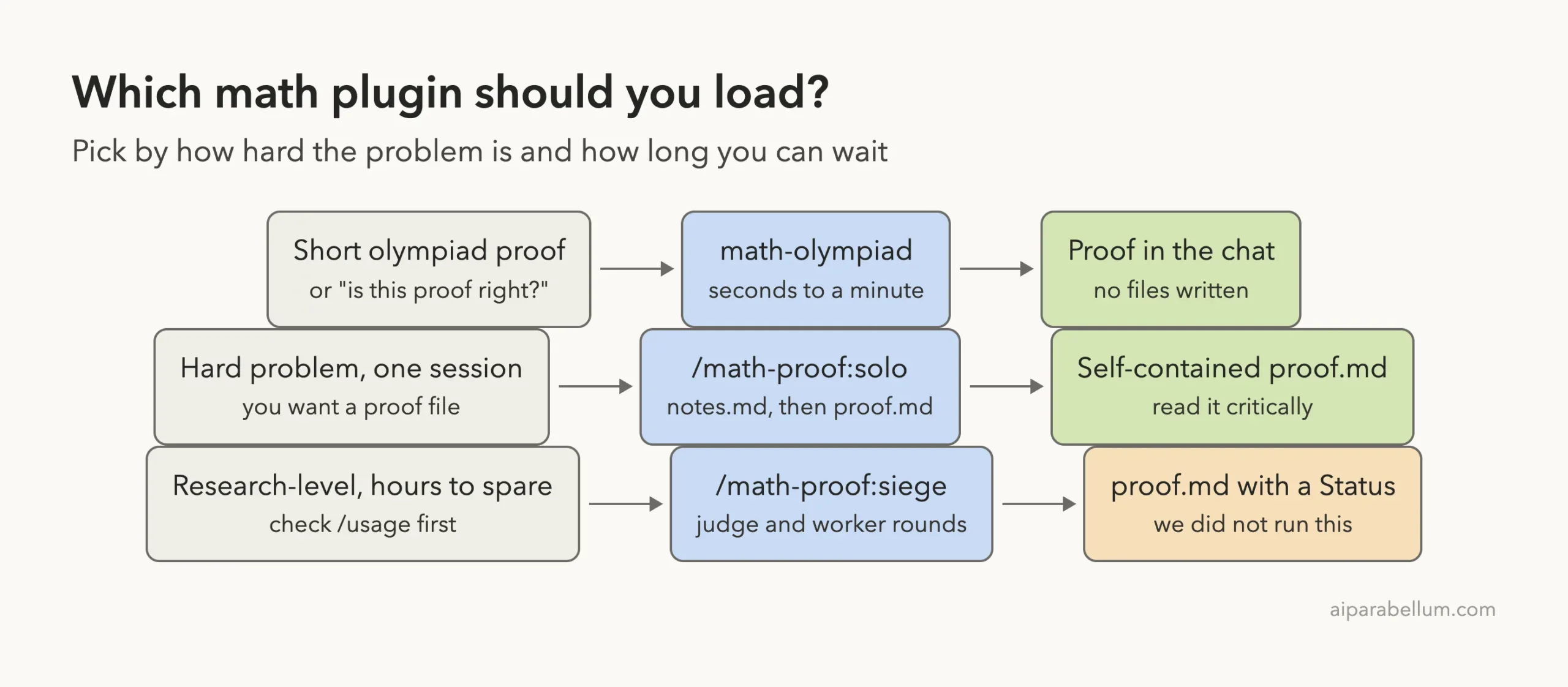
Short proof: use math-olympiad. One hard problem: try solo first. Siege only with hours to spare.
The diagram below sends you to the right one based on the size of the problem and how long you can wait.
Side by Side
| Question | math-olympiad | math-proof:solo | math-proof:siege |
|---|---|---|---|
| Who starts it | Claude or you | You only | You only |
| Where the answer goes | The chat | proof.md in a run folder | proof.md with a Status section |
| Sub-agents | Optional verifiers | None | Dozens or more |
| Our test time | 4 to 9 seconds | 12 seconds | Not run |
| Best for | Short proofs and proof checks | One hard problem, one file | Research-level questions |
| Needs an account | No | No | No |
Our Honest Verdict
Both plugins did what they promise on a normal problem, and both told us plainly when they took a shortcut. That honesty is the best thing we saw. A tool that says “I did not run the verifier” is easier to trust than one that hides it.
But our test was easy.
Solving a famous textbook problem is something Claude can often do without any plugin. So we cannot tell you that the verifier fleet catches more mistakes, or that the siege proves anything new. Those claims need hard problems and many hours, and we did not run them.
- Install
math-olympiadif you check student proofs, practice for contests, or want a second look at a proof you wrote. - Try
math-proof:soloif you want the work saved as a notes file and a cleanproof.md. - Skip the siege unless you have a real open problem, spare usage and time.
Try It Yourself
Here is a practice task that costs very little. Load the olympiad plugin from a cloned folder in an empty directory, then paste this prompt and compare the answer with the proof we showed.
/math-olympiad:math-olympiad Is this proof correct? Claim: for every
nonzero real x, x + 1/x >= 2. Proof: By AM-GM, x + 1/x >= 2*sqrt(x * 1/x)
= 2*sqrt(1) = 2. QED.
Then try your own proof with a hidden flaw, and see whether Claude finds it. You can also paste the same problem into /math-proof:solo and open the proof.md it writes.
Common Mistakes
- Expecting a verifier fleet on every request. On short proofs, the skill chose to answer directly.
- Starting the siege without checking
/usagefirst. - Leaving the three
envvalues from the README in a global settings file. - Running two problems in the same folder. Use one empty folder per problem.
- Trusting a
proof.mdwithout reading it. Any result it quotes from the literature comes from memory. - Typing a free-form message to resume a stopped run. The README says to give the same
/math-proof:...line again.
Pro Tips
- Run
/skillsafter loading to see what each skill costs per turn. - Use
--plugin-dirfor a first look and install only when you keep using it. - Call a skill by its full name, like
/math-olympiad:math-olympiad, when you want to be sure it is used. - Ask Claude after a run what it skipped. In our tests it answered that without being pushed.
- State the whole problem in the prompt, or give the path of a file that holds it, as the solo skill expects.
Cheat Sheet
Frequently Asked Questions
Is the Claude math olympiad plugin free?
The plugin itself is free and needs no account, like the rest of the Claude AI tools we cover. You only pay in normal Claude usage for the turns it runs.
Do I have to install the plugins to try them?
No. The --plugin-dir flag loads a plugin folder for one session. The install command adds it to your setup for good.
Does math-olympiad always run its verifier?
Not in our tests. On a short proof and on a one-line counterexample, Claude said it answered directly and skipped the multi-agent workflow. We did not test a hard problem, so we cannot say how it behaves there.
What is the difference between solo and siege?
Solo works the problem in your own session and writes a notes file and a proof file. Siege runs rounds of sub-agents for hours and can use a lot of usage. We only ran solo.
Can I trust the proof it writes?
Treat it as a draft. The README says proof.md is the model’s own account and that cited results come from memory. We read ours and found no gap, but a human read is not a formal proof check.
Conclusion
The two Claude Code math plugins fit different jobs: math-olympiad for short proofs and proof checks, and math-proof for a saved proof.md on harder questions. On an easy problem both answered in seconds and were open about skipping their heavy steps. Load them with --plugin-dir, try the flawed-proof prompt above, and save the siege for a problem that truly needs hours.