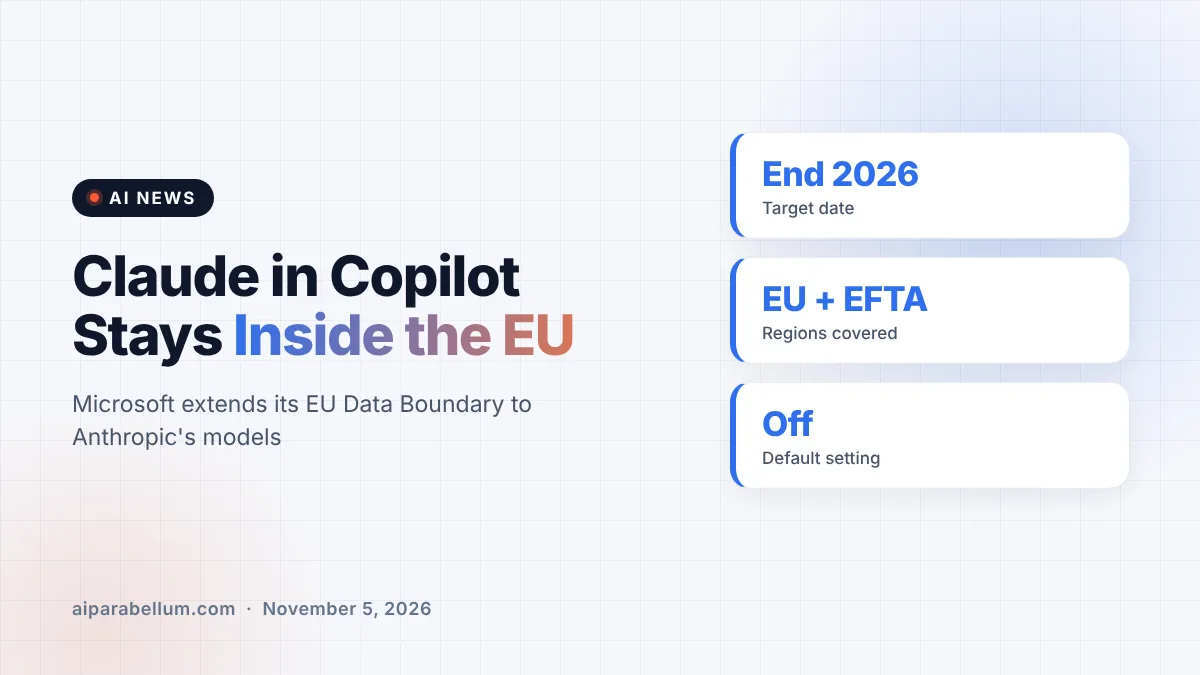
Microsoft says Claude models from Anthropic will soon run inside the EU Data Boundary when European organizations use them in Microsoft Copilot. The change, announced on November 5, 2026, means companies in the European Union and the European Free Trade Association (EFTA) won’t have to pick between Claude and Microsoft’s regional data-processing promises. Microsoft expects this to be in place by the end of 2026.
Until now, that trade-off was a real sticking point for many European IT teams. Regulated businesses and public bodies often need proof that their data stays in the region. Bringing Claude under the same rules removes a big reason to keep it switched off.
What Microsoft Announced About the EU Data Boundary
The EU Data Boundary is Microsoft’s commitment to store and process data for Microsoft 365 and other online services within the EU and EFTA. Microsoft says it goes beyond what current regulations require. Claude models will now join other models, including ones Microsoft operates itself, that already process data inside that boundary.
Here is the short version of what changes and when:
- Claude models in Copilot will process data within the EU Data Boundary for EU and EFTA customers.
- The target is the end of 2026, and Microsoft says it will share more details closer to launch.
- Coverage includes Copilot experiences such as Copilot Cowork, not just basic chat.
- Existing Claude users in Copilot will be moved over automatically, with no action needed.
Microsoft also notes that the boundary is part of its contract terms for eligible Microsoft 365 customers in the region. There is no opt-in step and no extra purchase. Organizations that want tighter control can also keep Microsoft 365 data at rest in their own country, an option available in 10 EU and EFTA countries.
Where Claude Already Shows Up in Copilot
This isn’t Claude’s first appearance inside Microsoft’s tools. Microsoft says Claude models already power work across several Copilot experiences. The new announcement is about where that processing happens, not about adding Claude for the first time.
| Copilot experience | Claude available today | Named in the EU announcement |
|---|---|---|
| Copilot Chat | Yes | Covered as a Copilot experience |
| Copilot in Microsoft 365 apps | Yes | Covered as a Copilot experience |
| Copilot Cowork | Yes | Yes, named directly |
| Copilot Code | Yes | Not named separately |
Microsoft frames this as model choice under one set of rules. The idea is that your people can pick the right model for each task, whether that’s Claude’s writing style or another provider’s model, while admins keep the same controls. If you’ve been comparing Claude versus Copilot, the line between them inside Microsoft 365 keeps getting thinner.
Security and Admin Controls for Claude in Copilot
Microsoft says Claude models in Copilot fall under its enterprise data protection. The company also says customer data isn’t used to train generative AI foundation models. Admins decide who can use Claude at all.
Off by default in Europe
For organizations in the EU and EFTA, the Claude setting is disabled by default. Admins can turn it on for everyone or only for selected users and groups in the Microsoft 365 admin center. Teams that haven’t enabled Claude yet can do so at any time, and processing will shift into the boundary once it’s available.
No migration work for current users
If your organization already uses Claude in Copilot, Microsoft says nothing needs to change on your side. Processing for those models moves into the EU Data Boundary automatically when the feature goes live. That should spare IT teams a round of reconfiguration.
Why the EU Data Boundary Matters for Companies
Data location is one of the first questions compliance teams ask about any AI tool. Banks, insurers, healthcare providers and government agencies in Europe often can’t approve a model that sends data outside the region. By extending the boundary to Anthropic’s models, Microsoft makes Claude easier to approve for those buyers.
It also fits a wider pattern. Anthropic has been signing large enterprise deals, from Workday’s Claude rollout to consulting partnerships. Removing a data-residency blocker in Europe opens another large group of potential users through Microsoft’s sales channel.
Our take: for many European organizations, the hardest part of using a new AI model isn’t the tech, it’s the paperwork. Putting Claude inside a boundary they already trust cuts a lot of that paperwork out.
What This Means for You
If you work at a European organization that runs Microsoft 365, here are practical next steps:
- Ask your IT admin whether Claude is enabled in your Copilot tenant, since it is off by default in the EU and EFTA.
- If your compliance team blocked Claude over data location, flag that this concern is being addressed by the end of 2026.
- Review which users or groups should get access, because admins can limit it rather than turning it on for everyone.
- Watch for Microsoft’s follow-up details on the exact launch date before you change any policies.
If you’re outside Europe, nothing changes for you right now. Still, it’s a sign that Microsoft treats Claude as a core part of Copilot, which matters if you’re weighing Copilot for work against other assistants. You can follow more updates like this on our AI news page.
Sources
Primary source: Microsoft’s announcement on Claude models and the EU Data Boundary.
Conclusion
Microsoft is moving Claude models in Copilot inside the EU Data Boundary, with a target of the end of 2026 for EU and EFTA customers. Existing users will switch over automatically, while new users can enable Claude through the admin center, where it stays off by default. Microsoft says the same data protection and admin controls apply as for its other Copilot models. For European businesses that held back over where their data goes, one of the biggest objections to using Claude at work is on its way out.