PagerDuty has launched PagerDuty Paige, an AI agent built for site reliability engineering that can sit on an on-call rotation just like a human responder. The company announced it on November 3 alongside a renamed flagship product, now called the PD Reliability Platform, and a new early-access program named PD Labs. Paige and the platform are generally available starting today.
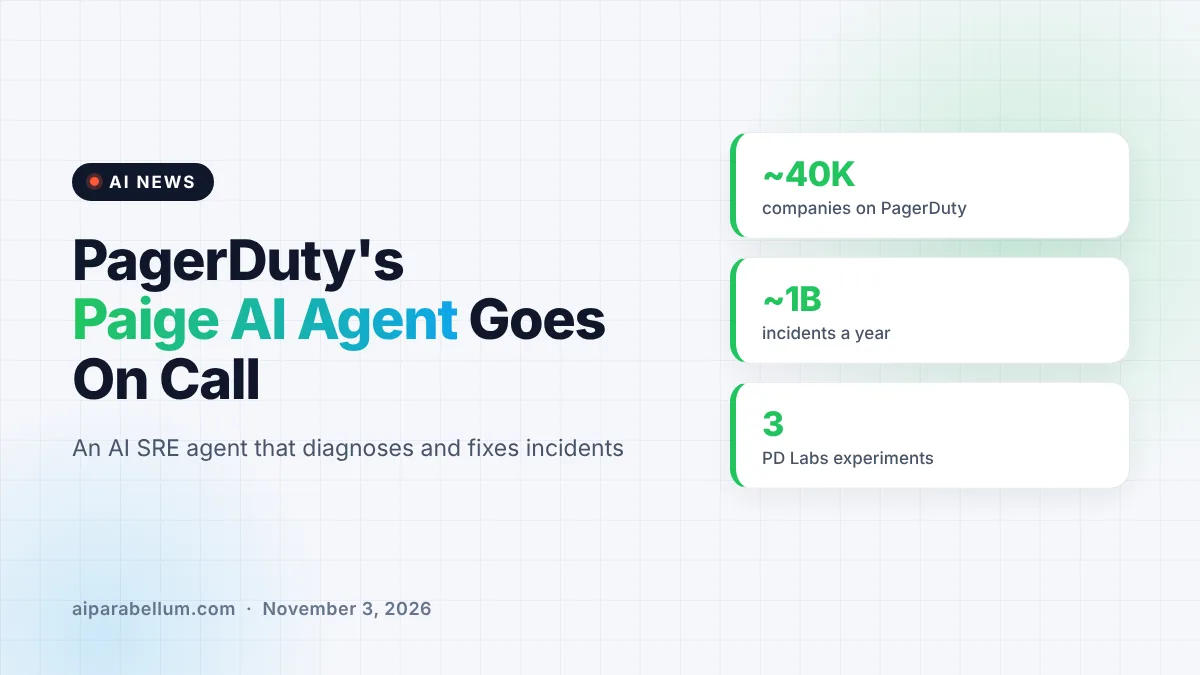
The pitch is simple: if AI is helping write more of the code that breaks, AI should also help fix it. PagerDuty says it handles nearly a billion incidents a year for almost 40,000 companies, so this is a big shift for a tool many engineers already rely on at 3 a.m.
What PagerDuty Paige Actually Does
Paige is PagerDuty’s next-generation SRE agent. It can be added to an escalation policy as a responder, which means a low-priority incident might be handled without waking anyone up. For bigger problems, it does the early digging so the first human on the scene starts with answers instead of a blank screen.
According to PagerDuty, Paige checks past incidents, pulls logs, and runs diagnostics before a person even opens the alert. Its suggestions come with supporting evidence and a confidence level. It can also gather the right people into a Slack or Zoom session and turn on the company’s Scribe agent to take notes.
Permissions stay with each team
Teams decide how much freedom Paige gets. A team that wants a person in the loop gets faster triage, but any fix waits for human approval. Paige acts on its own only in low-risk, well-understood situations that a team has explicitly allowed.
Over time, a team can grant Paige permission to run a proven fix for a known problem without asking first. PagerDuty frames this as trust that the agent earns incident by incident.
Memory that builds over time
After an incident is resolved, Paige drafts the post-incident review and saves what worked to a shared memory. The next time a similar failure appears, Paige consults that memory. PagerDuty also released a benchmark report claiming Paige beat leading AI coding agents at diagnosing simulated IT incidents, though that is the company’s own test.
PagerDuty Paige and the New Reliability Platform
The product formerly known as PagerDuty Operations Cloud is now the PD Reliability Platform. It feeds Paige the context it needs, such as code, docs, runbooks, service maps, and escalation policies. If you are curious how other vendors are handling oversight of AI helpers, our look at agent governance tools covers a similar problem.
Here is a quick breakdown of what launched:
| Product | What it is | Status |
|---|---|---|
| Paige | AI SRE agent that can go on call and diagnose incidents | Generally available |
| PD Reliability Platform | Renamed flagship, formerly PagerDuty Operations Cloud | Generally available |
| Platform Console | One view of incidents, on-call schedules and active AI agents | Part of the platform |
| PD Labs | Early-access program for experimental features | Open to customers |
The new Console shows which agents are switched on and what each one is doing. Responders can also run an entire incident inside Slack or Microsoft Teams, where a trigger opens a dedicated channel and a conference bridge automatically.
Three Early Experiments in PD Labs
PD Labs lets customers test features while they are still being built and talk directly with the engineers behind them. PagerDuty says not every experiment will graduate to the main platform. It launches with three:
- Topology: a live map of your services built from code, infrastructure and runbooks, with no configuration management database required.
- Deep Investigation: Paige tests several root-cause theories at once, ranks them by confidence, and explains what it ruled out.
- SRE Workbench: a shared workspace where people and Paige investigate side by side, with findings saved to the same memory.
Why PagerDuty Is Betting on AI Agents Now
PagerDuty argues that AI coding tools are pushing more software into production with less human review. AI-powered apps also fail in new ways, and CEO John DiLullo pointed to model drift, runaway token spending and leaked personal data as examples. His answer is to “fight fire with fire” by putting AI into incident response itself.
That puts PagerDuty in a crowded field of AI agents for operations, from standalone SRE bots to tools built into observability products. Its argument is that Paige already sits where on-call work happens. Telecom company Telus says it already runs PagerDuty’s Scribe Agent across every incident, so responders do not have to stop and take notes.
What This Means for You
If your team uses PagerDuty, a few practical points stand out:
- Start Paige with human approval turned on, and widen its permissions only for fixes you have seen work.
- Treat the benchmark claim with care, since PagerDuty ran it itself; test Paige on your own past incidents.
- Check the pricing model, which is tied to operational scale with a starting allotment of events, automation actions and user seats, plus flexible credits if you outgrow it.
- Qualified Essential, Plus and Ultimate customers who sign by January 15, 2027 get extra AI actions beyond the seeded amount for one year at no added cost, according to PagerDuty.
Giving an agent access to production also raises security questions, so it is worth reading up on AI agent security before you hand over the keys. Good agent tracing tools can also help you see exactly what an agent did during an outage. For more updates like this one, browse our latest AI news.
Sources
Primary source: PagerDuty’s Paige announcement. Additional reporting from SiliconANGLE.
Conclusion
PagerDuty is moving from alerting people about problems to having an AI agent help solve them. Paige can go on call, gather evidence, suggest fixes and learn from each incident, while teams keep control over what it is allowed to do on its own. The renamed PD Reliability Platform and PD Labs round out the launch. Whether Paige lives up to its benchmark claims will depend on how it performs in real outages, but for on-call engineers, fewer 3 a.m. wake-ups is an appealing promise.