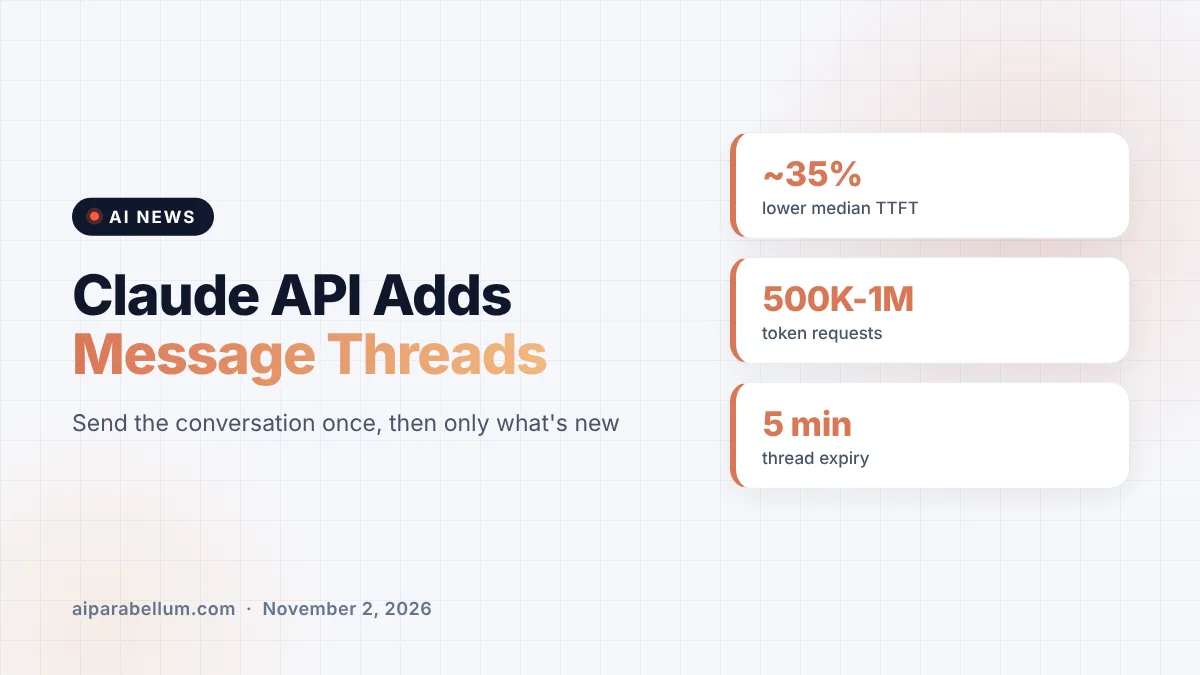
Anthropic has launched Claude message threads, a new public beta feature in the Messages API that lets an app send a conversation once and then share only what is new on each turn. The goal is simple: cut the wait before Claude starts answering when an agent is carrying a huge amount of context. Anthropic says median time to first token drops by about 35% on very long requests.
What Claude Message Threads Change
Today, an agent that talks to Claude has to resend the whole conversation on every request. That includes every earlier message, every tool result and every file it has looked at. A coding agent can make hundreds of these calls in one session, so the payload keeps growing.
Once a conversation reaches hundreds of thousands of tokens, simply uploading and processing all of it again adds delay before the reply begins. Message threads keep the conversation on Anthropic’s side for a short time. Your app then sends only the new turn plus a pointer to the last response.
How a thread works, step by step
- Create: the first request carries the full conversation, the system prompt and the tools, plus a thread setting that starts a new thread.
- Continue: each later request sends only the new messages and the ID of the previous response, leaving out the system prompt and tools.
- Replay: if the thread has expired or cannot be continued, the API returns a 404 error and your app sends the full conversation again to start fresh.
Developers turn this on with a beta header and one new thread parameter. Anthropic’s SDKs include a thread helper that builds these requests and handles the replay step automatically.
Speed Gains for Long Claude Sessions
The headline number comes from Claude Code itself. Anthropic says message threads are already on by default for most Claude Code users, and requests between 500,000 and 1 million tokens saw median time to first token fall by about 35%.
The company is clear about one limit: this is a speed feature, not a cost feature. Claude still reads the full conversation on every turn, so token usage stays the same and standard token rates and rate limits apply.
| Detail | What Anthropic says |
|---|---|
| Status | Public beta in the Messages API |
| Main benefit | Lower time to first token on long conversations |
| Measured gain | About 35% lower median TTFT at 500K to 1M tokens |
| Thread lifetime | Expires 5 minutes after the last request |
| Storage | Held in memory, encrypted, not written to disk |
| Pricing | Standard token rates and existing rate limits |
Where Message Threads Help Most
Anthropic points to workloads where context piles up quickly. The more an agent carries, the bigger the gain tends to be.
- Long-running coding agents, where each file edit or tool result adds to the history.
- Computer use agents, where screenshots stay with the thread instead of being uploaded again on every turn.
- Document and image-heavy workflows, where each request becomes much smaller.
The feature is available on the Claude API, Claude Platform on AWS, Claude in Microsoft Foundry and Claude Models on Google Cloud (Anthropic managed). If you already run Claude through a cloud provider, check which route you use before you plan around it.
The Fine Print Developers Should Know
Threads are best-effort, so your app must stay the source of truth for the conversation. The developer docs say a thread is deleted no more than one hour after its last use, and a continue request can fail for reasons the API does not explain. That is why every integration needs a replay path from day one.
Prompt caching does not happen on its own inside a thread. You still choose cache breakpoints, and a thread request can carry at most four of them, so the ideas in our guide to prompt caching savings still apply. MCP server URLs, MCP tokens and the container ID are not stored, so those must be sent on every request that uses them.
A few other rules matter for streaming and editing. You should continue a streamed response only after the final stop event arrives, and each response ID can be continued only once. To edit or branch an earlier message, you start a new thread.
What This Means for You
If you use Claude through Claude Code, you may already be getting this speedup without changing anything. Long sessions should feel snappier once the context grows large.
If you build your own agents on the API, here is a practical checklist:
- Try threads first on your longest agent loops, where the gain is largest.
- Keep your own copy of every message and test the replay path on purpose.
- Do not expect a lower bill; pair threads with smart caching and the habits in our token usage tips if cost matters.
- Remember threads expire after five quiet minutes, so slow human-in-the-loop flows will replay more often.
For more Anthropic updates, see our latest AI news coverage.
Sources
Primary source: Anthropic’s message threads announcement. Additional details from the Claude Platform message threads docs and the Claude Platform release notes.
Conclusion
Message threads tackle one of the quiet pain points of long-running AI agents: the growing pause before each reply as context piles up. By keeping the conversation on the server for a few minutes, Anthropic cuts that wait by about a third on the biggest requests without changing what developers pay. The trade-off is extra care in the client, since threads can vanish and must be replayed. For teams running heavy coding or computer use agents, it is a low-effort change worth testing now.