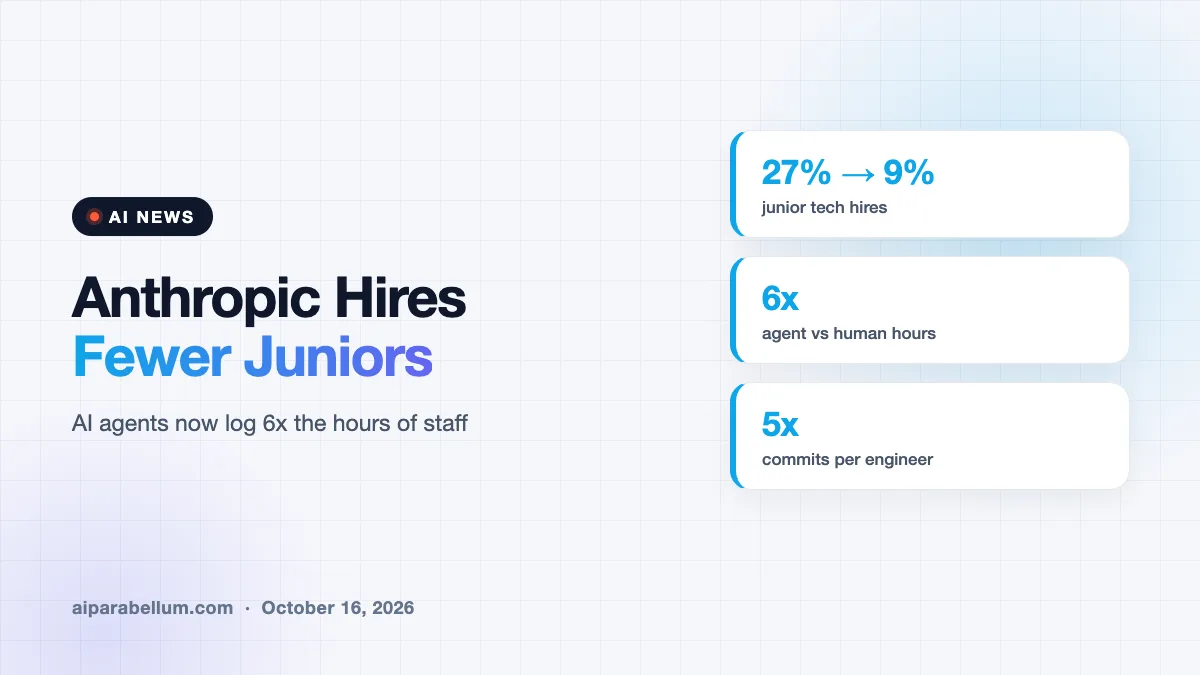
Anthropic has published a detailed look at its own workforce, and the biggest finding is about Anthropic junior hiring. The share of entry-level technical hires has dropped sharply as AI agents took over more coding work inside the company. By August, the agents run by employees were logging six times as many hours as the people using them.
What the Report Found About Anthropic Junior Hiring
The study comes from the Anthropic Institute and draws on internal hiring records, AI usage data, calendars, surveys and 17 employee interviews. Its authors argue that a company this deep into AI could be an early signal of where other workplaces are heading. Still, they stress that an AI lab is not a typical employer.
The clearest change is in who gets hired. Talk of weaker demand for junior engineers started inside core technical teams in January 2026. By April, engineering and research teams had pulled back on hiring for lower-level technical roles.
| Measure | Before | Now |
|---|---|---|
| Junior share of technical staff | 21% (early 2025) | 14% |
| Junior share of technical hires | 27% | 9% |
| Technical departments’ share of all staff | 61% | 56% |
| Coding-agent sessions per month for non-technical staff | 2 (August 2025) | 90 (May 2026) |
| Standing written instructions for agents | A few hundred (July 2025) | About 8,500 |
Fewer Admin Roles, More Cross-Team Moves
Administrative jobs that usually grow with a company have stayed lean, helped by agent assistants and automated review. Meanwhile, people who had been at Anthropic for at least a year were 50% more likely to switch departments each month in 2026 than in 2025. One content team that once wrote product greetings now writes prompts and evaluations for Claude instead.
How AI Agents Changed Work at Anthropic
Agent work hours passed human work hours for the first time in March 2026, according to the report. Code commits per engineer now run at five times the pace of six months earlier. Lawyers processed more contracts, and sales reps closed deals with more clients after adopting agents.
To test whether AI tools caused the jump, researchers tracked 192 engineers who adopted coding agents against 74 who did not. Output rose sharply after adoption. They also found no difference in how often agent-written code was later removed or reverted compared with code people wrote directly.
Human Attention Is the New Bottleneck
The report says interactive Claude sessions spend about 80% of their time idle, waiting for a person to respond. Even for non-technical teams, reading all of their agents’ output would take more than half the work week. As a result, “meta-work” like writing specs and monitoring agent pipelines grew from 10% of sessions in fall 2025 to 22% in spring 2026.
People did not stop talking to each other, though. The median employee now spends 20% more time in meetings than a year ago, and technical individual contributors are up 16%.
What Anthropic Hiring Managers Want Now
Hiring notes show managers care far more about how candidates use AI. In 2024, comments on AI tool skills showed up in about 5% of technical and 7% of non-technical interview assessments. By 2026 those rates had roughly tripled and quadrupled.
- For technical roles, the biggest gains were in comments on autonomy and judgment.
- Talk about narrow domain expertise shrank as a share of assessments.
- For non-technical roles, customer and mission focus rose while pure execution skills got less attention.
Anthropic also says it is building an internal early warning system that flags roles facing AI-driven change. The goal is to move affected employees into better-fitting jobs before their work disappears.
What This Means for You
You do not work at an AI lab, but the patterns here may reach your field sooner than you think. If you are early in your career, the message is to build skills that agents cannot easily replace. Practical steps worth taking now:
- Get comfortable running and checking AI agents, not just chatting with them. Our guide on AI agents replacing older tools shows where this is heading.
- Show judgment on real projects, since that is what hiring managers increasingly look for.
- Write clear specs and instructions, because that “meta-work” is now a core skill.
- Keep decisions documented, so both teammates and agents have the context they need.
If you code, tools like Claude AI already handle much of the routine work described here. Anthropic’s earlier move to build its own Git replacement shows how far agent output has grown inside the company.
Sources
This article is based on Anthropic’s research report How employment is changing at Anthropic and its companion summary Working at the frontier shapes expectations for the future.
Conclusion
Anthropic’s own data shows junior technical hiring falling from 27% to 9% of hires while AI agents grew to outwork staff six to one. Productivity rose across engineering, sales and legal, but human attention became the main limit on how much agents can do. Hiring managers now prize autonomy, judgment and skill with AI over narrow expertise. These are a single company’s internal numbers, so they will not map neatly onto every workplace. Even so, they offer an early look at how AI-heavy work may reshape entry-level jobs.