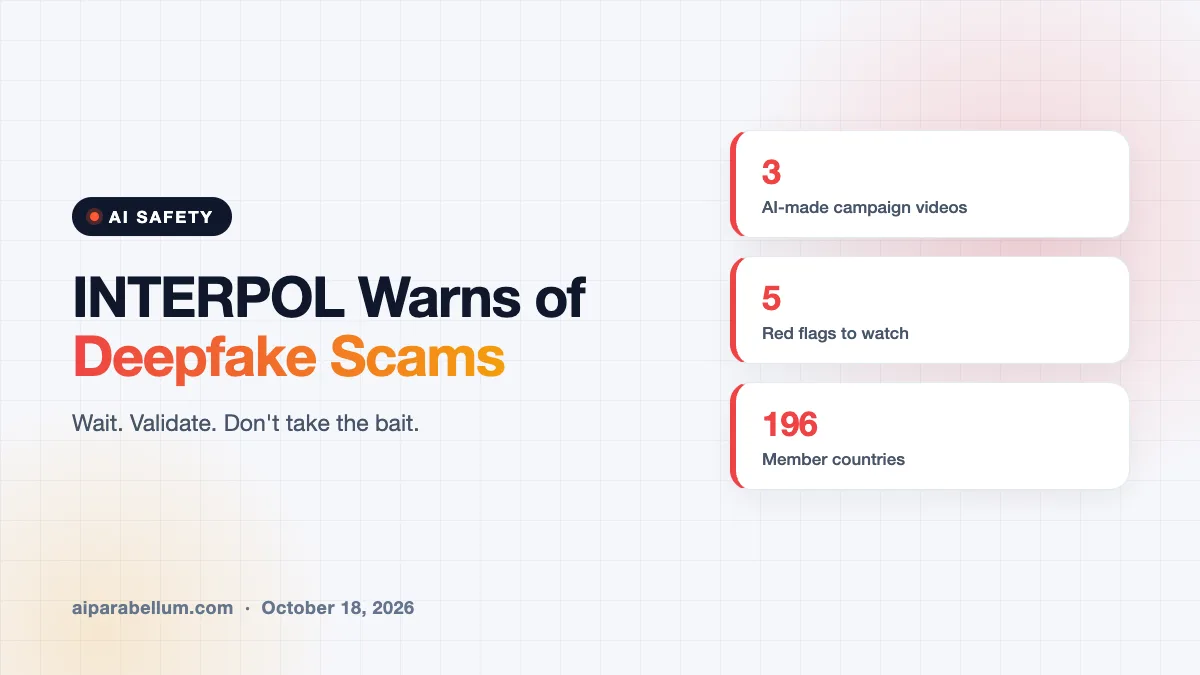
INTERPOL has launched a public awareness campaign about AI deepfake scams, warning that fake faces and cloned voices are now aimed at ordinary people, not just celebrities. The global police organization announced the effort from Singapore on October 18, with a simple rule for anyone who gets a suspicious call or video: wait, validate and don’t take the bait.
What the Deepfake Scam Campaign Includes
The campaign is built around three short videos. In a fitting twist, the videos are themselves AI-generated, showing how synthetic media can be used to trick people.
INTERPOL says generative AI tools no longer need much skill or money to use. With just a small amount of content found online, they can copy a real person’s face or voice convincingly.
From Public Figures to Private Citizens
Deepfakes used to be seen mainly as a threat to famous people. INTERPOL says that has changed, and these scams now target everyday people through investment fraud, impersonation, romance scams, sextortion, deepfake pornography and disinformation.
In real life, that might be a video call from a “colleague” asking for a bank transfer. It could also be a panicked call from a “family member” in trouble, or an online relationship that feels genuine but isn’t.
Toshinobu Yasuhira, director of the INTERPOL Innovation Centre, says AI is wiping out the classic signs of a scam. Spelling mistakes, off-brand logos and clumsy formatting, once easy giveaways, are quickly disappearing.
Red Flags of AI Deepfake Scams
INTERPOL lists five warning signs that should make you slow down. Here they are in plain terms.
| Red flag | What it looks like |
|---|---|
| Unsolicited contact | Someone reaches out out of the blue and steers the chat toward money or personal details |
| Urgency | You’re pushed to act right now, often because of a claimed crisis or emergency |
| Emotional manipulation | Fear, distress or demands for secrecy keep you from asking anyone else |
| Unusual payment methods | Requests for wire transfers, crypto or gift cards that are hard to trace |
| Fast-moving relationship | An online romance turns intense quickly and moves off the dating platform |
The common thread is pressure. Scammers want you acting on emotion before you have time to check anything.
A deepfake only works if you trust what you see and hear in the moment, so the best defense is simply taking a moment.
How to Protect Yourself, According to INTERPOL
The advice for individuals is practical and doesn’t require any special tools. INTERPOL suggests these four habits.
- Stay calm and skeptical: take time to think, even if you believe you know the caller, and talk it over with someone nearby.
- Verify on your own: hang up and contact the person through a number or channel you already know. For online matches, check that their photos aren’t taken from somewhere else.
- Set a safe word: agree on a secret phrase or question with close family and friends to confirm identity on odd calls.
- Lock down accounts: turn on two-factor authentication for all your online accounts.
The safe word tip is especially useful against cloned voices. Our guide on AI voice scams explains why these calls can sound so real.
Extra Steps for Businesses
INTERPOL also asks companies to train staff on deepfake scams, voice phishing and social engineering. It recommends multi-step checks for money transfers, including face-to-face confirmation for large sums, and keeping software up to date.
If you think you’ve been targeted, INTERPOL says to contact local police right away. If you’ve already sent money, call your bank as soon as possible.
Part of a Wider Effort on Synthetic Media
The campaign is the public-facing side of Project SynthWave PLUS, which supports police in Southeast Asia and beyond with research, awareness and training on synthetic media threats. The project is funded by the Government of Japan.
INTERPOL connects police forces in 196 member countries. So while the project’s focus starts in Southeast Asia, the warning signs it describes apply to scams anywhere, including the US.
What This Means for You
You don’t need to become a deepfake expert to stay safe. You mostly need a few habits that break the scammer’s script.
- Treat any urgent money request as suspicious, even if the face or voice looks right.
- Call back on a number you already have before sending anything.
- Pick a family safe word this week, before you ever need it.
- Learn the visual signs with our guide on spotting deepfake videos.
Phone makers are adding help too, like the Android scam detection features rolling out in messages. For broader tips, see our AI scam prevention guide, and keep up with new threats on our AI news page.
Sources
This article is based on INTERPOL’s official announcement, INTERPOL, published October 18, 2026.
Conclusion
INTERPOL’s new campaign warns that AI deepfake scams have moved from celebrities to everyday people, using fake video calls, cloned voices and fast online romances. Its three AI-generated videos carry a simple rule: wait, validate and don’t take the bait. The red flags to watch are surprise contact, urgency, emotional pressure, odd payment requests and relationships that move too fast. Verifying through a known channel, setting a family safe word and using two-factor authentication go a long way. The tools behind these scams are getting better, but a short pause is still one of the strongest defenses you have.