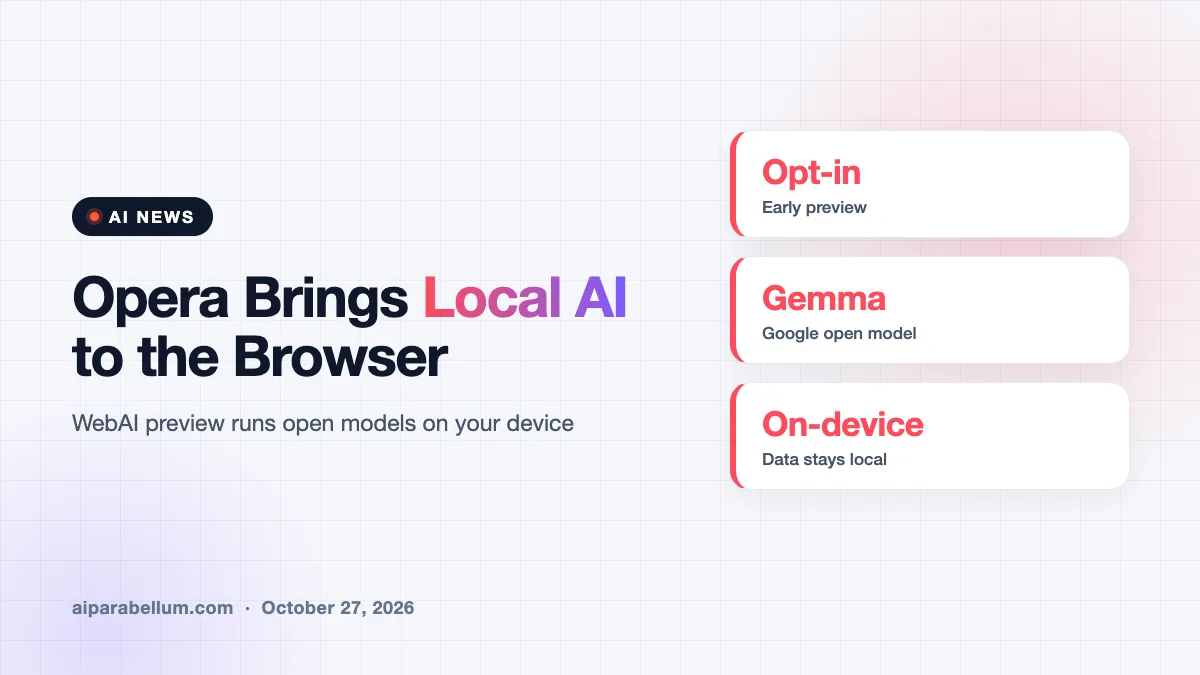
Opera has started putting local AI models straight into its browser. The company’s new WebAI feature lets websites and extensions run AI on your own computer instead of calling a cloud service, and an early preview is live today in Opera One.
It is a small launch with a big idea behind it: a lot of everyday AI work may not need a data center at all.
What Opera Launched Today
Opera says it began shipping local AI models in its browsers on October 27, 2026. The first piece is WebAI, which arrives as an opt-in early preview in Opera One. Opera GX and Opera Neon are next in line.
WebAI is a proposed web standard that Opera describes as backed by companies such as Google and Microsoft. It gives websites and browser extensions a way to use AI models hosted through the browser itself. Opera’s version is model-agnostic, so it is not locked to a single AI provider.
Which models work at launch
At launch you can already tap into Google’s open-weight Gemma model. On Macs, Opera also supports Apple’s on-device foundation model. Opera says more open models, tuned for different devices, are coming.
How Local AI in the Browser Works
Normally, an AI feature on a website sends your text to a company’s servers and waits for an answer. With local AI in the browser, the model runs on your laptop, so the data never leaves your machine.
Opera says WebAI can generate text, classify content and work out how pieces of information relate to each other. Its own example is an extension that sorts your tabs, flags clickbait or spots relevant job posts, with no account, no fee and no data sent to an AI service.
| Feature | Cloud AI | Local AI (WebAI) |
|---|---|---|
| Where the model runs | Company servers | Your own computer |
| Cost to users | Often a subscription | No AI subscription needed |
| Cost to developers | Pay for every request | No AI infrastructure to run |
| Where your data goes | Sent to a provider | Stays on your device |
| Speed | Depends on the provider | Depends on your hardware |
Privacy Controls and System Requirements
Opera is leaning on privacy here. The feature is opt-in, and nothing is downloaded until you turn it on. Site-specific permissions also let you decide which websites can reach the local models.
The preview runs on 64-bit Windows PCs with Intel or AMD chips and on Macs with Apple silicon. Because the model runs on your device, an older or slower computer will feel it. Local processing keeps your data close, but it does not remove every privacy risk.
This is also part of a wider push toward on-device AI. If you follow that trend, our coverage of local AI agents and of Perplexity Computer shows the same direction from other companies.
Also Launching: HTML-in-Canvas
Alongside WebAI, Opera released HTML-in-Canvas. It lets developers place real, interactive web pages inside 2D and 3D scenes, with menus, buttons and forms that still work as the scene moves. Opera built two demos, Webpage Bulldozer and Gamer Room, and says they run in its browsers with no setup.
It is not an AI feature, but Opera is clearly aiming it at games and Opera GX users.
What This Means for You
You do not need to change anything today, since WebAI is an early preview. Still, there are a few practical points to keep in mind.
- If you use Opera One on a supported computer, you can opt in and try the local models yourself.
- If you care about privacy, local models mean your text is not sent to an AI company’s servers.
- If you build extensions, WebAI could let you add AI features without paying for every request.
- If your computer is older, expect slower results, since your hardware does the work.
Privacy-minded readers may also like our look at Claude Code privacy and our look at the Sigma AI browser. You can follow similar launches in our AI news section.
Why Browser Makers Care About On-Device AI
Browsers sit in front of almost everything people do online, which makes them a natural home for AI that runs close to the user. Opera first offered built-in access to local models in an experimental developer build in 2024. Its executive in charge of browsers and AI, Krystian Kolondra, says the company first shipped local models to developers then and is now bringing them to everyone.
A shared standard matters too. If WebAI catches on, a website could ask the browser for a local model instead of bundling its own. That would make AI features cheaper to build and easier for you to control.
Sources
Primary source: Opera’s announcement. Additional reporting from TechCrunch and 9to5Mac.
Conclusion
Opera’s WebAI preview is an early but concrete step toward AI that lives on your own computer. It trades cloud power for privacy and lower cost, and your hardware decides how well it performs. If other browsers follow the same standard, running AI locally could become a normal part of browsing.