
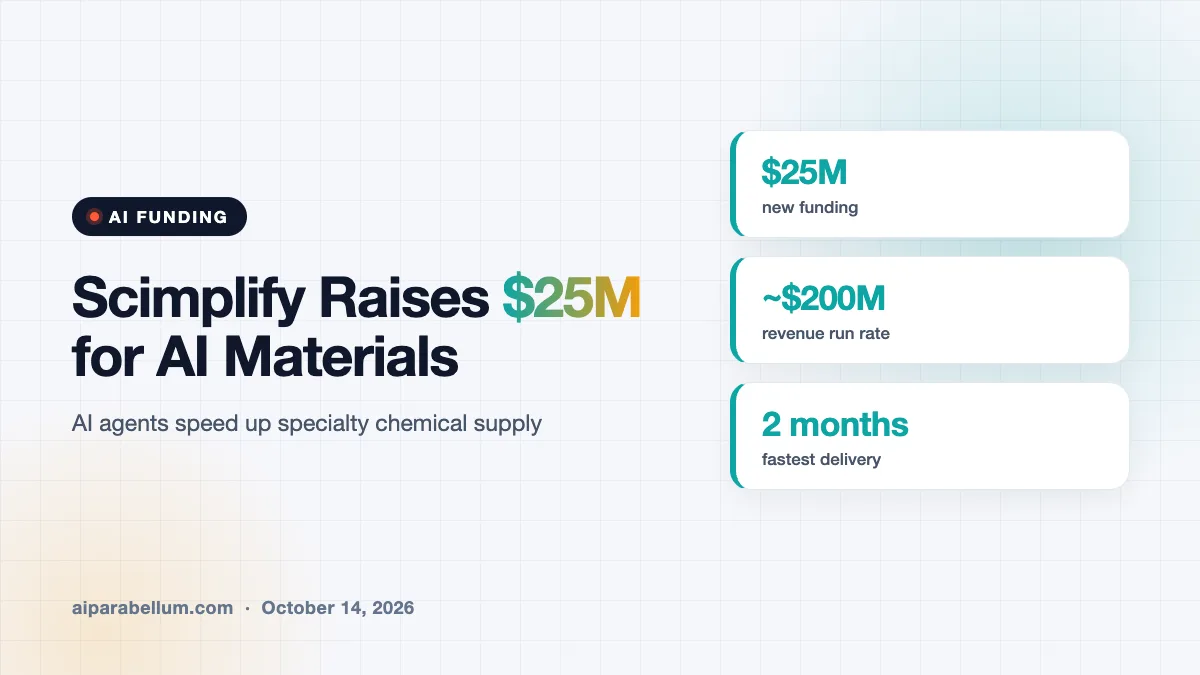
Scimplify, a Bengaluru startup that uses AI agents to plan and run specialty chemical production, has raised $25 million in new funding. The Scimplify funding round is aimed at a big target: helping manufacturers find alternatives to Chinese suppliers for chemicals and critical materials used in chips, defense gear and energy systems.
The company says it can sometimes take a customer from a written spec to finished material in about two months. That same work usually takes 12 to 18 months, according to co-founder Sachin Santhosh.
Inside the Scimplify Funding Round
This was an all-equity strategic round led by Hitachi Ventures. Two of the startup’s customers, Henkel and Teknor Apex, joined as new investors. Earlier backers Accel India, Bertelsmann India Investments, Omnivore and 3one4 Capital also put in more money.
Scimplify did not share its valuation. A person familiar with the deal put it at $250 million after the investment, up from $150 million after a $40 million Series B in March 2025. The startup says its total equity funding now stands at $80 million.
| Detail | Figure |
|---|---|
| New funding | $25 million (all equity) |
| Lead investor | Hitachi Ventures |
| Reported post-money valuation | About $250 million |
| Total equity raised | $80 million |
| Annualized revenue run rate | About $200 million (3x in a year) |
| U.S. revenue run rate | About $60 million, up from $10 million |
| Employees | About 340, including roughly 70 scientists |
How Scimplify Uses AI Agents in Chemical Production
Discovering a promising new material is only half the battle. Turning it into something a factory can produce at scale means designing a process, qualifying plants and passing strict quality checks. That slow middle step is the one Scimplify wants to shrink.
The Scinode platform
When an order comes in, Scimplify’s scientists work out the manufacturing process in its labs in Bengaluru and Hyderabad. The job then moves to partner factories for full production. The company’s in-house platform, called Scinode, helps by picking production routes and plants while tracking quality and regulatory rules.
Scinode splits the work across specialized AI agents, each focused on one area. Santhosh said the agents work backward from what the customer needs and keep that context for future orders. It’s a practical example of how AI agent tools are moving beyond chat windows and into physical supply chains.
- Research agents help figure out how to make a material.
- Manufacturing agents match the job to suitable plants.
- Quality-control agents track standards and compliance.
Scimplify’s own team oversees output across a network of more than 500 manufacturing sites. It serves over 1,000 customers and has shipped to more than 40 countries. Named customers include TDK, BASF and Hitachi.
Why the U.S. Matters to This Startup
The U.S. is now Scimplify’s fastest-growing market. Santhosh said the company’s American revenue run rate jumped about sixfold in a year, to roughly $60 million, or about 30% of the business. Customers outside India now bring in more than half of total revenue, compared with under 5% about 18 months ago.
Today, about 90% of its manufacturing happens in India. Over the next year, the startup plans to expand production into the U.S. and Japan. It has set aside around $7.5 million of the new money for the U.S. push and about $2 million for more work on Scinode.
Reducing Reliance on China for Critical Materials
The bigger story here is supply chain risk. Many specialty chemicals and critical materials come from a small number of countries, with China at the top of the list. Scimplify is pitching itself as a faster way to set up a second source.
Energy, electronics and defense now make up about 45% to 50% of its revenue, up from less than 15% a year ago. The company is working on tungsten derivatives made from scrap and on rare earth materials, two areas where China dominates supply. Rising demand for AI data centers and electronics, plus wartime defense needs, are driving much of that growth.
AI’s next big payoff may not be a smarter chatbot. It may be shaving a year off the time it takes to build a factory-ready supply of a scarce material.
What This Means for You
You probably won’t buy anything from Scimplify directly, but this kind of company shapes the prices and availability of the electronics you use. Here’s what’s worth noticing:
- AI agents are being trusted with real-world industrial jobs, not just emails and code.
- Faster second sources for materials could ease shortages that hit chips and batteries.
- Investors keep backing agent-driven startups, much like the recent Pluto Security round on the security side.
- If you run a business, the same idea of splitting work across focused agents applies to smaller workflows too. Our look at how AI agents are replacing traditional integrations explains how.
Keep in mind that the revenue, growth and timeline figures come from the company itself. Scimplify also says it has been EBITDA-positive for two months and expects an after-tax profit this month, with a goal of a $400 million revenue run rate within a year. For more daily updates, browse our latest AI news or explore top AI business tools.
Sources
This article is based on reporting by TechCrunch, including its interview with Scimplify co-founder Sachin Santhosh.
Conclusion
Scimplify’s $25 million raise shows how AI agents are moving into heavy industry, where speed can matter as much as cost. Backed by Hitachi Ventures and two of its own customers, the startup wants to cut material development from over a year to a couple of months. Its U.S. expansion and work on tungsten and rare earths put it right in the middle of the push to loosen China’s grip on critical supplies. The growth numbers are the company’s own, so the next year will show whether its agent-driven approach can scale outside India.
