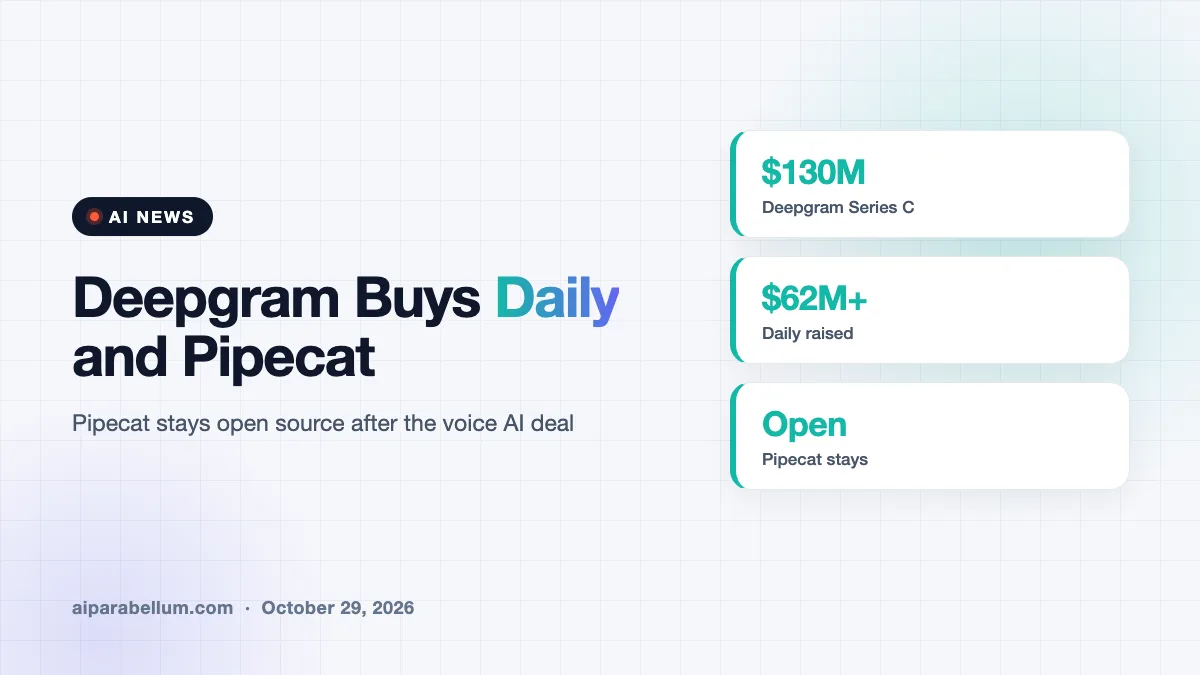
Deepgram is acquiring Daily, the maker of the open-source Pipecat voice AI framework, in a deal announced on October 29. The companies did not share a price, but they say Pipecat will stay open source. If you build or use voice agents, this deal matters because it puts a popular open toolkit under the roof of a major speech AI company.
What the Deepgram and Daily Deal Covers
Daily provides hosted infrastructure for voice and video calls, and it maintains Pipecat. Pipecat is a framework that connects the moving parts of a voice agent: speech-to-text, a large language model and text-to-speech, while keeping delay low.
Deepgram, which reached unicorn status earlier this year with a $130 million Series C round, builds speech models. Daily has raised more than $62 million from investors that include Tiger Global and Nat Friedman, according to PitchBook data. Both companies also went through the same Y Combinator batch in 2016.
Why Pipecat Stays Open Source
Daily’s announcement also points to an independent Pipecat Foundation. That fits what both leaders told reporters: the framework should stay open and vendor-neutral.
Daily co-founder Kwindla Kramer said several companies showed interest in buying the business. He chose Deepgram because its CEO, Scott Stephenson, committed to keeping Pipecat open for good.
Stephenson says developers should be free to use the best model for their job, even when it is not a Deepgram one. If Deepgram falls behind in some area, he says, the company would rather point users to partners while it improves.
A New Open Protocol for Voice Agents
Alongside the deal, Deepgram is launching the Real-Time Context Standard, or RCS. It is an open protocol for voice agents that Deepgram built together with the Pipecat team.
RCS carries extra information with the audio, such as context from a whisper. It also tells a language model how to use those signals and how the spoken reply should sound.
- Context pulled from the audio itself, like tone or volume
- Instructions for how the language model should use that context
- Guidance on how the response should sound
The Voice AI Market Is Consolidating
Voice AI is attracting heavy investment on both the model side and the infrastructure side. Model makers such as ElevenLabs, Gradium and Fish Audio have raised millions of dollars. Infrastructure players like LiveKit and Vapi have also raised multi-million-dollar rounds this year.
| Company | Role in the deal | Key fact |
|---|---|---|
| Deepgram | Buyer | Unicorn after a $130M Series C this year |
| Daily | Acquired company | Over $62M raised, maker of Pipecat |
| Pipecat | Open-source framework | Stays open source and vendor-neutral |
| RCS | New open protocol | Co-developed with the Pipecat team |
For Deepgram, Pipecat also opens doors beyond voice, since the framework handles real-time communication in other formats too. Kramer says the team always treated it as a toolkit for a new kind of real-time, AI-native software, not only a voice toolkit.
What This Means for You
If you already build on Pipecat, nothing changes in how you can use it today, and the stated plan is to keep it open. Still, it is smart to watch how the new foundation is run and how the roadmap develops.
- Developers: keep an eye on RCS if you want agents that react to how someone speaks, not only what they say.
- Business teams: expect more bundled voice agent stacks, which can make setup simpler. Our guide to AI support agents shows where that pays off.
- Shoppers of tools: compare vendors, because consolidation can change pricing and partnerships.
Voice is also moving fast in consumer products, as seen in Grok Voice 3. For more stories like this, browse our AI news section, and see how voice agents work in practice.
Sources
Primary source: Daily’s acquisition announcement. Additional reporting from TechCrunch.
Conclusion
Deepgram’s purchase of Daily pairs a leading speech AI company with one of the most used open-source voice agent frameworks. The promise to keep Pipecat open and vendor-neutral is the key point, and developers will judge it by what happens over the coming months.