Meta has rewritten its commercial terms again, this time removing a sentence that critics said let the company use content from business websites to train its AI. The change to the Meta commercial terms comes just days after legal experts and news publishers raised alarms about the wording. Meta now says the crawling rules only ever applied to its ads and business products, and that robots.txt still works the way it always has.
What Changed in the Meta Commercial Terms
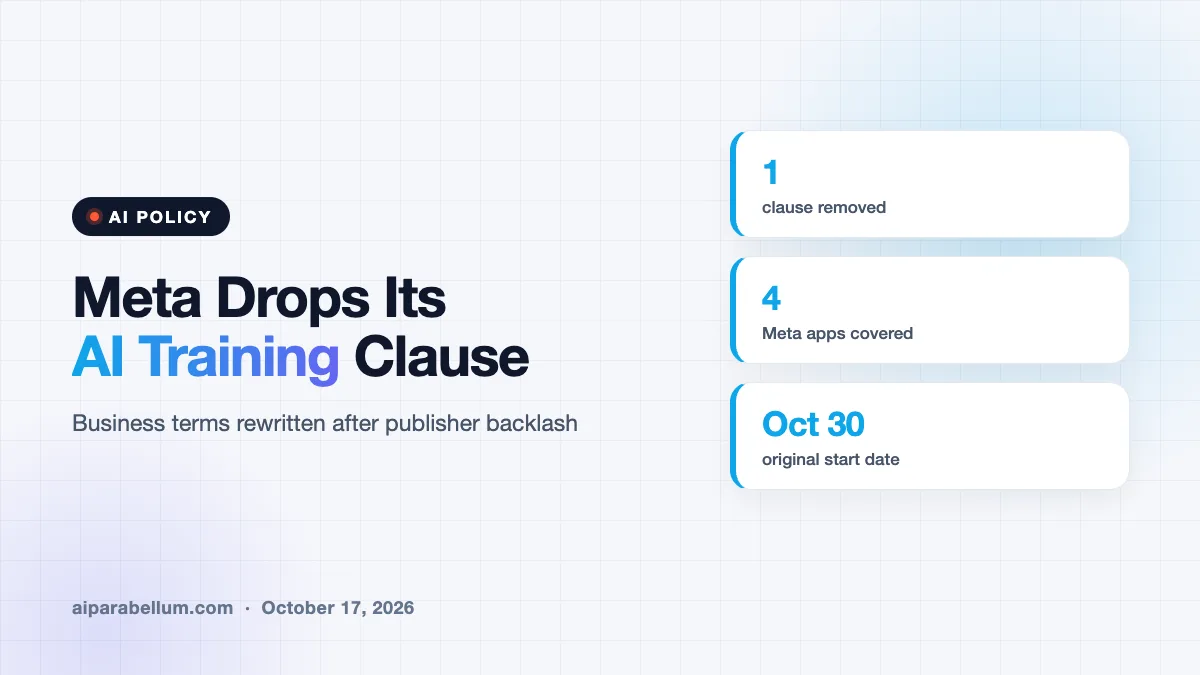
The removed sentence said Meta could use any content from domains linked to a business account to provide, develop, improve, research, train, and maintain its products. That one word, train, is what set off the debate. Without the sentence, the terms no longer spell out a right to use that content for AI training.
Meta spokesperson Daniel Roberts said the company had heard the feedback and wanted to clarify its intent. In a statement, he said the terms do not change how Meta uses web crawlers and that content owners can still signal their choices through robots.txt. He also said the terms are not about scraping news sites and do not give Meta new rights that override those choices.
Here is a quick look at how the situation shifted over the past week:
| Point | Earlier version | After the update |
|---|---|---|
| AI training language | Said Meta may use content from linked sites to train its products | Sentence removed |
| Scope of crawling | Domains tied to a business account or its products | Meta says it covers only ads and business products |
| robots.txt | Critics feared the terms could override it | Meta says site owners can still use it |
| Meta’s stance | Called the change a consolidation of existing terms | Says it clarified the wording after feedback |
Why the Original Wording Worried Publishers
The terms apply to companies that use Meta Business Suite, the dashboard that runs Facebook pages, Instagram profiles, Messenger, and WhatsApp channels. That includes a huge number of news outlets, which rely on Meta to share stories and reach readers. Under the earlier text, those businesses authorized Meta to send scrapers, bots, and crawlers to their linked domains and pull updates over time.
Legal experts, including Cornell law professor James Grimmelmann, read the clause as a way for Meta to collect training data for free. Some also worried it could let Meta sidestep the robots.txt files that sites use to block AI crawlers. The consolidated terms were set to take effect on October 30 with no opt-out, so publishers felt they had to either accept the language or leave the platform.
The Licensing Question
Fact-checked, edited journalism is valuable training data, and many AI companies now pay for it. Several labs have signed licensing deals with news organizations, while others face copyright lawsuits from publishers. Critics argued that the old wording could have helped Meta skip those deals entirely, which is why the reaction was so quick.
How Meta Explains Its Commercial Terms Update
Meta’s first response was firm. Andy Stone, Meta’s vice president of communications, and Roberts said any suggestion that its crawler practices had changed was false, and the company described the update as merging its commercial and self-serve ad terms into one place. This latest edit goes further by deleting the disputed sentence outright.
The company’s position is that the crawling permissions exist only to support its ads and business products, and it says it has made that clear in the terms themselves. That is a much narrower purpose than critics saw in the earlier text. The difference now is that the terms no longer bundle it with broad language about training AI models.
What This Means for You
If you run a business page, a news site, or an online store connected to Meta, this update is good news, but it is still worth staying alert. Terms can change again, and the crawling permission itself has not vanished. A few practical steps can help:
- Review your robots.txt file and make sure it reflects which AI crawlers you want to allow or block.
- Read the updated Meta commercial terms before they take effect if you manage a Business Suite account.
- Keep an eye on server logs for unfamiliar bots hitting your pages.
- If your content has licensing value, talk to a lawyer about how platform terms affect your rights.
For more background, our earlier report on Meta’s crawling terms covers the original clause in detail. The fight over AI and publisher traffic is also playing out in search, as seen in how Google handles links in its AI answers. Meta’s AI push is moving fast on other fronts too, including its open-weight Muse model.
Small businesses using AI themselves can find helpful options in our guide to business AI tools. If data privacy is your main worry, our explainer on differential privacy shows how companies can protect data used in AI. You can follow every update like this on our AI news page.
Sources
This article is based on reporting from The Verge on the removed language and Meta’s new statement, and from ZDNET on the original terms, the October 30 start date, and Meta’s earlier response.
Conclusion
Meta backed down quickly once publishers and legal experts pushed back, and it removed the one sentence that tied business website content to AI training. The company still keeps broad crawling permissions, but it now says they serve only its ads and business tools and respect robots.txt. That is a meaningful win for site owners who want control over how their work is used. Still, the episode shows how a few words in a long contract can shape who gets to train AI on what. Anyone with a Meta business account should read the final terms before they take effect.