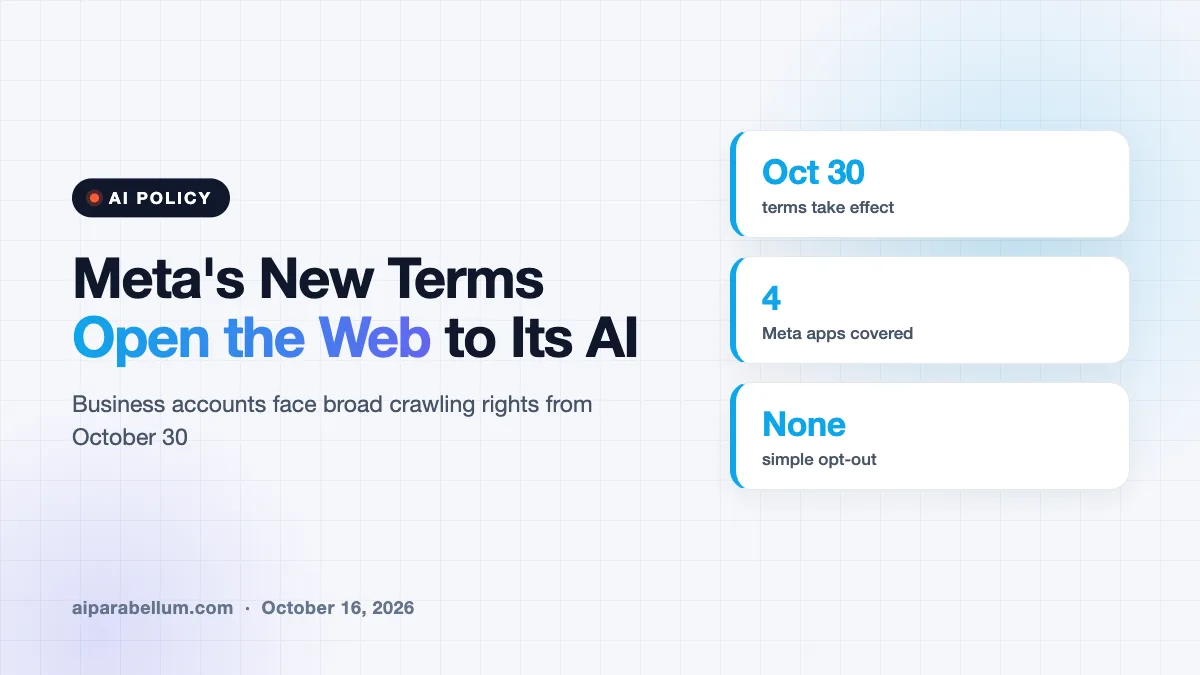
Meta’s commercial terms are getting a rewrite, and the new version could hand the company broad permission to crawl websites tied to any business that uses Facebook, Instagram, WhatsApp, or Messenger. The updated terms take effect on October 30, 2026, and they say Meta may use what it collects to develop, research, and train its products. Meta says nothing about its crawling is changing, but legal experts think the wording reaches much further than that.
What Meta’s Commercial Terms Now Say
The new clause covers business accounts that promote products or content across Meta’s apps. It authorizes Meta, or anyone acting for it, to use scrapers, bots, crawlers, and similar tools to access, index, cache, and collect content from domains “associated” with a business’s products or services.
It also lets Meta create test credentials to get into those pages and pull updates over time. The collected content can then be used to provide, improve, research, train, and maintain Meta’s products and features.
Here is a quick look at the main pieces of the change.
| Detail | What the terms or reports say |
|---|---|
| Effective date | October 30, 2026 |
| Who is covered | Business accounts on Facebook, Instagram, WhatsApp, and Messenger |
| What Meta can access | Domains, pages, and URLs associated with a business’s products or services |
| Allowed uses | Provide, develop, improve, research, train, and maintain Meta products |
| Opt-out | None described; businesses that disagree may stop using Meta’s products commercially |
| Meta’s position | A consolidation of existing terms, with robots.txt still respected |
No Clear Way to Say No
The terms don’t ask for a fresh opt-in, and they don’t offer a simple opt-out. Instead, businesses that keep using the platforms after October 30 are treated as agreeing. Those that object “may stop all access or use” of Meta’s products for business purposes, which is a tough ask for a shop that sells through Instagram or answers customers on WhatsApp.
Why Publishers Are Worried About AI Training
The concern was first raised in reporting by Nieman Lab, which spoke with several legal experts. Nearly every news outlet runs at least one Meta business account, so the clause could, in theory, cover a huge amount of journalism.
Cornell law professor James Grimmelmann said the language gives Meta permission to train AI on content from publishers’ sites and possibly use it in ways that compete with them. Media and IP lawyer Matt Topic called it a remarkable provision and said publishers should assume it could be enforceable, even though it hasn’t been tested. University of Wisconsin law professor Benjamin Sobel compared the setup to tying, since businesses must accept scraping to keep using Meta’s business tools.
The robots.txt Question
Most sites use a robots.txt file to tell crawlers what they may and may not visit. Experts quoted in the reporting say Meta could argue that a signed commercial agreement overrides those instructions. That matters because Meta, like OpenAI, has been striking paid AI licensing deals with outlets such as CNN, Fox News, USA Today, and People Inc.
Broad crawling rights could give Meta access to a much wider pool of content without those deals. Meta also declined to say whether the test credentials clause could reach content behind paywalls or login walls.
How Meta Is Responding
Meta strongly disputes the idea that this is a new AI training push. Spokesperson Daniel Roberts said the company is simply merging its commercial and self-serve ad terms and that there is no change to how it uses web crawlers. He added that content owners can still use robots.txt to signal their preferences.
Andy Stone, Meta’s vice president of communications, said in a post on X that the update is about pulling accurate product information from third-party sites for ads and recommendations. In his words, it is “not about scraping news sites.”
There is also no reported evidence so far that Meta has started systematically scraping every associated domain. The clause itself doesn’t name any specific AI model, either.
Meta’s Commercial Terms and Small Businesses
This isn’t only a newsroom issue. For a small business, the sites linked to a Meta account can include product pages, pricing, blog posts, help docs, FAQs, and images. A simple brochure site may lose little here, but a company built on original research or paid content may see these rights as a real business risk.
The timing has raised eyebrows, too. Meta recently launched a Meta One subscription that asks businesses and creators to pay to include links in posts and reels, while the new terms would let it crawl those same linked pages for free.
The Legal Picture Is Still Unsettled
In the EU, copyright rules let rights holders opt out of text and data mining with machine-readable signals, and the AI Act expects general-purpose AI providers to respect those choices. How that plays against a contract you accept just by staying active hasn’t been tested in court. In the US, the question is similarly open, which is part of why the fight over AI and publisher content keeps growing, as seen in disputes like the one over Google AI Mode links.
What This Means for You
If you run a business page, shop, or ad account on Meta’s apps, a few practical steps make sense before October 30.
- Read the updated Commercial Terms yourself, especially the section on crawling and associated domains.
- Review your robots.txt file and confirm which crawlers you allow or block, even if its legal weight is now debated.
- List which of your linked pages hold valuable content, such as paid research, templates, or detailed docs.
- Consider moving premium material behind clearer access controls and watching how Meta clarifies the paywall question.
- If you publish news or original content, talk with a lawyer about whether the clause affects existing licensing plans.
It also helps to think about how your site shows up across AI tools in general. Our guide on GEO versus SEO explains how AI systems are changing the way content gets found and reused. If you’re tracking Meta’s broader AI push, see our coverage of Muse Wonder and the open-weight Muse Spark Open model.
The real story isn’t one clause. It’s that access to content, not just compute, is becoming the most contested resource in AI, and terms of service are turning into a quiet battleground.
For more daily updates like this, browse our AI news section.
Sources
This article draws on reporting from The Verge and TechRound, both of which summarize the original findings and Meta’s responses.
Conclusion
Meta’s updated commercial terms give it sweeping written permission to crawl and use content from websites tied to business accounts, starting October 30. Meta insists nothing about its crawling is changing and that robots.txt still counts, while legal experts warn the wording could be used to sidestep blocking rules and licensing deals. Until regulators or courts weigh in, the clause will mean whatever each side argues it means. If your business depends on Meta’s apps, now is a good time to review the terms, check your site’s crawler settings, and decide which content you most want to protect.